9.4 Forces and Kinetic Energy
TL;DR
This content discusses the relationship between forces and special relativity, highlighting the differences in kinetic energy calculations and the transformation of forces under Lorentz transformations.
Transcript
MARKUS KLUTE: Welcome back to special relativity, 8.20. After discussing energy and momentum and examples with collisions, we now want to talk about forces. And we get back to the example of Alice traveling to the center of the galaxy and asking what does it mean in terms of acceleration. So we start from Newton's second law. We know that a force i... Read More
Key Insights
- 🧑🏭 Forces in special relativity are described by Newton's second law, but with a time-dependent gamma factor and velocity.
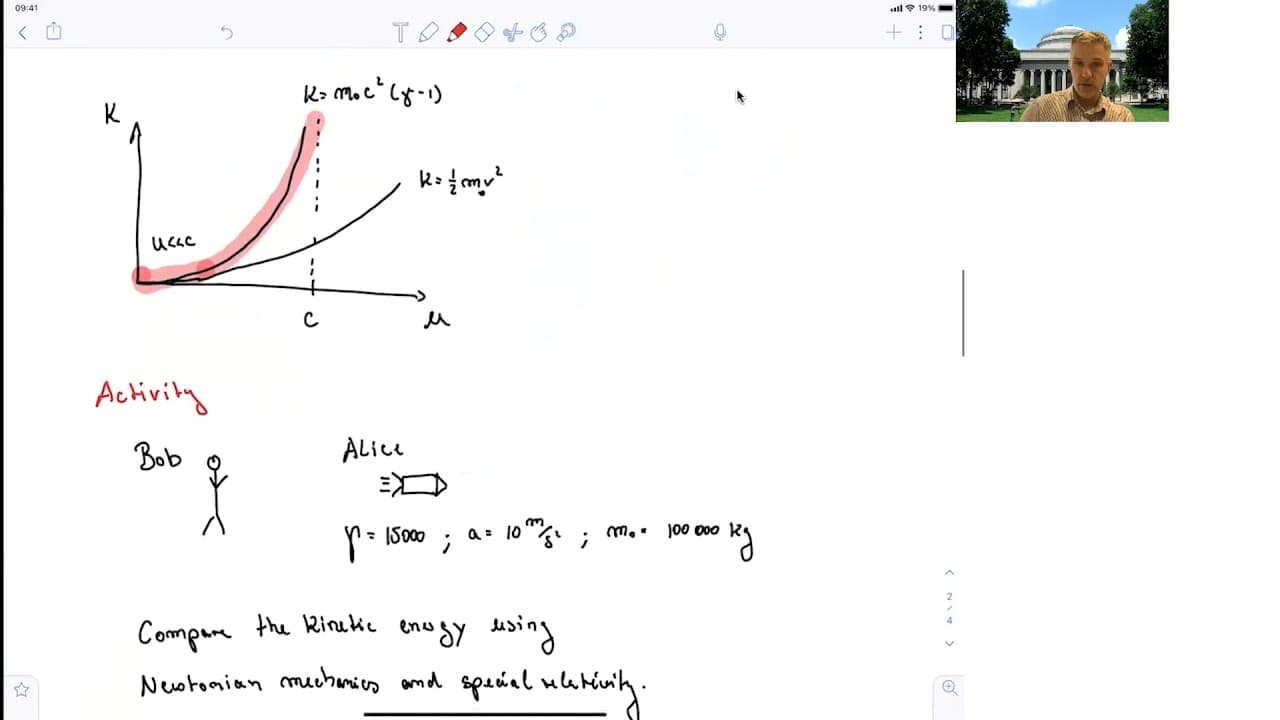
- 🙂 The calculation of kinetic energy involves integrating the force over the path of the particle and leads to a formula that includes the rest mass, velocity, and the speed of light.
- ✋ At small velocities, the classical and relativistic calculations of kinetic energy match, but at higher velocities, there is a significant difference.
- ❓ The force in special relativity has two components, one parallel to the acceleration and the other not parallel to it, unlike in Galilean transformations.
- 🚱 Lorentz transformations affect the force in special relativity, causing it to have two non-parallel components, which contradicts our intuitive understanding.
- 🦾 The difference in kinetic energy calculations between classical mechanics and special relativity can be enormous, as demonstrated by the example of Alice's journey to the center of the galaxy.
- ✋ Special relativity predicts a much larger kinetic energy compared to classical mechanics, especially at higher velocities.
Install to Summarize YouTube Videos and Get Transcripts
Explore YouTube Video Summarizer or Get YouTube Transcript Extractor
Questions & Answers
Q: What is the formula for calculating kinetic energy in special relativity?
The formula for calculating kinetic energy in special relativity is k = (m0c^2)(γ - 1), where m0 is the rest mass, c is the speed of light, and γ is the Lorentz factor.
Q: How does the calculation of kinetic energy differ for velocities close to the speed of light?
At higher velocities, the classical calculation of kinetic energy is inadequate, and the relativistic calculation shows a significant increase in the kinetic energy due to the Lorentz factor γ.
Q: What are the two components of the force in special relativity?
In special relativity, the force acting on a particle has two components. One component is parallel to the acceleration (mγa), while the other component (m0u∆γ) is not parallel to the acceleration.
Q: How does the force transform under Lorentz transformations in special relativity?
The force in special relativity does not remain parallel to the acceleration under Lorentz transformations. It has two components, one parallel to the acceleration and the other not parallel to it, making it counterintuitive.
Summary & Key Takeaways
-
The content explores the concept of forces in special relativity, starting from Newton's second law and its application in calculating kinetic energy.
-
The calculation of kinetic energy involves integrating the force over the path of the particle, which leads to a formula involving the mass, velocity, and the speed of light.
-
For small velocities, the classical calculation of kinetic energy matches the relativistic calculation, but at higher velocities, there is a significant difference.
Read in Other Languages (beta)
Share This Summary 📚
Summarize YouTube Videos and Get Video Transcripts with 1-Click
Try YouTube Summary with ChatGPT & Claude or YouTube Transcript Generator
Explore More Summaries from MIT OpenCourseWare 📚


Summarize YouTube Videos and Get Video Transcripts with 1-Click
Try YouTube Summary with ChatGPT & Claude or YouTube Transcript Generator