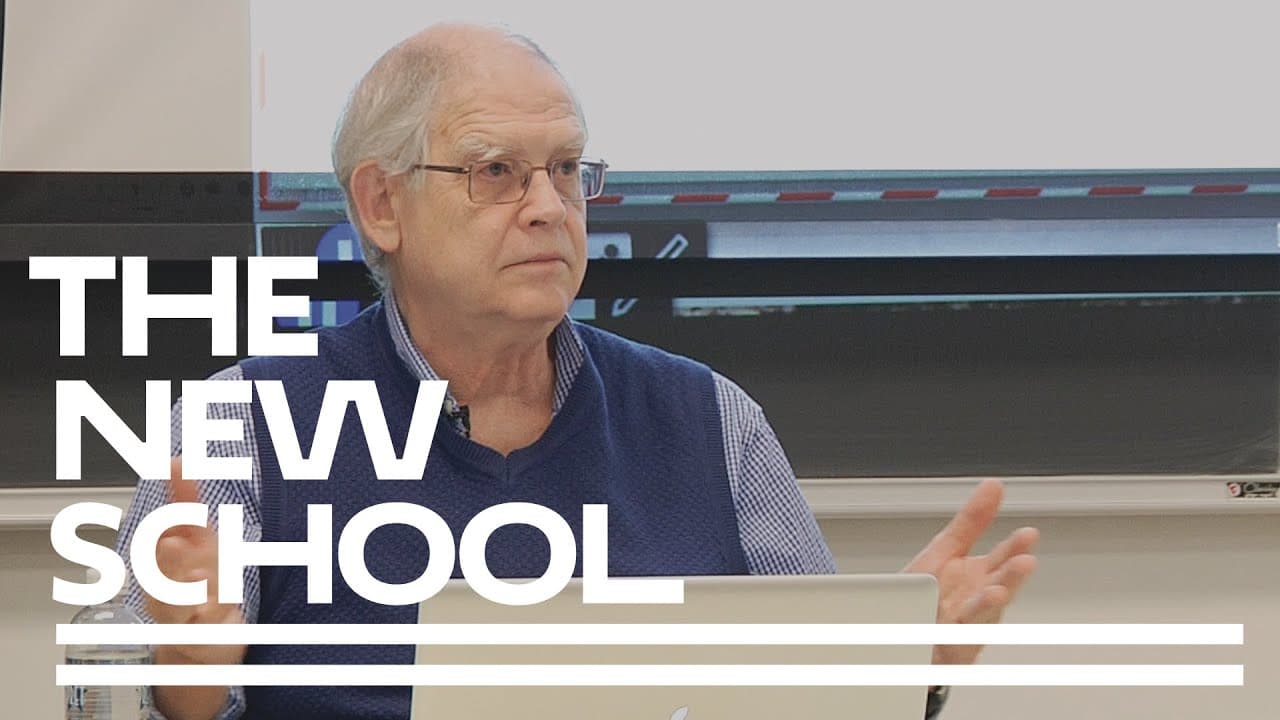
Class 01 | Advanced Microeconomics | Duncan Foley
TL;DR
Introduction to Bayesian and Information Theory in Economics.
Transcript
Read and summarize the transcript of this video on Glasp Reader (beta).
Key Insights
- Duncan Foley introduces the course on advanced microeconomics, emphasizing the importance of student engagement and questions as a public good.
- The course aims to integrate information theory into economics, focusing on social interaction models and entropy-constrained behavior.
- Foley plans to cover classical and Keynesian economics, focusing on information theory and social coordination models.
- The course will explore decentralized spontaneous organization, theory of money, and capitalist economies using entropy-constrained behavior and social interaction models.
- Foley discusses the philosophy of social science, highlighting its self-referential nature compared to natural sciences.
- Probability is discussed in a Bayesian context, emphasizing degrees of belief and the importance of conditional probability.
- Shannon's information theory is introduced, focusing on its application to economics and the measurement of information.
- The course warns students that learning this material may change their understanding of political economy and economic data interpretation.
Install to Summarize YouTube Videos and Get Transcripts
Explore YouTube Video Summarizer or Get YouTube Transcript Extractor
Questions & Answers
Q: What is the main focus of Duncan Foley's advanced microeconomics course?
The main focus of Duncan Foley's advanced microeconomics course is to integrate information theory into economics, particularly through social interaction models and entropy-constrained behavior. The course aims to explore fundamental issues in classical and Keynesian economics, using these theoretical frameworks to address decentralized spontaneous organization, theory of money, and capitalist economies.
Q: How does Foley view the philosophy of social science compared to natural sciences?
Foley views the philosophy of social science as fundamentally different from natural sciences due to its self-referential nature. Social sciences involve the investigator as part of the study, leading to a value-laden character that is not present in natural sciences. Foley argues that while social sciences can incorporate methods from natural sciences, they must transcend them to address the unique aspects of human society.
Q: What is the significance of Bayesian probability in Foley's course?
Bayesian probability is significant in Foley's course as it represents degrees of belief and is used to discuss the probability of hypotheses and theories in economics. Foley emphasizes the importance of conditional probability and the iterative process of updating beliefs based on new data. This approach is crucial for understanding econometric theory and the interpretation of economic data.
Q: How does Shannon's information theory relate to economics in the course?
Shannon's information theory is related to economics in the course by providing a quantitative measure of information, which Foley applies to economic models. The theory's concepts, such as entropy and code length, are used to analyze information transmission and uncertainty in economic systems. This approach aims to enhance the understanding of economic behavior and decision-making processes.
Q: What warning does Foley give to students about learning this material?
Foley warns students that learning the material in this course may change their understanding of political economy and the interpretation of economic data irreversibly. He cautions that the process of learning can be painful and stressful, particularly for those who cling uncritically to received ideas. This warning highlights the transformative potential of the course content.
Q: What are the key building blocks of the course according to Foley?
The key building blocks of the course, according to Foley, are the entropy-constrained behavior model and the social interaction model. These frameworks apply information theory to individual and social behavior in economics, offering an alternative to general equilibrium theory. Foley plans to explore these models systematically and apply them to fundamental problems in political economy.
Q: How does Foley plan to address the theory of money in the course?
Foley plans to address the theory of money in the course by using the entropy-constrained behavior model and the social interaction model to examine monetary neutrality and the decentralized spontaneous organization of an economy. By applying these models, Foley aims to provide a deeper understanding of the role of money in economic systems and its impact on economic behavior and outcomes.
Q: What is the role of student questions in Foley's course?
Student questions play a crucial role in Foley's course as they are considered a public good that benefits the entire class. Foley encourages students to ask questions and engage in colloquies, as this helps clarify concepts and enhances understanding for everyone. He emphasizes that questions often reflect common uncertainties and can lead to a deeper exploration of the course material.
Summary & Key Takeaways
-
Duncan Foley introduces an advanced microeconomics course, focusing on integrating information theory with classical and Keynesian economics. The course encourages student engagement and questions, highlighting their role as a public good. Foley aims to explore fundamental issues in political economy using entropy-constrained behavior and social interaction models.
-
The course will cover decentralized spontaneous organization, theory of money, and capitalist economies. Foley discusses the philosophy of social science, highlighting its self-referential nature compared to natural sciences. Probability is discussed in a Bayesian context, emphasizing degrees of belief and the importance of conditional probability.
-
Shannon's information theory is introduced, focusing on its application to economics and the measurement of information. The course warns students that learning this material may change their understanding of political economy and economic data interpretation, highlighting the transformative potential of the ideas presented.
Read in Other Languages (beta)
Share This Summary 📚
Summarize YouTube Videos and Get Video Transcripts with 1-Click
Try YouTube Summary with ChatGPT & Claude or YouTube Transcript Generator
Explore More Summaries from The New School 📚
Summarize YouTube Videos and Get Video Transcripts with 1-Click
Try YouTube Summary with ChatGPT & Claude or YouTube Transcript Generator