Masonry wall (brick wall with mortar) under in-plane cyclic loading using simplified micro Abaqus
TL;DR
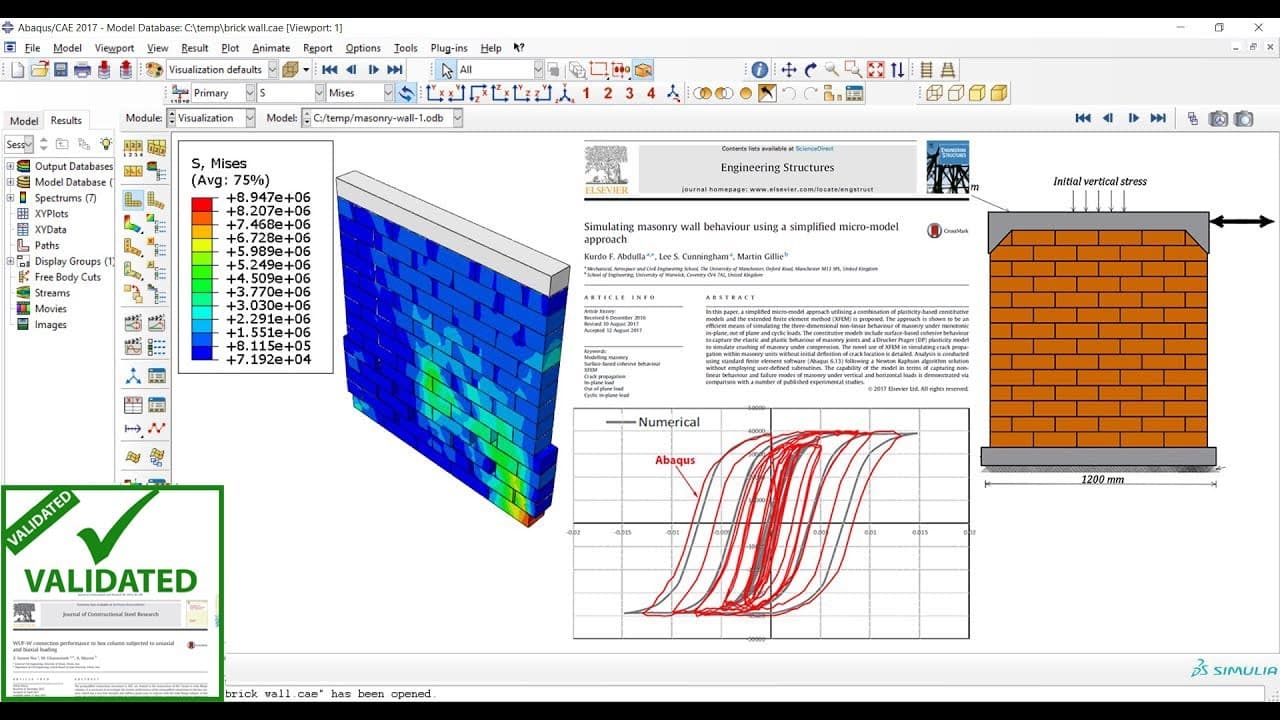
Simulation of masonry wall under cyclic loading using Abaqus software.
Transcript
Read and summarize the transcript of this video on Glasp Reader (beta).
Key Insights
- The simulation uses a simplified micro method in Abaqus to model the behavior of a masonry wall under cyclic loading.
- A compressive load of 0.7 MPa is applied before the in-plane cyclic loading to the masonry wall.
- The simulation results from Abaqus show a strong correlation with the results from the referenced article.
- Different methods for simulating masonry walls in Abaqus include micro, simplified micro, and macro methods.
- The simplified micro method involves defining only the geometric shape of the brick and using interaction properties for mortar.
- Young's modulus for the simplified micro method is a combination of brick and mortar properties, calculated as 2888 MPa.
- The Drucker-Prager model is used for defining plastic properties, with specific values for angles and stress ratios.
- The hysteresis diagram is created to compare horizontal displacement and load, showing close alignment with the article's results.
Install to Summarize YouTube Videos and Get Transcripts
Explore YouTube Video Summarizer or Get YouTube Transcript Extractor
Questions & Answers
Q: What method is used for simulating the masonry wall in this tutorial?
The tutorial uses the simplified micro method to simulate the masonry wall under cyclic loading. This method involves defining only the geometric shape of the brick in the parts module and using interaction properties to simulate the mortar, which simplifies the modeling process compared to the micro method.
Q: How is the compressive load applied in the simulation?
In the simulation, a compressive load of 0.7 MPa is applied to the top of the masonry wall before the in-plane cyclic loading. This is achieved by creating a load in the Abaqus software, selecting the appropriate surface, and specifying the pressure value as 0.7 MPa.
Q: What are the key parameters used in the Drucker-Prager model for this simulation?
The Drucker-Prager model is used to define the plastic properties of the masonry wall. Key parameters include a friction angle of 36 degrees, a flow stress ratio of 1, and a dilation angle of 11.3 degrees. These parameters help simulate the material's behavior under stress conditions accurately.
Q: How are the interaction properties between bricks defined in the simulation?
Interaction properties between bricks are defined using cohesive behavior and damage options in the interaction module. The stiffness of the mortar in normal and shear directions is specified with values like KNN, KSS, and KTT, all set to specific values in Newton per cubic millimeter, ensuring proper simulation of mortar behavior.
Q: What is the significance of the hysteresis diagram in the simulation?
The hysteresis diagram is significant as it illustrates the relationship between horizontal displacement and load during cyclic loading. It is used to validate the simulation results by comparing the diagram obtained from Abaqus with the article's results, demonstrating the simulation's accuracy and effectiveness.
Q: How does the simplified micro method differ from the micro method in simulating masonry walls?
The simplified micro method differs from the micro method by not requiring the geometric shape of the mortar to be created separately. Instead, it uses interaction properties to simulate mortar behavior, simplifying the modeling process while still providing accurate results for the masonry wall simulation.
Q: What is the role of Young's modulus in the simulation?
Young's modulus is crucial in defining the elastic properties of materials in the simulation. For the simplified micro method, a combined Young's modulus of 2888 MPa is used, calculated from the individual properties of brick and mortar. This ensures the model accurately represents the material's response to stress.
Q: Why is the simulation's result compared with an article's findings?
The simulation's results are compared with an article's findings to validate the accuracy and reliability of the model. By showing a strong correlation between the Abaqus simulation and the article's data, the tutorial demonstrates that the simulation methodology is sound and can be trusted for similar analyses.
Summary & Key Takeaways
-
This tutorial demonstrates the simulation of a masonry wall under cyclic loading using the simplified micro method in Abaqus. The process involves applying a compressive load followed by cyclic loading, with results compared to an article's findings, showing strong concordance.
-
Three methods for simulating masonry walls in Abaqus are discussed: micro, simplified micro, and macro. The simplified micro method is highlighted for its efficiency, requiring only the geometric shape of bricks and interaction properties for mortar.
-
The tutorial details the steps in Abaqus, including defining material properties, applying loads, and creating a hysteresis diagram. The results show a strong correlation with the article's data, validating the simulation's accuracy.
Read in Other Languages (beta)
Share This Summary 📚
Summarize YouTube Videos and Get Video Transcripts with 1-Click
Try YouTube Summary with ChatGPT & Claude or YouTube Transcript Generator
Explore More Summaries from Saeed Moeini 📚
Summarize YouTube Videos and Get Video Transcripts with 1-Click
Try YouTube Summary with ChatGPT & Claude or YouTube Transcript Generator