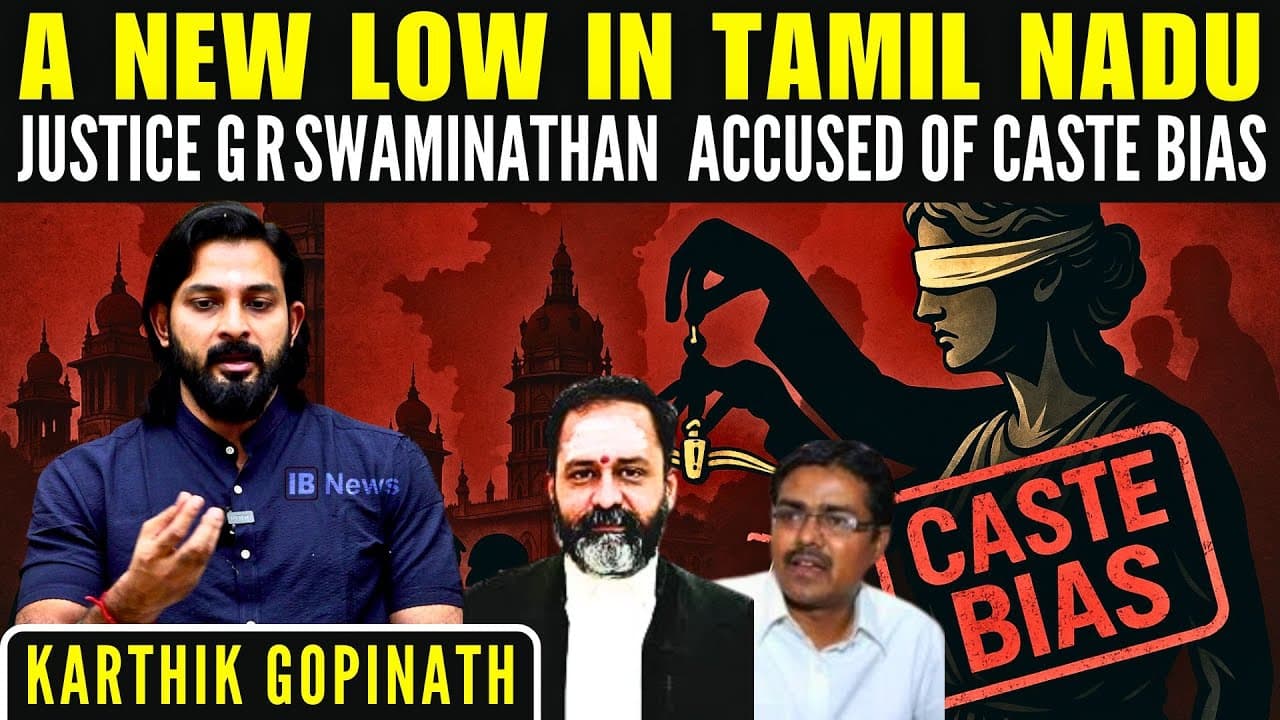
A new low in Tamil Nadu - Madras HC Justice G R Swaminathan accused of Caste Bias • Karthik Gopinath
TL;DR
Justice Swaminathan faces caste bias accusations amid political turmoil.
Transcript
Read and summarize the transcript of this video on Glasp Reader (beta).
Key Insights
- Justice G.R. Swaminathan of Madras High Court is accused of caste bias, raising concerns over judiciary independence.
- The controversy involves political figures, retired judges, and a suspended lawyer, indicating a coordinated attack on the judiciary.
- Criticism of judgments is acceptable, but personal attacks on judges undermine public trust in the judiciary system.
- The DMK is accused of attempting to control the judiciary by intimidating judges who deliver judgments against their interests.
- Justice Swaminathan's integrity and liberal judgments have made him a target for political vendetta, according to the discussion.
- There are allegations of forgery and impersonation by some retired judges, further complicating the situation.
- The outgoing Chief Justice of Tamil Nadu was transferred, raising suspicions of political influence in judicial appointments.
- The case highlights the ongoing struggle for judicial independence in Tamil Nadu amid political pressures and caste dynamics.
Install to Summarize YouTube Videos and Get Transcripts
Explore YouTube Video Summarizer or Get YouTube Transcript Extractor
Questions & Answers
Q: What are the accusations against Justice G.R. Swaminathan?
Justice G.R. Swaminathan is accused of caste bias in his judgments, which has sparked significant controversy. These accusations are seen as part of a larger political vendetta aimed at undermining his credibility and the independence of the judiciary in Tamil Nadu. The controversy involves various political figures and retired judges.
Q: How does the controversy affect judicial independence?
The controversy threatens judicial independence by undermining public trust in the judiciary and intimidating judges who deliver judgments against political interests. It highlights the challenges of maintaining an impartial judiciary in the face of political pressures and accusations of bias, which can erode the credibility of the justice system.
Q: What role do political figures play in this controversy?
Political figures, particularly from the DMK, are accused of orchestrating a coordinated attack on Justice Swaminathan to control the judiciary. By intimidating judges who deliver unfavorable judgments, they aim to influence judicial decisions, thereby threatening the independence and integrity of the judiciary in Tamil Nadu.
Q: What are the implications of the retired judges' involvement?
The involvement of retired judges, some of whom are accused of forgery and impersonation, complicates the controversy. It raises concerns about ethical conduct and the influence of political affiliations on judicial proceedings. Their involvement underscores the need for accountability and transparency within the judiciary.
Q: Why is the transfer of the Chief Justice significant?
The transfer of the outgoing Chief Justice of Tamil Nadu is significant because it raises suspicions of political influence in judicial appointments. The timing of the transfer, with only a few months left in his tenure, suggests possible manipulation to affect judicial decisions, highlighting the challenges of maintaining judicial independence.
Q: What is the DMK's alleged strategy regarding the judiciary?
The DMK is alleged to be using a strategy of intimidation and control over the judiciary. By targeting judges like Justice Swaminathan, who deliver judgments based on merit rather than political interests, they aim to set a precedent that discourages impartial judicial decisions, thereby consolidating their influence over the judiciary.
Q: How does the controversy impact public trust in the judiciary?
The controversy impacts public trust in the judiciary by casting doubt on the impartiality and integrity of judicial decisions. Personal attacks on judges and allegations of bias undermine the credibility of the justice system, making it essential to address these issues to restore confidence in judicial processes and uphold the rule of law.
Q: What measures are suggested to address the controversy?
To address the controversy, it is suggested that there should be accountability for those involved in forgery and impersonation, as well as measures to protect judicial independence from political interference. Ensuring transparency and ethical conduct within the judiciary is crucial to restoring public trust and upholding the integrity of the justice system.
Summary & Key Takeaways
-
Justice G.R. Swaminathan of the Madras High Court faces accusations of caste bias, sparking a significant controversy in Tamil Nadu. The accusations are seen as part of a coordinated political vendetta involving politicians, retired judges, and a suspended lawyer, aiming to undermine judicial independence.
-
The discussion emphasizes the importance of maintaining public trust in the judiciary and criticizes personal attacks on judges. It highlights the DMK's alleged attempts to control the judiciary by intimidating judges who deliver judgments against their interests, thus threatening judicial independence.
-
The controversy is further complicated by allegations of forgery and impersonation by retired judges. The transfer of the outgoing Chief Justice of Tamil Nadu raises suspicions of political influence in judicial appointments, underscoring the challenges facing judicial independence in the state.
Read in Other Languages (beta)
Share This Summary 📚
Summarize YouTube Videos and Get Video Transcripts with 1-Click
Try YouTube Summary with ChatGPT & Claude or YouTube Transcript Generator
Explore More Summaries from PGurus 📚






Summarize YouTube Videos and Get Video Transcripts with 1-Click
Try YouTube Summary with ChatGPT & Claude or YouTube Transcript Generator