How to Implement Inverse Kinematics for Hexapod Robot in Python
TL;DR
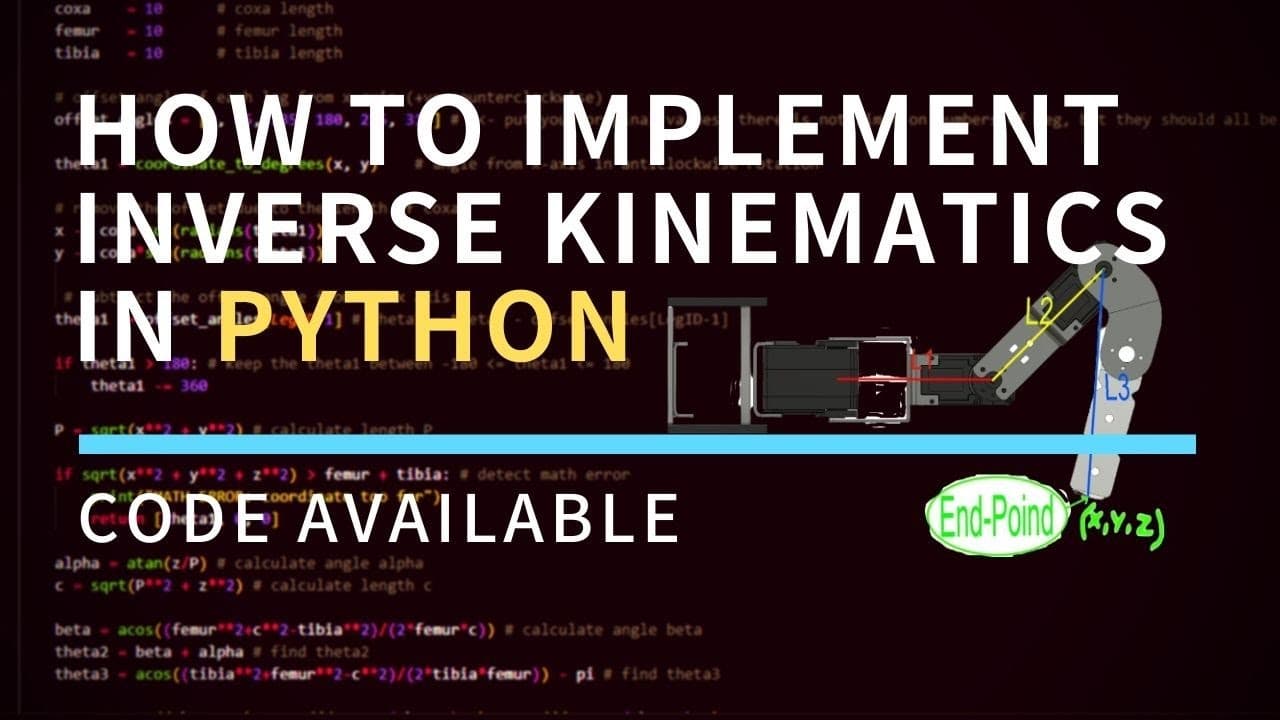
Learn to implement inverse kinematics for hexapod robots using Python.
Transcript
Read and summarize the transcript of this video on Glasp Reader (beta).
Key Insights
- The video demonstrates implementing inverse kinematics for hexapod robots using Python, focusing on practical coding rather than mathematical theory.
- A helper function is introduced to convert x and y coordinates into angles, simplifying angle calculations for robot legs.
- The inverse kinematics function processes x, y, z coordinates to calculate angles for each leg joint, ensuring correct servo motor movement.
- The function accommodates different leg orientations by incorporating offset angles, allowing control over multiple legs without separate code.
- Error handling is included to prevent crashes when the target point is unreachable, ensuring robust function performance.
- The code is adaptable, allowing users to modify parameters like leg length and number of legs to suit different robot models.
- The video encourages viewers to access the code on GitHub for experimentation and customization, enhancing learning and application.
- Additional resources and videos are offered for further exploration of hexapod robotics and Python programming techniques.
Install to Summarize YouTube Videos and Get Transcripts
Explore YouTube Video Summarizer or Get YouTube Transcript Extractor
Questions & Answers
Q: How does the helper function improve the inverse kinematics process?
The helper function simplifies the inverse kinematics process by converting x and y coordinates into angles around the z-axis. This conversion allows for straightforward calculation of the initial joint angle, which is essential for determining the correct servo motor positions. The function outputs angles in degrees, facilitating easy integration into the main kinematics function.
Q: What is the purpose of incorporating offset angles in the function?
Incorporating offset angles allows the function to accommodate legs with different orientations, ensuring accurate angle calculations for each leg. By adjusting for these offsets, the function can control multiple legs without requiring separate code for each one. This flexibility is crucial for hexapod robots, where legs may not be aligned identically.
Q: How does the function handle unreachable target points?
The function includes error handling to manage situations where the target point is physically unreachable by the leg. If the input coordinates are too far, the function returns only the first angle, preventing mathematical errors that could cause a crash. This feature enhances the function's robustness and reliability.
Q: What customization options does the code offer for different robot models?
The code is highly customizable, allowing users to modify parameters such as leg length (coxa, femur, tibia) and the number of legs. These adjustments enable the function to suit various hexapod robot designs, making it a versatile tool for different projects. Users can also change offset angles to match their robot's specific orientation.
Q: Why is it beneficial to have the code available on GitHub?
Having the code available on GitHub provides users with the opportunity to experiment, modify, and improve the function to meet their specific needs. It encourages learning through hands-on experience and allows users to share their adaptations or improvements with the community, fostering collaborative development in robotics programming.
Q: What additional resources are recommended for further learning?
The video suggests exploring additional resources such as related videos on hexapod robotics, inverse kinematics, and Python programming. These resources provide deeper insights into various aspects of robotics control and coding, enabling viewers to expand their knowledge and skills in building and programming complex robotic systems.
Q: How does the function ensure accuracy in servo motor movement?
The function ensures accuracy in servo motor movement by calculating precise angles for each joint based on the input coordinates. It uses trigonometric calculations and the cosine rule to determine the required angles, which are then adjusted for any offsets. This precise computation ensures that each servo motor moves to the correct position for desired leg movement.
Q: What are the key challenges addressed in the video?
The key challenges addressed include calculating joint angles for complex leg movements, handling different leg orientations, and ensuring robust performance through error handling. The video provides solutions such as using a helper function for angle conversion, incorporating offset angles, and including error checks to prevent crashes, making the function adaptable and reliable.
Summary & Key Takeaways
-
This video tutorial guides viewers through implementing inverse kinematics for hexapod robots using Python. It emphasizes practical coding solutions, such as a helper function to convert coordinates into angles, and ensures robust performance through error handling. The adaptable code supports various robot configurations, making it versatile for different projects.
-
The tutorial explains how to calculate angles for each leg joint, enabling precise servo motor control. By incorporating offset angles, the function handles different leg orientations with ease, eliminating the need for separate code for each leg. This approach simplifies programming and enhances robot functionality.
-
Viewers are encouraged to access the code on GitHub, allowing them to experiment and tailor the function to their specific robot models. The video also provides links to additional resources and related content, supporting further learning and exploration in hexapod robotics and Python programming.
Read in Other Languages (beta)
Share This Summary 📚
Summarize YouTube Videos and Get Video Transcripts with 1-Click
Try YouTube Summary with ChatGPT & Claude or YouTube Transcript Generator