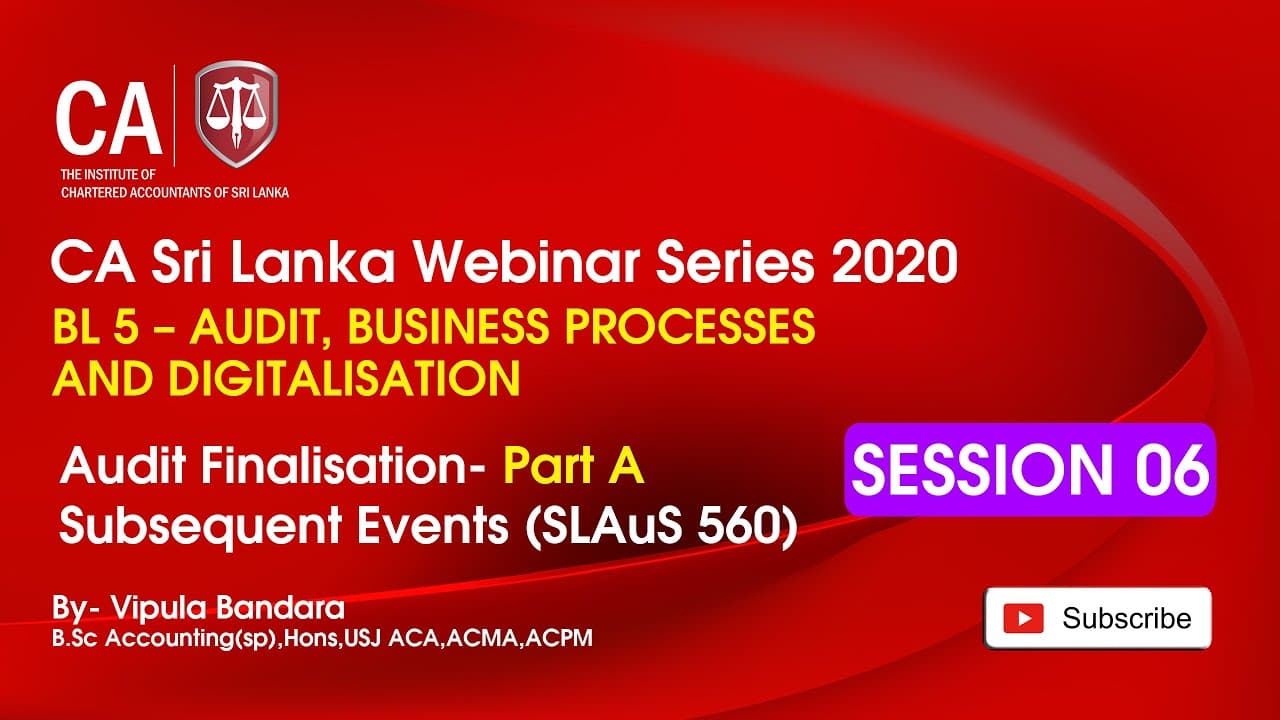
BL5 Audit Finalisation Going Concern (SLAuS 570) Part - A / 24 Jan 2021 Session 6
TL;DR
Discusses audit finalization focusing on going concern and subsequent events.
Transcript
Read and summarize the transcript of this video on Glasp Reader (beta).
Key Insights
- Audit finalization involves reviewing subsequent events and going concern assumptions before finalizing audit reports.
- Subsequent events are incidents occurring after the reporting date but before financial statement issuance, requiring evaluation for potential adjustments.
- Auditors are responsible for gathering evidence of subsequent events between the reporting date and audit report signing.
- There are six key audit procedures for subsequent events: management inquiry, process review, board minutes review, interim financial review, litigation review, and obtaining written representation.
- Auditors have no direct obligation for events between audit report signing and financial statement issuance unless informed by management or becoming aware of significant events.
- If management refuses to amend financial statements for significant events, auditors may issue a public notice to prevent reliance.
- After public issuance, auditors have no direct responsibility for events unless informed or becoming aware, requiring evaluation and possible revised reporting.
- Revised audit reports for post-issuance events must include an explanatory paragraph to avoid confusion.
Install to Summarize YouTube Videos and Get Transcripts
Explore YouTube Video Summarizer or Get YouTube Transcript Extractor
Questions & Answers
Q: What is the primary focus of audit finalization discussed in the webinar?
The primary focus of audit finalization discussed in the webinar is on evaluating subsequent events and going concern assumptions before the audit report is finalized. This involves ensuring that all significant events occurring after the reporting date but before the financial statements are issued are adequately considered and reflected in the financial statements.
Q: What are subsequent events in the context of auditing?
Subsequent events in auditing refer to incidents or events that occur after the financial reporting date but before the financial statements are issued to the public. These events require evaluation to determine if they necessitate adjustments to the financial statements or additional disclosures to ensure that the financial statements present a true and fair view.
Q: What responsibilities do auditors have regarding subsequent events?
Auditors are responsible for gathering sufficient and appropriate audit evidence regarding subsequent events occurring between the reporting date and the audit report signing. They must ensure that management has identified and appropriately accounted for these events in the financial statements. Auditors perform specific procedures, including management inquiries, reviewing board minutes, and examining interim financial statements.
Q: How should auditors handle events occurring after the audit report is signed but before public issuance?
For events occurring after the audit report is signed but before public issuance, auditors have no direct obligation to seek out these events. However, if informed by management or if they become aware of significant events, auditors must evaluate their impact on the financial statements. If changes are necessary, they should discuss with management to revise the financial statements and audit report.
Q: What are the six key audit procedures for subsequent events?
The six key audit procedures for subsequent events are: 1) Inquiry from management and those charged with governance, 2) Review of the management process for identifying subsequent events, 3) Review of board minutes, 4) Review of interim financial statements, 5) Review of litigation-related documents, and 6) Obtaining written representation from management confirming the identification and treatment of subsequent events.
Q: What actions can auditors take if management refuses to amend financial statements for significant events?
If management refuses to amend financial statements for significant events, auditors can issue a public notice to prevent reliance on the financial statements. This action, known as 'seek to prevent reliance,' is a means for auditors to communicate to the public that the financial statements should not be relied upon due to unaddressed issues.
Q: What changes are required in audit reports for revised financial statements after public issuance?
For revised financial statements issued after public issuance, the audit report must include an additional explanatory paragraph to avoid confusion. This paragraph, which may be an emphasis of matter or other matter, highlights the reasons for the revision and ensures that users of the financial statements understand the changes and their implications.
Q: What is the significance of going concern assumptions in audit finalization?
Going concern assumptions are critical in audit finalization as they assess whether an entity can continue its operations for the foreseeable future without the need to liquidate or cease operations. Auditors must evaluate management's assessment of going concern and consider any events or conditions that may cast significant doubt on the entity's ability to continue as a going concern, ensuring that these are appropriately disclosed in the financial statements.
Summary & Key Takeaways
-
The webinar focuses on the audit finalization process, emphasizing the importance of evaluating subsequent events and going concern assumptions. Auditors must gather evidence for events occurring between the reporting date and the signing of the audit report.
-
Auditors have specific responsibilities for subsequent events, including six key procedures: management inquiry, process review, board minutes review, interim financial review, litigation review, and obtaining written representation.
-
For events occurring after the audit report is signed but before public issuance, auditors have no direct obligation unless informed by management or becoming aware of significant events, necessitating evaluation and potential revised reporting.
Read in Other Languages (beta)
Share This Summary 📚
Summarize YouTube Videos and Get Video Transcripts with 1-Click
Try YouTube Summary with ChatGPT & Claude or YouTube Transcript Generator
Explore More Summaries from CA Online Academy 📚
Summarize YouTube Videos and Get Video Transcripts with 1-Click
Try YouTube Summary with ChatGPT & Claude or YouTube Transcript Generator