What is Artificial Intelligence? In 5 minutes.(Part 2 link in Description)
TL;DR
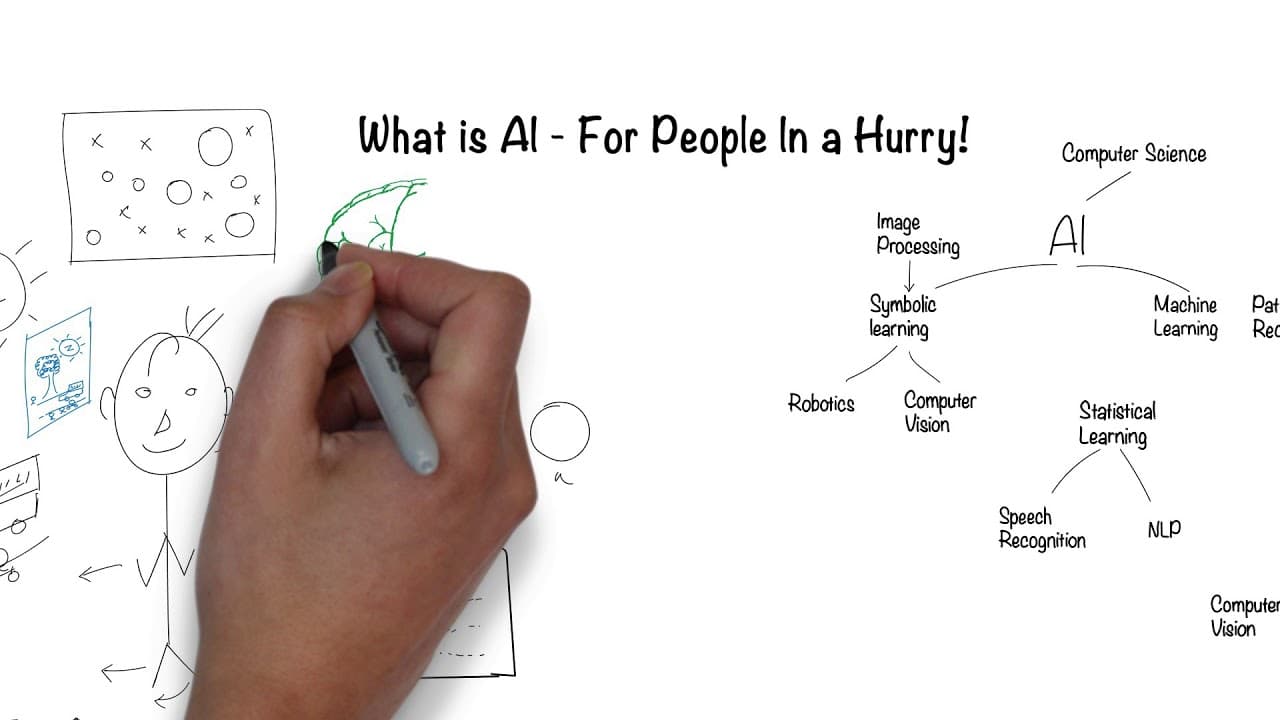
AI aims to create systems that function like humans.
Transcript
Read and summarize the transcript of this video on Glasp Reader (beta).
Key Insights
- Artificial intelligence seeks to create systems that mimic human intelligence and operate independently, drawing inspiration from human capabilities.
- Speech recognition and natural language processing enable machines to communicate through language, similar to human speaking and reading abilities.
- Computer vision and image processing allow machines to interpret visual information, akin to human sight and understanding of surroundings.
- Pattern recognition and machine learning enhance machines' ability to identify patterns and make predictions using vast amounts of data.
- Neural networks, inspired by the human brain's structure, facilitate cognitive capabilities in machines, with deep learning focusing on complex tasks.
- Convolutional neural networks and recurrent neural networks are specialized AI techniques for tasks like object recognition and memory retention.
- Machine learning involves supervised, unsupervised, and reinforcement learning, each with distinct methods for training algorithms and achieving goals.
- Classification and prediction are key applications of machine learning, helping categorize data or forecast future outcomes based on learned patterns.
Install to Summarize YouTube Videos and Get Transcripts
Explore YouTube Video Summarizer or Get YouTube Transcript Extractor
Questions & Answers
Q: What is the primary goal of artificial intelligence?
The primary goal of artificial intelligence is to create systems that can function intelligently and independently, similar to human beings. This involves replicating human cognitive abilities such as understanding language, recognizing patterns, processing visual information, and making decisions based on data.
Q: How do machines achieve speech recognition?
Machines achieve speech recognition through statistical learning, where they are trained to understand and process spoken language. This involves analyzing patterns in speech data, allowing machines to convert spoken words into text and respond appropriately, similar to how humans communicate through language.
Q: What is the role of computer vision in AI?
Computer vision plays a crucial role in AI by enabling machines to interpret and understand visual information from the environment. It involves processing images to recognize objects, scenes, and patterns, thereby allowing machines to make sense of their surroundings in a manner akin to human vision.
Q: How do neural networks contribute to AI?
Neural networks contribute to AI by mimicking the structure and function of the human brain, enabling machines to learn and perform tasks that require cognitive abilities. They consist of interconnected nodes that process information, with deep learning using complex networks for tasks such as image recognition and language processing.
Q: What distinguishes deep learning from other AI techniques?
Deep learning distinguishes itself from other AI techniques by using complex neural networks with multiple layers to perform sophisticated tasks. It allows machines to learn hierarchical representations of data, enabling them to understand intricate patterns and make decisions that require a high level of cognitive processing.
Q: What are the main types of learning in machine learning?
The main types of learning in machine learning are supervised, unsupervised, and reinforcement learning. Supervised learning involves training with labeled data, unsupervised learning finds patterns without labeled data, and reinforcement learning uses trial-and-error to achieve goals, each serving different purposes in AI development.
Q: How do machines use pattern recognition?
Machines use pattern recognition to identify and analyze patterns within data, allowing them to make predictions and classify information. By processing large volumes of high-dimensional data, machines can detect subtle patterns that may not be apparent to humans, enhancing decision-making and problem-solving capabilities.
Q: What is the difference between classification and prediction in machine learning?
In machine learning, classification involves categorizing data into predefined groups based on learned patterns, while prediction involves forecasting future outcomes using existing data. Both techniques leverage machine learning algorithms to analyze data and provide insights, aiding in decision-making and strategic planning.
Summary & Key Takeaways
-
Artificial intelligence is a branch of computer science aiming to create systems that function intelligently and independently, drawing inspiration from human capabilities like speech, vision, and pattern recognition.
-
Machine learning, a key component of AI, involves training machines with data to recognize patterns and make predictions, using techniques like supervised, unsupervised, and reinforcement learning.
-
Neural networks, inspired by the human brain, are fundamental to AI, with deep learning enabling machines to perform complex tasks by mimicking cognitive processes through specialized networks like CNNs and RNNs.
Read in Other Languages (beta)
Share This Summary 📚
Summarize YouTube Videos and Get Video Transcripts with 1-Click
Try YouTube Summary with ChatGPT & Claude or YouTube Transcript Generator
Explore More Summaries from Dr. Raj Ramesh 📚
Summarize YouTube Videos and Get Video Transcripts with 1-Click
Try YouTube Summary with ChatGPT & Claude or YouTube Transcript Generator