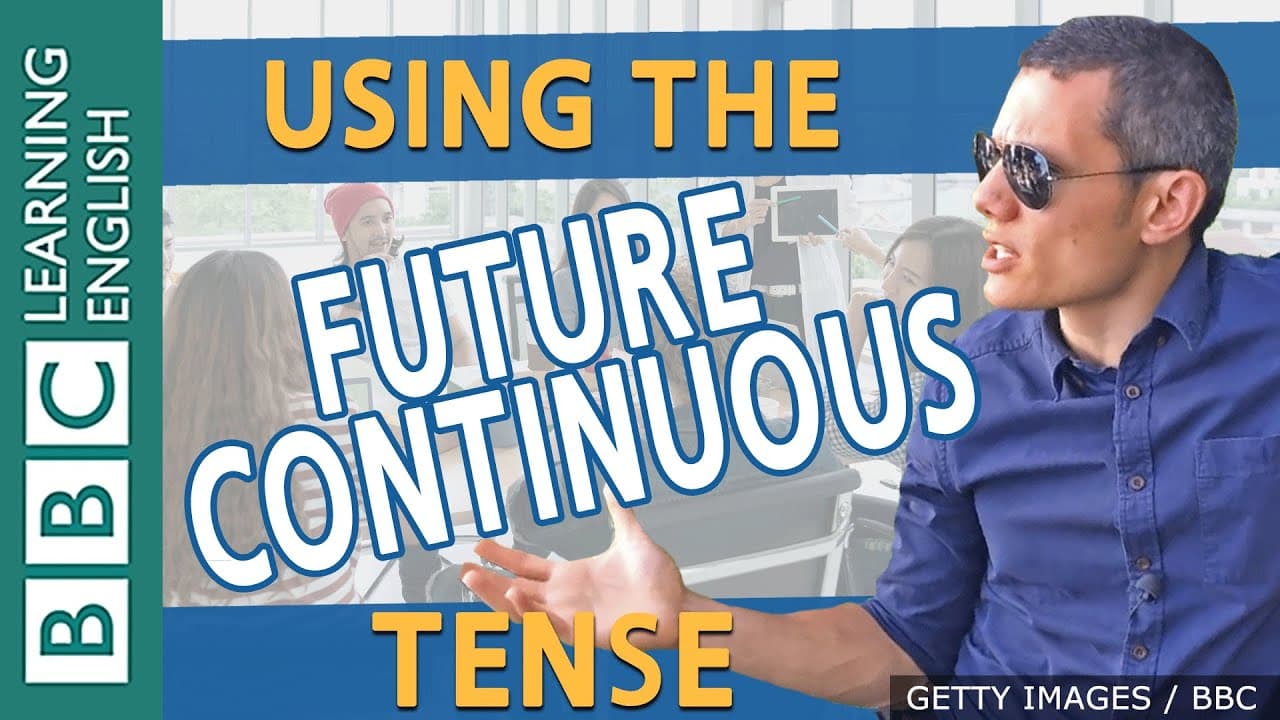
BBC English Masterclass: Uses of the future continuous tense
TL;DR
Learn natural uses of the future continuous tense.
Transcript
Hi guys. Dan for BBC Learning English here. In this Masterclass we'll be looking at natural uses for the future continuous. Now, as you can see, it's a beautiful day in London, the sun is shining. Oo the sun is shining, sunshine, holidays! That gives me an idea. ''Ladies and gentlemen, this is Captain Dan speaking. Welcome aboard BBC Airlines fligh... Read More
Key Insights
- The future continuous tense is used to describe activities in progress at a specific future time, providing a sense of ongoing action.
- Captain Dan uses the future continuous to create a sense of routine and normalcy, which helps passengers relax during a flight.
- In addition to specific times, the future continuous can describe actions that will naturally occur without requiring a decision.
- The future continuous can be used to politely inquire about someone's future plans without pressuring them for a decision.
- This tense can also be applied to state verbs, allowing for more flexibility in sentence construction and meaning.
- Using the future continuous in announcements or routine descriptions provides reassurance and indicates that events are proceeding as expected.
- Examples like giving a lift or delivering a birthday present illustrate how future continuous describes future actions linked to current intentions.
- The distinction between 'Are you going to dinner?' and 'Will you be coming to dinner?' highlights the subtle differences in pressure and expectation conveyed by different tenses.
Install to Summarize YouTube Videos and Get Transcripts
Explore YouTube Video Summarizer or Get YouTube Transcript Extractor
Questions & Answers
Q: Why does Captain Dan use the future continuous in his announcement?
Captain Dan uses the future continuous in his announcement to create a sense of normalcy and routine. By describing actions that will occur naturally, he reassures passengers that everything is proceeding as expected, which helps them relax during the flight. This usage emphasizes certainty and reduces any potential anxiety.
Q: How can the future continuous be used in polite inquiries?
The future continuous can be used in polite inquiries to ask about someone's future plans without pressuring them for an immediate decision. For example, 'Will you be coming to dinner?' implies a simple inquiry into future plans, whereas 'Are you going to come to dinner?' might suggest a need for a definite answer.
Q: What is the significance of using the future continuous with state verbs?
Using the future continuous with state verbs allows for greater flexibility in sentence construction and meaning. This usage bends traditional grammatical rules, enabling speakers to express future intentions in a more nuanced way, such as asking 'Will you be wanting dinner?' This approach can soften requests or inquiries, making them less direct.
Q: How does the future continuous differ from other future tenses?
The future continuous differs from other future tenses by emphasizing actions in progress at a specific future time or events that will naturally occur. Unlike simple future, which may imply a decision or plan, the future continuous suggests ongoing action or routine, providing a sense of continuity and certainty.
Q: Can you provide an example of the future continuous indicating a natural occurrence?
An example of the future continuous indicating a natural occurrence is 'We will be flying at 50,000 feet.' This statement suggests that flying at this altitude is part of the normal course of events during the flight, requiring no effort or decision on the speaker's part, thus reassuring passengers.
Q: Why is the future continuous effective in routine descriptions?
The future continuous is effective in routine descriptions because it conveys a sense of predictability and normalcy. By describing actions as part of a regular pattern, it reassures listeners that everything is under control and proceeding as expected, which is particularly useful in situations like flight announcements.
Q: What role does the future continuous play in expressing intentions?
The future continuous plays a role in expressing intentions by linking current plans to future actions, often in a more relaxed manner. For instance, 'I'll be seeing him at work on Monday' indicates a future meeting based on existing plans, providing a smooth transition from present intentions to future events.
Q: How does the future continuous aid in communication during announcements?
The future continuous aids in communication during announcements by providing clarity and assurance. It describes actions as part of a routine, helping listeners understand what to expect without feeling pressured or anxious. This approach is particularly effective in environments like flights, where maintaining calm and order is essential.
Summary & Key Takeaways
-
Dan from BBC Learning English explains the natural uses of the future continuous tense, highlighting its role in describing ongoing actions at specific future times. He uses an airplane announcement as an example to demonstrate how this tense can create a sense of routine and relaxation.
-
The future continuous can also describe events that will naturally occur without requiring decisions, adding a layer of certainty and normalcy. This usage is helpful in polite inquiries about future plans, reducing pressure on the listener.
-
By applying the future continuous to state verbs, speakers gain flexibility in expressing future intentions. Examples such as giving a lift or delivering a gift illustrate how this tense links current intentions to future actions, while maintaining a relaxed tone in communication.
Read in Other Languages (beta)
Share This Summary 📚
Summarize YouTube Videos and Get Video Transcripts with 1-Click
Try YouTube Summary with ChatGPT & Claude or YouTube Transcript Generator
Explore More Summaries from BBC Learning English 📚

Summarize YouTube Videos and Get Video Transcripts with 1-Click
Try YouTube Summary with ChatGPT & Claude or YouTube Transcript Generator