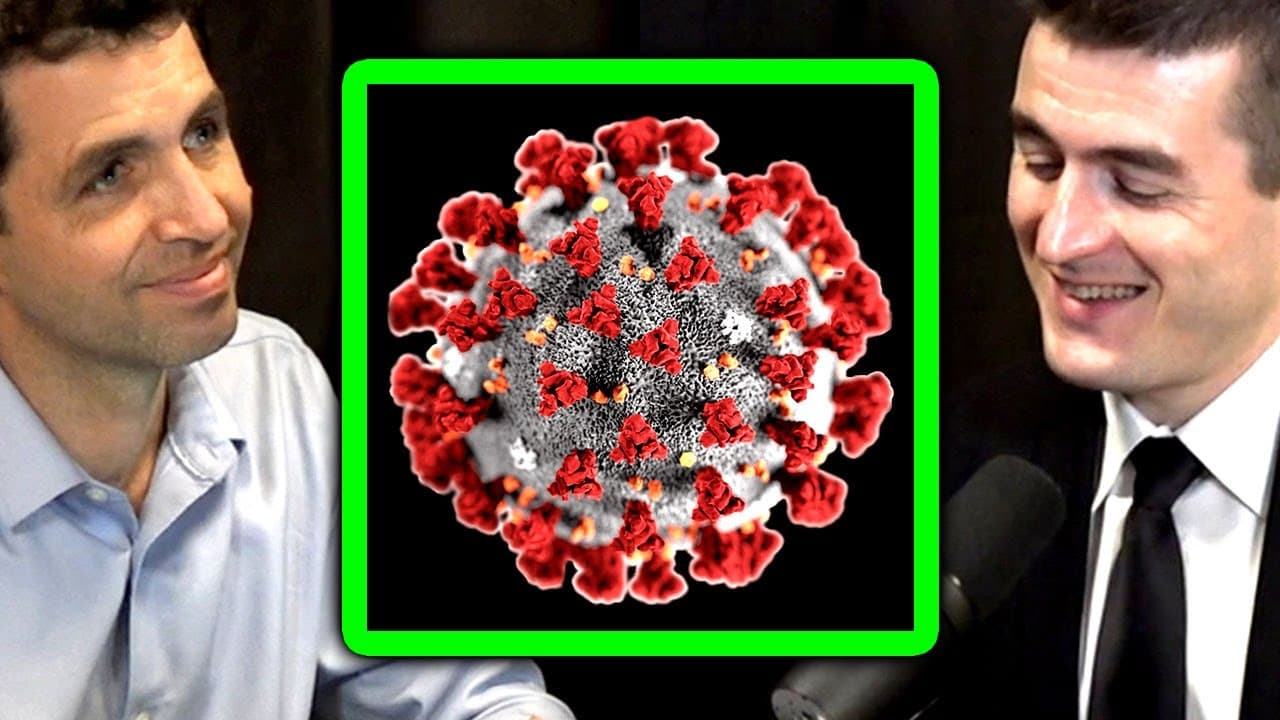
Evolution of Coronavirus | Manolis Kellis and Lex Fridman
TL;DR
Using evolutionary signatures, researchers analyzed the SARS-CoV-2 genome and discovered important insights about its proteins and genes.
Transcript
so you now have this mapping between all of the set of functions that could all encode the same all of the set of sequences that can all encode the same function what evolutionary signatures does is that it basically looks at the shape of that distribution of sequences that all encode the same thing and based on that shape you can basically say oh ... Read More
Key Insights
- ❓ Evolutionary signatures can identify the evolutionary patterns of proteins and genes.
- ❓ The SARS-CoV-2 genome analysis revealed that orf10 is not a protein but an RNA structure.
- ❓ A hidden gene within orf3a suggests the presence of an additional important protein.
Install to Summarize YouTube Videos and Get Transcripts
Explore YouTube Video Summarizer or Get YouTube Transcript Extractor
Questions & Answers
Q: How does the concept of evolutionary signatures help in understanding the evolution of proteins and genes?
Evolutionary signatures analyze the shape of the distribution of sequences encoding the same function to identify different evolutionary patterns. By looking at patterns rather than specific sequences, this technique can distinguish between proteins, RNA structures, and regulatory motifs.
Q: What did the comparison of the SARS-CoV-2 genome with other coronaviruses reveal?
The comparison showed that orf10, the last gene in the SARS-CoV-2 genome, is not a protein but an RNA structure. It also unveiled a hidden gene within orf3a, suggesting the existence of an additional important protein. This analysis helps in understanding the genetic makeup of SARS-CoV-2.
Q: Why is it important to determine which proteins are evolving rapidly in SARS-CoV-2?
Proteins that are evolving rapidly, such as the spike protein (S1), are crucial for the virus's survival and replication. Rapid evolution in these proteins suggests the virus's adaptation to different hosts and environments, highlighting their potential significance in infectivity and virulence.
Q: How do evolutionary signatures provide insights into the evolution of SARS-CoV-2 proteins?
Evolutionary signatures indicate the rate of evolution for each protein in the SARS-CoV-2 genome. For example, the polymerase and nuclear capsid proteins are slow-evolving, while the spike protein (S1) evolves rapidly. This information helps determine which proteins play important roles in the virus's lifecycle and interaction with the host.
Summary & Key Takeaways
-
By examining the shape of the distribution of sequences that encode the same function, evolutionary signatures can determine whether proteins, RNA structures, or regulatory motifs are evolving.
-
In a study comparing the SARS-CoV-2 genome to 44 related coronaviruses, researchers found that the last gene, orf10, was not a protein but an RNA structure. They also identified a hidden gene within orf3a that may have significant importance.
-
Understanding the proteins and genes of SARS-CoV-2 is crucial for comprehending coronavirus biology and potentially finding successful treatments or preventive measures.
Read in Other Languages (beta)
Share This Summary 📚
Summarize YouTube Videos and Get Video Transcripts with 1-Click
Try YouTube Summary with ChatGPT & Claude or YouTube Transcript Generator
Explore More Summaries from Lex Clips 📚




Summarize YouTube Videos and Get Video Transcripts with 1-Click
Try YouTube Summary with ChatGPT & Claude or YouTube Transcript Generator