RLC parallel circuits | PDC | Pulse Digital Circuits | Lec-20
TL;DR
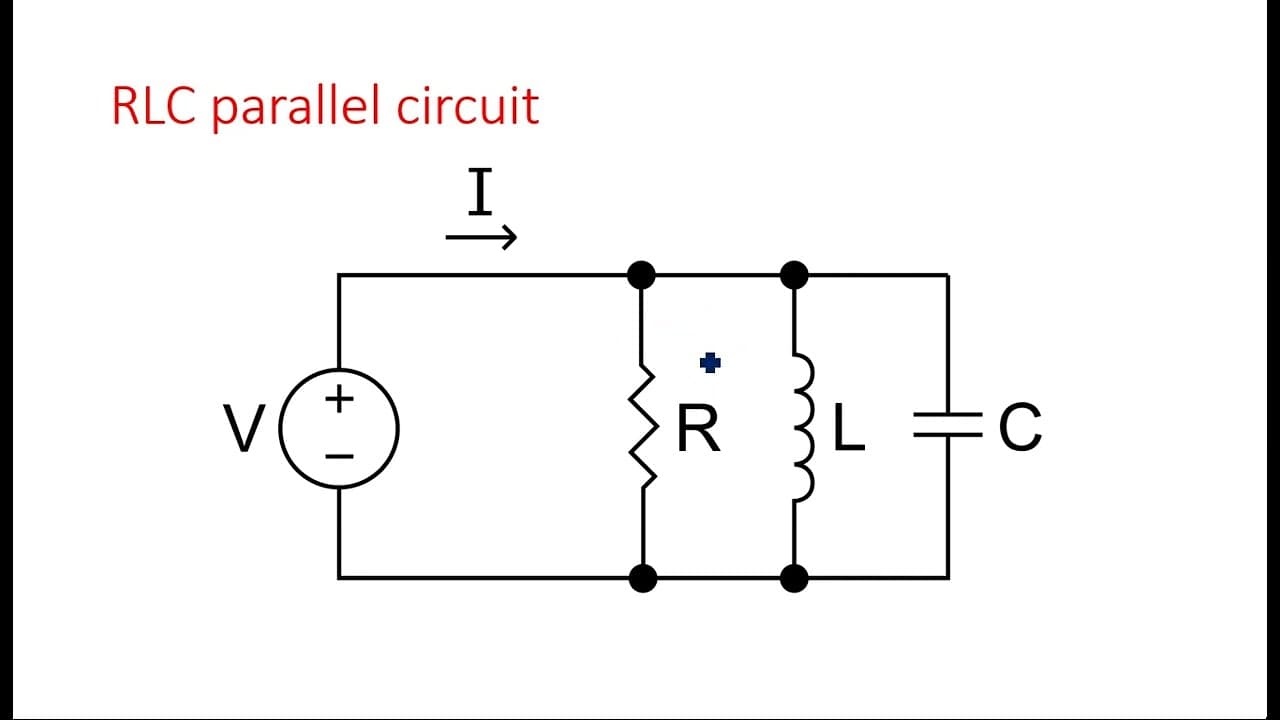
The video explains the analysis and characteristics of RLC parallel circuits, focusing on damped conditions.
Transcript
hi everyone in this video I am going to explain about the RLC Barrel circuit in the previous video we have seen RLC series circuit where we have calculated the roots of that circuit and we have also seen when it when the circuit becomes under damped and when it is over damped and when it is critically dampered these are the three possible condition... Read More
Key Insights
- 💐 RLC parallel circuits consist of resistance, inductance, and capacitance configured to share voltage, influencing current flow dynamics.
- ⚡ The transferred voltage and current relationships in a parallel configuration differ considerably from series arrangements, affecting application in signal processing.
- 🫚 Critical calculations for the roots are fundamental for understanding how the circuit behaves under different damping scenarios, essential for engineers designing stable circuits.
- 🈸 Each damping condition (over, under, critical) provides unique characteristics that can be leveraged for specific circuit applications, such as in tuning and filtering.
- 🥺 The transfer function is a vital aspect, as it illustrates the relationship between input and output features, leading to better analysis of system behavior.
- 🤩 The comparisons with series circuits highlight key conceptual differences and reinforce learning on circuit theory, essential for advanced studies in electronics.
- ❓ Understanding the LaPlace transform is essential for converting circuit equations to the frequency domain, facilitating easier analysis.
Install to Summarize YouTube Videos and Get Transcripts
Explore YouTube Video Summarizer or Get YouTube Transcript Extractor
Questions & Answers
Q: What is the main difference between RLC series and parallel circuits?
The primary difference between RLC series and parallel circuits lies in how components are arranged. In a series circuit, all components are connected end-to-end, leading to a single path for current, whereas in a parallel circuit, components are connected across the same voltage source, resulting in multiple pathways for current to flow. This affects behavior in terms of impedance and damping characteristics.
Q: How are the roots of an RLC parallel circuit calculated?
To determine the roots of an RLC parallel circuit, one needs to derive the transfer function and apply the characteristic equation. Specifically, the standard form used is s² + (1/RC)s + (1/LC) = 0. This quadratic equation allows calculation of roots using the quadratic formula, which provides insights into the circuit's damping characteristics and stability.
Q: What are the implications of different damping conditions in an RLC parallel circuit?
Different damping conditions, such as underdamped, critically damped, and overdamped, have significant implications on the circuit's response to inputs. Underdamped circuits oscillate before settling, critically damped circuits reach equilibrium without oscillation in the shortest time, and overdamped circuits take longer to settle down, indicating slower response times and potential stability concerns.
Q: How does the damping ratio impact circuit behavior?
The damping ratio, which compares resistive to reactive components, affects circuit behavior by defining how quickly the circuit response will stabilize after a disturbance. A lower ratio indicates more oscillation and potentially unstable behavior, while a higher ratio corresponds to a more stable response, which is crucial for applications requiring precise control of electrical signals.
Summary & Key Takeaways
-
The video introduces the RLC parallel circuit, explaining its structure involving resistance, capacitance, and inductance, highlighting the differences from the RLC series circuit.
-
Key concepts include deriving the transfer function and finding the roots based on the circuit's characteristics, demonstrating how they relate to damped conditions.
-
Three primary conditions of damping—underdamped, critically damped, and overdamped—are defined through comparative analysis with the RLC series circuit.
Read in Other Languages (beta)
Share This Summary 📚
Summarize YouTube Videos and Get Video Transcripts with 1-Click
Try YouTube Summary with ChatGPT & Claude or YouTube Transcript Generator