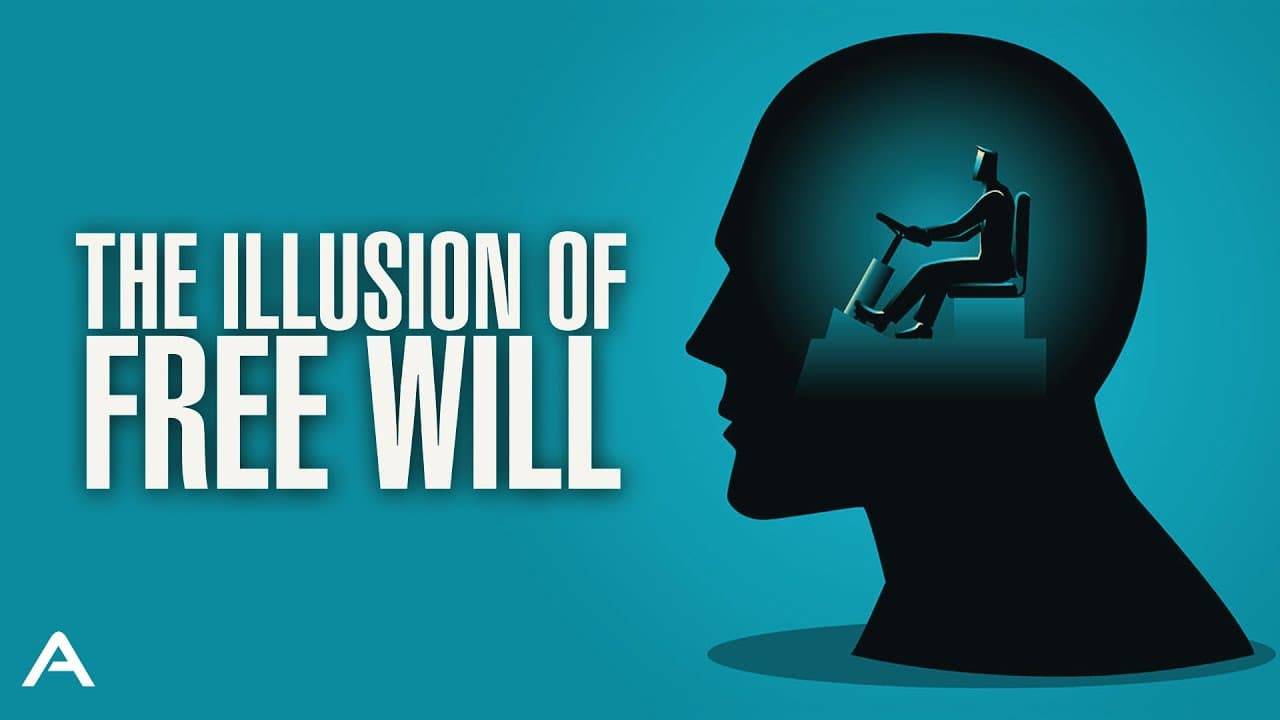
The Illusion of Free Will
TL;DR
Free will is an illusion, as scientific research shows that our decisions are predetermined by our subconscious before we experience them consciously.
Transcript
here is an apple and here's a banana pick one whichever one you picked it was your decision completely this is what we call free will it's the idea that we are the sole authors of our destiny that in the face of multiple choices whatever decision we make is completely down to us we have the power of free choice but what if i told you that free will... Read More
Key Insights
- 🌱 Free will is a myth, as our decisions are predetermined by subconscious processes before we are consciously aware of them.
- 💡 Surrounding influences, such as upbringing and genetics, play a significant role in shaping our decision-making process.
- 🧠 Brain scans have shown that decisions can be predicted up to 10 seconds before they are consciously made, further supporting the idea of determinism.
- 📚 The conscious effort to shape our subconscious is paradoxical, as desire and choice also stem from the subconscious.
- 🌈 Belief in free will is similar to belief in religion, as they both contradict the laws of physics.
- 👥 Brain tumors and malfunctions can significantly alter behavior, casting doubt on the concept of free will.
- 🏛️ The absence of free will challenges moral and legal systems, as the basis for praise and punishment becomes questionable.
- 🤝 Understanding determinism fosters empathy, humility, and a sense of responsibility towards others, as we realize the influence of external factors on our own lives.
- 🌍 This knowledge can be unsettling, but choosing to act as if we have free will allows us to make decisions that positively impact the world.
Install to Summarize YouTube Videos and Get Transcripts
Explore YouTube Video Summarizer or Get YouTube Transcript Extractor
Questions & Answers
Q: How does scientific research prove that our decisions are predetermined by our subconscious?
In studies using EEG and fMRI, researchers have been able to predict a person's decisions seconds before they consciously make them, indicating that our subconscious has already made the decision for us before we become aware of it.
Q: Why do our upbringing and surrounding influences play a significant role in our decision-making?
Our experiences, values, and beliefs are shaped by our environment, including our upbringing and the society we grow up in. These factors heavily influence our decision-making process and challenge the idea of pure individual agency.
Q: How do brain tumors and malfunctions affect a person's choices?
Brain tumors and malfunctions can change a person's behavior and decision-making by altering specific areas responsible for decision-making processes. Removing the tumor or treating the malfunction can restore normal decision-making abilities.
Q: What are the implications of the absence of free will on morality and legal justice?
The lack of free will challenges the basis of societal institutions like morality and legal justice, as it raises questions about individual responsibility and accountability for one's actions. This has implications for how we view punishment and rehabilitation in the criminal justice system.
Summary & Key Takeaways
-
Scientific studies have shown that our subconscious makes decisions before we consciously experience them, leading to the conclusion that free will is an illusion.
-
Our upbringing, genetics, and surrounding influences play a significant role in our decision-making, challenging the idea of individual agency.
-
Brain tumors and malfunctions have been proven to change a person's behavior and decision-making, raising questions about the extent of our control over our choices.
-
Free will is a myth, as scientific evidence reveals that our subconscious makes decisions before we consciously experience them.
-
Our upbringing, genetics, and surrounding influences heavily influence our decision-making process.
-
Brain tumors and malfunctions can completely alter a person's behavior and choices, further challenging the notion of free will.
Read in Other Languages (beta)
Share This Summary 📚
Summarize YouTube Videos and Get Video Transcripts with 1-Click
Try YouTube Summary with ChatGPT & Claude or YouTube Transcript Generator
Explore More Summaries from Aperture 📚

Summarize YouTube Videos and Get Video Transcripts with 1-Click
Try YouTube Summary with ChatGPT & Claude or YouTube Transcript Generator