3D printers - 6 Minute English
TL;DR
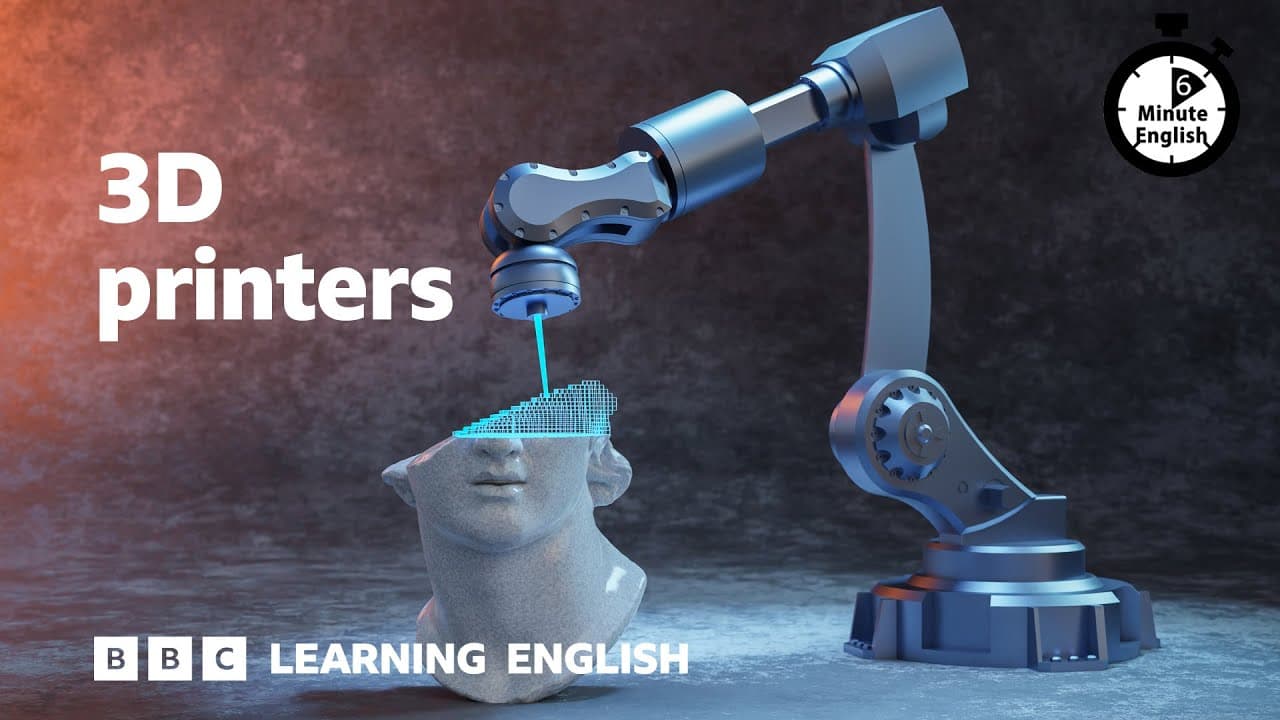
3D printers are transforming industries by creating solid objects efficiently.
Transcript
Hello. This is 6 Minute English from BBC Learning English. I'm Sam. And I'm Neil. In 1436 in Germany, Johannes Gutenberg invented the printing press - a machine capable of making many copies of the same page of text. Ever since, printing has been used around the world to produce books, newspapers and magazines. Printing technology has come a long ... Read More
Key Insights
- 3D printers can create solid, three-dimensional objects using materials like plastic, concrete, and metal, marking a significant advancement from traditional printing methods.
- Unlike traditional sculpting, 3D printing builds objects by adding material layer by layer, enabling innovative solutions across various fields.
- The expiration of patents after the millennium allowed for the development of affordable 3D printers, leading to widespread experimentation and discovery of new applications.
- 3D printing is particularly effective for creating prototypes, which are models that can be tested and refined to develop better products.
- In medicine, 3D printers have revolutionized the production of prosthetics, allowing for custom-made artificial body parts that are tailored to individual needs.
- The process of creating prosthetic eyes has been significantly streamlined through 3D printing, reducing the time required from several hours to just thirty minutes.
- The first known text printed using wooden blocks was the religious text, the Buddha's Diamond Sutra, demonstrating the historical roots of printing technology.
- Vocabulary related to 3D printing includes terms like 'mucking about,' 'prototype,' 'prosthetics,' 'custom-made,' and 'time-consuming,' reflecting the diverse applications and impacts of this technology.
Install to Summarize YouTube Videos and Get Transcripts
Explore YouTube Video Summarizer or Get YouTube Transcript Extractor
Questions & Answers
Q: How do 3D printers differ from traditional sculpting methods?
3D printers differ from traditional sculpting methods by building objects from the ground up, adding material layer by layer. This contrasts with sculpting, where material is removed from a solid block to reveal a shape. This additive process allows for greater precision and complexity in object creation.
Q: What impact did the expiration of patents have on 3D printing technology?
The expiration of patents after the millennium greatly impacted 3D printing technology by making it more affordable and accessible. This led to increased experimentation and innovation as tech companies and individuals explored new applications, realizing the potential of 3D printers beyond industrial uses.
Q: What are some applications of 3D printing in the medical field?
In the medical field, 3D printing is used to create custom prosthetics, such as artificial limbs and eyes, tailored to individual needs. This technology allows for precise, bespoke solutions that improve patient outcomes and quality of life. The process is also more time-efficient compared to traditional methods.
Q: What was the oldest known text printed using wooden blocks?
The oldest known text printed using wooden blocks was the Buddha's Diamond Sutra, a religious text. This method of block printing involved using hand-carved wooden blocks pressed into ink, a precursor to modern printing technologies that laid the groundwork for future innovations like 3D printing.
Q: How has 3D printing improved the production of prosthetic eyes?
3D printing has significantly improved the production of prosthetic eyes by automating the process, reducing the time required from several hours to just thirty minutes. This advancement makes custom prosthetic eyes more accessible and less time-consuming, providing a quicker solution for patients in need.
Q: What vocabulary is associated with 3D printing?
Vocabulary associated with 3D printing includes 'mucking about,' referring to experimenting without serious intent; 'prototype,' a model for testing; 'prosthetics,' artificial body parts; 'custom-made,' tailored to individual specifications; and 'time-consuming,' describing processes that require significant time investment.
Q: How did 3D printing technology evolve after the year 2000?
After 2000, 3D printing technology evolved rapidly due to the expiration of key patents, which lowered costs and increased accessibility. This led to widespread experimentation by tech companies and individuals, discovering new applications in prototyping, education, and bespoke manufacturing, transforming various industries.
Q: What are some key advantages of 3D printing over traditional manufacturing methods?
Key advantages of 3D printing over traditional manufacturing include the ability to create complex, customized objects with greater precision and less waste. The additive process allows for intricate designs that are difficult or impossible with conventional methods, and it enables rapid prototyping and faster production times.
Summary & Key Takeaways
-
3D printers are a technological breakthrough, enabling the creation of solid objects from materials like plastic and metal by layering material. This method contrasts with traditional sculpting and has opened new possibilities in various fields, especially after patents expired, making the technology more accessible.
-
The accessibility of 3D printers has led to their use in educational and industrial settings, with significant applications in prototyping. These printers have proven invaluable in developing and refining products, demonstrating their versatility beyond industrial tools.
-
In healthcare, 3D printing has transformed the creation of prosthetics, offering bespoke solutions that significantly enhance patients' quality of life. By automating processes like the creation of prosthetic eyes, 3D printing reduces production time and improves accessibility to custom medical solutions.
Read in Other Languages (beta)
Share This Summary 📚
Summarize YouTube Videos and Get Video Transcripts with 1-Click
Try YouTube Summary with ChatGPT & Claude or YouTube Transcript Generator
Explore More Summaries from BBC Learning English 📚
Summarize YouTube Videos and Get Video Transcripts with 1-Click
Try YouTube Summary with ChatGPT & Claude or YouTube Transcript Generator