Numerical Based on Decay Constant Problem 18 - Nuclear Chemistry & Radioactivity
TL;DR
This content explains how to calculate the age of a sample using the decay constant and provides a step-by-step solution to a specific numerical problem.
Transcript
click the bell icon to get latest videos from akira her friends in the previous topic we have discussed about the numerical based on the decay constant problem number 17 and now we have your going to talk about the pronoun Marais teen so let us find out what is the cushion that is and what is the required data that we need from this question so fri... Read More
Key Insights
- 🤕 Carbon-14 decay can be used to determine the age of organic materials.
- 🤩 The half-life of carbon-14 is a key parameter in decay calculations.
- 🛟 The decay constant is inversely proportional to the half-life.
- 🤕 Calculating the age of a sample involves determining the decay constant and using it in the age formula.
- ❓ Understanding disintegration per second (DPS) values is crucial in decay calculations.
- 🤕 The difference in DPS values can indicate the age difference between samples.
- 🤕 The formula for calculating the age of a sample involves the natural logarithm function.
Install to Summarize YouTube Videos and Get Transcripts
Explore YouTube Video Summarizer or Get YouTube Transcript Extractor
Questions & Answers
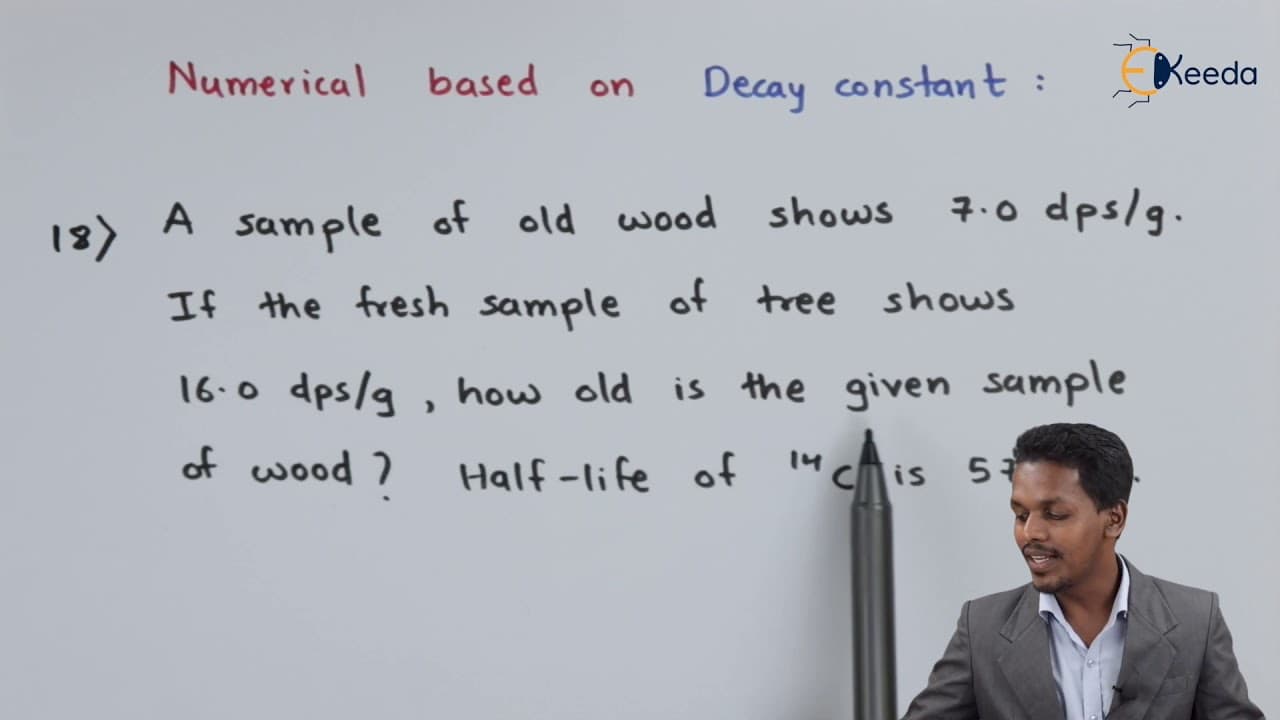
Q: What is the initial and final DPS values of the wood samples in the problem?
The initial DPS value is 16.0 for the fresh wood sample, and the final DPS value is 7.0 for the old wood sample.
Q: What is the decay constant (lambda) in the problem?
The decay constant is calculated using the formula T_half = 0.693/lambda. In this case, T_half is given as 5730 years, which results in a decay constant of 1.209x10^-4 year^-1.
Q: How is the age of the old wood sample calculated?
The age of the old wood sample can be calculated using the formula T = (2.303/lambda) * log(n_0/n), where n_0 is the initial DPS value (16) and n is the final DPS value (7). The calculated age is approximately 6839 years.
Q: What is the unit of the decay constant and the calculated age?
The decay constant has a unit of year^-1, and the calculated age has a unit of years.
Summary & Key Takeaways
-
The content discusses a numerical problem about the decay of carbon-14 in a wood sample.
-
The problem involves comparing the disintegration per second (DPS) of an old wood sample (7.0 DPS) with a fresh wood sample (16.0 DPS).
-
The half-life of carbon-14 is given as 5730 years, and the goal is to determine the age of the old wood sample.
Read in Other Languages (beta)
Share This Summary 📚
Summarize YouTube Videos and Get Video Transcripts with 1-Click
Try YouTube Summary with ChatGPT & Claude or YouTube Transcript Generator
Explore More Summaries from Ekeeda 📚


Summarize YouTube Videos and Get Video Transcripts with 1-Click
Try YouTube Summary with ChatGPT & Claude or YouTube Transcript Generator