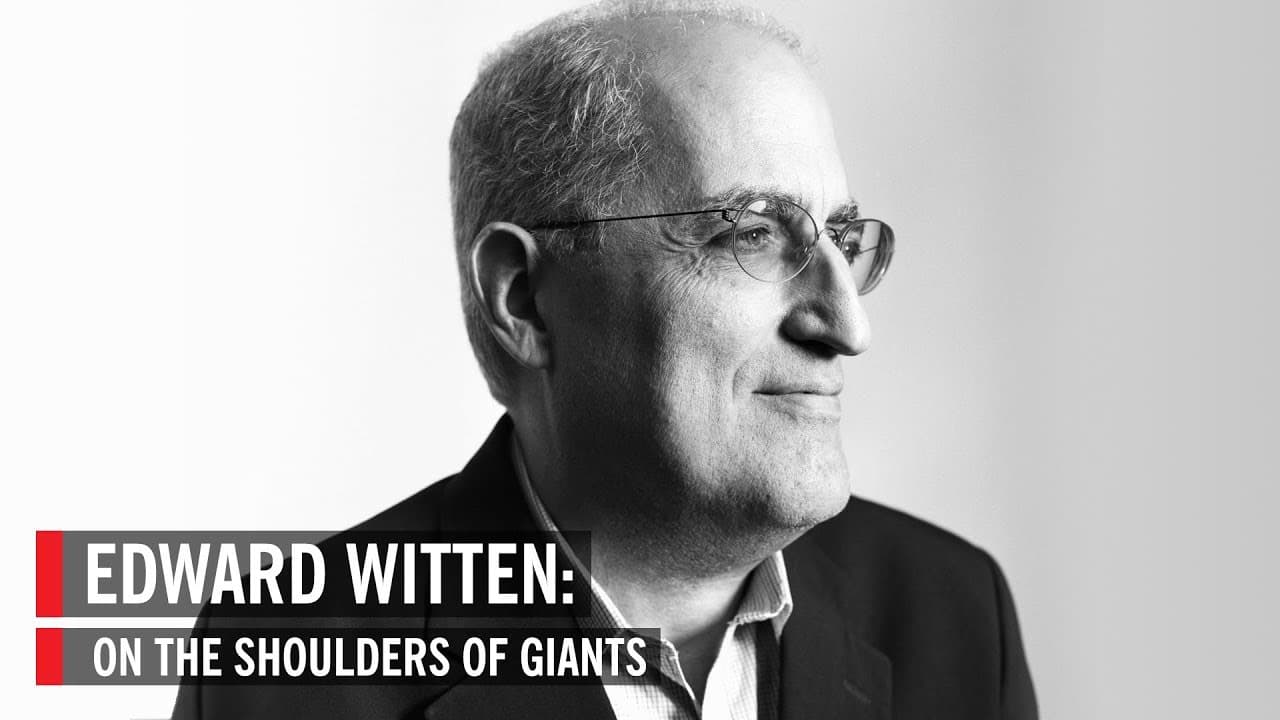
Edward Witten: On the Shoulders of Giants
TL;DR
This talk discusses the concept of "nature rhyming" in the field of physics, exploring similarities between different realms of physics, including wave phenomena and the potential unification of particles and forces through string theory.
Transcript
so the title of my talk is Nature's Rhymes it's been said that history doesn't repeat itself but it does Rhyme the Curious Thing about the quote is that although somebody definitely said it it doesn't seem to be clear who did it's most often attributed to the writer Mark Twain however you can easily find websites claiming that there's no evidence t... Read More
Key Insights
- ⚖️ The concept of "nature rhyming" in physics highlights the similarities and patterns found across different realms of physics, even with variations in scales and types of phenomena.
- 🌊 Waves, whether in water, strings, light, or matter, exhibit common characteristics and behaviors, leading to a unified description in terms of wave equations.
- 👋 The principle of least action and its connection to wave phenomena and interference patterns provides insights into the underlying dynamics of waves and their behavior.
Install to Summarize YouTube Videos and Get Transcripts
Explore YouTube Video Summarizer or Get YouTube Transcript Extractor
Questions & Answers
Q: Who was Thomas Young and what were his contributions to physics?
Thomas Young was a prominent figure in the early 19th century who established that light is a wave through his experiments. He also made significant contributions to deciphering Egyptian hieroglyphs and measuring the sizes of molecules.
Q: How does the principle of least action relate to wave phenomena?
The principle of least action, introduced by physicists like Euler and Lagrange, explains the behavior of waves by considering all possible paths and minimizing the action, which is a combination of the kinetic and potential energies of the wave. This principle allows us to understand the interference patterns and behaviors exhibited by waves.
Q: How does string theory unify particles and forces?
In string theory, the different elementary particles are interpreted as different vibrational modes of a fundamental string. This unifies the particles into a single entity and also incorporates the forces as different interactions of the string vibrations. It offers a potential framework for merging quantum mechanics and general relativity.
Q: What is the significance of random quantum geometry in string theory?
Random quantum geometry, specifically on the string world sheet, allows for the description of the quantum behavior of strings. It provides a mathematical framework to understand the vibrational modes and interactions of the string, which leads to the unification of particles and forces, including the gravitational field.
Summary & Key Takeaways
-
The talk begins with the idea that history rhymes, and how physics often repeats itself with similar structures found in different realms, involving different scales of length and energy.
-
It explores the wave nature of light and matter, emphasizing the commonalities and differences between wave equations and describing the experiments by Thomas Young in the 19th century that established light as a wave.
-
The talk then introduces the discovery of matter waves, particularly in the context of electrons and strings, highlighting the similarities in their wave equations.
-
It moves on to discuss the principle of least action and its significance in understanding the behavior of particles and strings, as well as the concept of random quantum geometry.
-
The talk concludes with the potential rhyme between string theory and general relativity, suggesting that the unification of particles and forces through string theory may lead to a deeper understanding of quantum gravity.
Read in Other Languages (beta)
Share This Summary 📚
Summarize YouTube Videos and Get Video Transcripts with 1-Click
Try YouTube Summary with ChatGPT & Claude or YouTube Transcript Generator
Explore More Summaries from World Science Festival 📚

Summarize YouTube Videos and Get Video Transcripts with 1-Click
Try YouTube Summary with ChatGPT & Claude or YouTube Transcript Generator