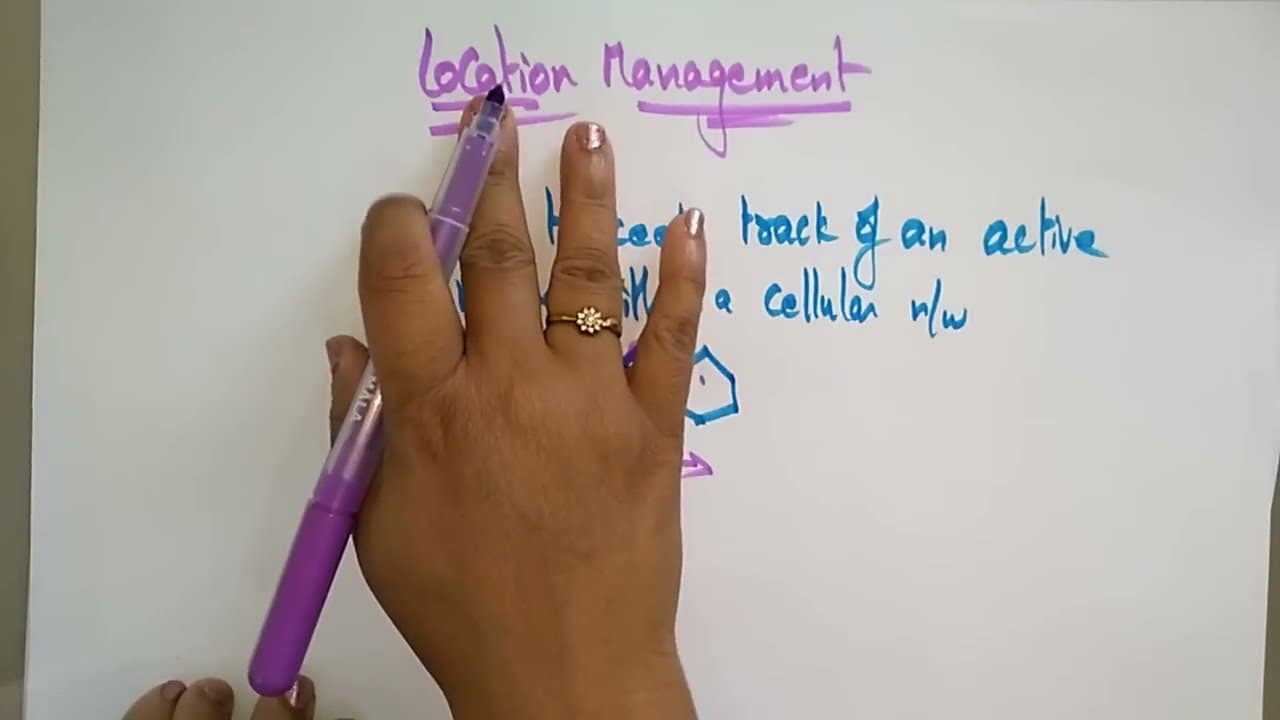
Location management | MC | Mobile Computing | Lec- 09 | Bhanu Priya
TL;DR
Location management in mobile computing tracks active mobile devices across different network cells.
Transcript
students welcome back coming to the next Topic in the subject mobile Computing was location management so how the location is managing in Mobile Computing now let's see actually this location management deals with how to keep track of an active mobile how to keep track of an active mobile active mobile means you're talking to someone so your mobile... Read More
Key Insights
- 📲 Location management is vital for mobile communication services, ensuring that calls remain connected as users move.
- 🚉 Active mobile stations must continuously update their locations to maintain effective connectivity within a cellular network.
- 📟 The interplay between location updating and paging is essential for maintaining seamless communication during mobility.
- 📌 Static location update schemes might lead to inefficiencies due to their generalized approach to updating user locations.
- 👤 Dynamic location update schemes foster adaptability and efficiency by considering individual user behaviors in updating frequency.
- 📲 The paging process is critical for quickly locating mobile devices, especially during active calls, preventing service interruptions.
- 🥺 Understanding location management's functions can lead to better network design and user experience in mobile computing applications.
Install to Summarize YouTube Videos and Get Transcripts
Explore YouTube Video Summarizer or Get YouTube Transcript Extractor
Questions & Answers
Q: What is location management and why is it important in mobile computing?
Location management is a system that keeps track of mobile devices' locations within a cellular network, particularly when they are active. Its importance lies in facilitating uninterrupted communication, as it ensures that calls and internet services remain connected even when users move between different cells and base stations.
Q: Can you explain the two main operations of location management?
The two primary operations in location management are location updating and paging. Location updating involves continuously informing the network about a mobile device's current location so calls can be properly routed. Paging is the process of querying multiple cells to determine the exact location of a mobile device for incoming calls, ensuring connection integrity.
Q: How do static and dynamic location update schemes differ?
Static location update schemes define fixed frequency and occurrence of location updates regardless of user activity, leading to potentially less efficient updates. In contrast, dynamic schemes allow for user-specific adjustments in the frequency of location updates, taking into account factors like call arrival and mobility patterns, which enhances responsiveness and efficiency.
Q: What role does the paging schema play in location management?
The paging schema is essential for routing incoming calls to the correct mobile device location. It polices a range of cells within the network to identify where a mobile user is currently located, allowing the network to send out a paging query that ensures the call reaches its intended destination without interruption.
Q: What are the characteristics of the static location update schema?
The static location update schema determines a set frequency for location updates without considering individual user behavior. This means devices either continuously update or do not update their location at all, possibly leading to inefficiencies due to a lack of personalized tracking and adaptability to changing user locations.
Q: How does the dynamic location update schema enhance user experience?
The dynamic location update schema improves user experience by adjusting the frequency of location updates based on the individual user's needs and behaviors, such as call patterns or mobility rates. This approach allows the network to optimize resources and maintain better service quality, resulting in fewer dropped calls and improved connectivity.
Q: What are the strategies employed in the paging process?
The paging process can utilize several strategies, including simultaneous paging, where multiple cells are polled at once, sequential paging, which checks cells one at a time, and intelligent paging, which uses more sophisticated algorithms to quickly locate an active device, enhancing call routing efficiency.
Summary & Key Takeaways
-
Location management is crucial in mobile computing as it continuously tracks active mobile stations during communication, ensuring calls and data remain connected while moving between network cells.
-
The two main operations in location management are location updating, which informs the network of a device's position, and paging, which queries multiple cells to locate a user for incoming calls.
-
Location update schemes are divided into static and dynamic types; static updates are consistent and frequency-based, while dynamic updates adapt to user behavior and network conditions for better efficiency.
Read in Other Languages (beta)
Share This Summary 📚
Summarize YouTube Videos and Get Video Transcripts with 1-Click
Try YouTube Summary with ChatGPT & Claude or YouTube Transcript Generator