Iain Couzin: Lessons from a Cannibal Plague | Nat Geo Live
TL;DR
Locust swarms, impacting one in 10 people globally, are driven by cannibalistic behavior and a need for survival in a protein- and nutrient-scarce environment.
Transcript
well it's a it's a real pleasure to be here today to tell you about my research in Collective Behavior now what are these creatures locusts exactly a Biblical plague right locusts have been around for a very long time causing trouble um and yet we still have a very limited understanding of why insects like locusts perform these mass migrations and ... Read More
Key Insights
- 🌸 Locust swarms have a significant impact on human populations, causing famine and economic loss.
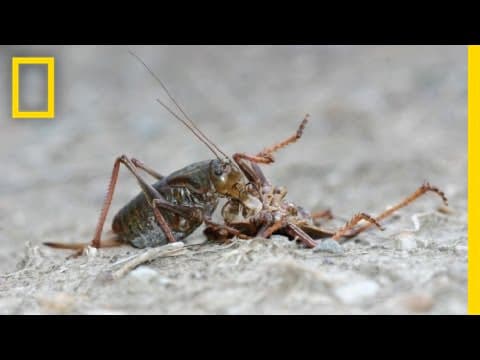
- 💁 Cannibalistic behavior in locusts may be a driving factor in the formation of swarms.
- 💪 Uninformed individuals can have a strong influence in collective decision-making processes, promoting democratic consensus.
- 💄 Understanding collective behavior in animals can provide insights into human decision-making processes.
- 🐟 Fish experiments have provided experimental evidence supporting the theoretical predictions about collective decision-making.
- 👨🔬 The research extends beyond locust swarms to study socially contagious behavior in human societies.
- 🥺 The presence of uninformed individuals can lead to a transition of control from a strongly opinionated minority to a numerical majority.
Install to Summarize YouTube Videos and Get Transcripts
Explore YouTube Video Summarizer or Get YouTube Transcript Extractor
Questions & Answers
Q: Why do locusts swarm, and what drives their behavior?
Locusts swarm to survive in their protein- and nutrient-scarce environment, and cannibalistic behavior may play a role in their decision to form swarms.
Q: How do locust swarms impact human populations?
Locust swarms can cause famine, economic loss, and impact the livelihoods of one in 10 people worldwide.
Q: How do locust swarms form in the field?
Locust swarms can be tracked in the field using footprints in the sand, and their formation can be observed and studied by researchers.
Q: How do uninformed individuals influence collective decision-making?
Uninformed individuals can inhibit the influence of a strongly opinionated minority by returning control to a numerical majority, promoting democratic consensus decision-making.
Summary & Key Takeaways
-
Locust swarms, such as the desert locust, have a massive impact on the earth's land surface and human livelihoods, causing famine and economic loss.
-
Research has revealed that locusts display cannibalistic behavior, feeding on each other, which may drive the formation of swarms.
-
The presence of uninformed individuals in collective decision-making processes can lead to a transition of control from a strongly opinionated minority to a numerical majority.
Read in Other Languages (beta)
Share This Summary 📚
Summarize YouTube Videos and Get Video Transcripts with 1-Click
Try YouTube Summary with ChatGPT & Claude or YouTube Transcript Generator
Explore More Summaries from National Geographic 📚





Summarize YouTube Videos and Get Video Transcripts with 1-Click
Try YouTube Summary with ChatGPT & Claude or YouTube Transcript Generator