1. Course Overview, Interval Scheduling
TL;DR
The earliest finish time selection rule is proven to be optimal for interval scheduling, but fails for weighted interval scheduling.
Transcript
The following content is provided under a Creative Commons license. Your support will help MIT OpenCourseWare continue to offer high quality educational resources for free. To make a donation or view additional materials from hundreds of MIT courses, visit MIT OpenCourseWare at ocw.mit.edu. SRINIVAS DEVADAS: So welcome to 6046. My name is Srinivas ... Read More
Key Insights
- 🏋️ The earliest finish time selection rule is optimal for interval scheduling, but not for weighted interval scheduling.
- ❓ Weighted interval scheduling requires dynamic programming to find the optimal solution.
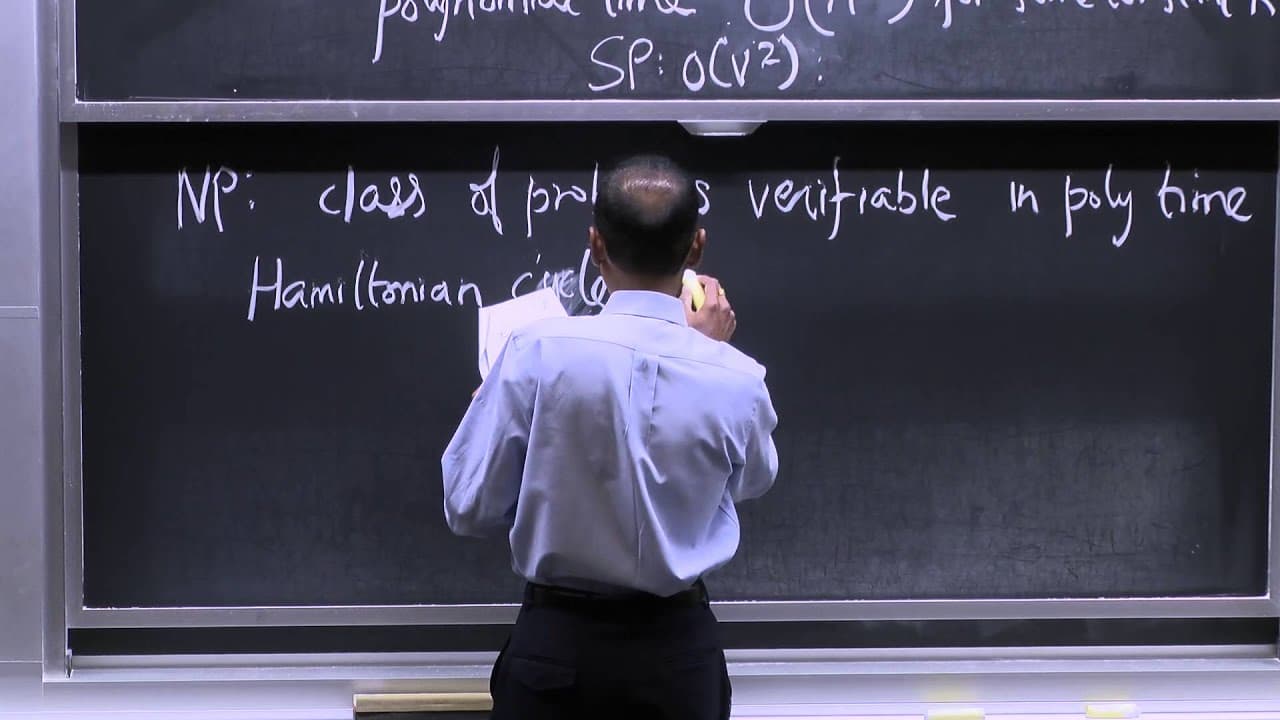
- 🎰 Non-identical machines in interval scheduling make the problem NP-complete.
Install to Summarize YouTube Videos and Get Transcripts
Explore YouTube Video Summarizer or Get YouTube Transcript Extractor
Questions & Answers
Q: What is the TLDR summary of the content?
The earliest finish time selection rule is proven to be optimal for interval scheduling, but fails for weighted interval scheduling.
Q: What is the main difference between interval scheduling and weighted interval scheduling?
Weighted interval scheduling assigns weights to requests and the goal is to schedule a subset of requests with maximum weight.
Q: What is the complexity of the weighted interval scheduling dynamic programming solution?
The complexity is O(n^2), where n is the number of requests.
Q: What happens if there are multiple non-identical machines in interval scheduling?
The problem becomes NP-complete, and a different approach is needed.
Q: How can intractability be dealt with in interval scheduling?
Intractability can be managed by using polynomial-time algorithms that may not always provide the optimal solution, but are efficient for common cases.
Summary & Key Takeaways
-
The greedy algorithm with the earliest finish time is optimal for interval scheduling, but not for weighted interval scheduling.
-
Weighted interval scheduling requires the use of dynamic programming to find the optimal solution.
-
A small change to the interval scheduling problem, such as adding multiple non-identical machines, makes the problem NP-complete.
Read in Other Languages (beta)
Share This Summary 📚
Summarize YouTube Videos and Get Video Transcripts with 1-Click
Try YouTube Summary with ChatGPT & Claude or YouTube Transcript Generator
Explore More Summaries from MIT OpenCourseWare 📚


Summarize YouTube Videos and Get Video Transcripts with 1-Click
Try YouTube Summary with ChatGPT & Claude or YouTube Transcript Generator