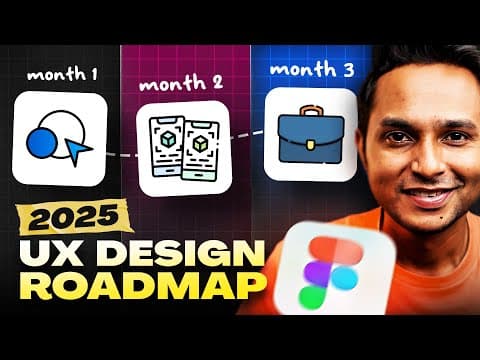
How I’d Learn UI/UX Design In 2025 with AI [6 Months]

TL;DR
Learn UI/UX design in 6 months with AI guidance.
Transcript
Read and summarize the transcript of this video on Glasp Reader (beta).
Key Insights
- The evolving design industry now seeks 'builders' who can envision, strategize, and execute like product unicorns, leveraging AI tools.
- Foundational design skills remain crucial; observing and questioning the world like a designer is essential for developing a critical eye.
- Mastering Figma is pivotal for design work, as it integrates with AI tools to enhance design efficiency and creativity.
- AI, like ChatGPT, can accelerate learning by providing practical examples and drafts, fostering a learn-by-doing approach.
- Developing 'epoch skills'—empathy, presence, opinion, creativity, and hope—can differentiate designers in an AI-driven world.
- The concept of 'vibe everything' emphasizes using AI for various tasks, including design, coding, and product prototyping.
- Building a comprehensive portfolio with detailed case studies is vital for showcasing problem-solving skills and design thinking.
- AI tools enhance productivity but understanding when and how to apply human judgment and creativity remains irreplaceable.
Install to Summarize YouTube Videos and Get Transcripts
Explore YouTube Video Summarizer or Get YouTube Transcript Extractor
Questions & Answers
Q: What is the new expectation for designers in 2025?
In 2025, designers are expected to be 'builders' who can envision, strategize, and execute ideas into real products. This means having skills that overlap with product management and development, and being able to leverage AI tools to enhance productivity and creativity.
Q: Why is mastering Figma important for designers?
Mastering Figma is crucial because it is the primary tool for UI/UX design, allowing designers to create and iterate on designs efficiently. It also integrates with AI tools, enabling designers to prototype and refine their work more effectively, making it essential for modern design workflows.
Q: How can AI tools like ChatGPT assist in learning design?
AI tools like ChatGPT can assist in learning design by providing practical examples, drafts, and explanations for various design tasks. They enable a learn-by-doing approach, allowing designers to quickly grasp concepts, refine their skills, and stay updated with industry trends.
Q: What are 'epoch skills' and why are they important?
Epoch skills, which include empathy, presence, opinion, creativity, and hope, are crucial human-centric abilities that differentiate designers in an AI-driven world. These skills are essential for effective problem-solving, communication, and creating user-centered designs, as they cannot be easily replicated by AI.
Q: What is 'vibe everything' in the context of design?
'Vibe everything' refers to the approach of using AI tools to handle various tasks, such as design, coding, and prototyping, through conversational interfaces. It emphasizes the integration of AI into workflows, allowing designers to execute tasks efficiently by interacting with AI tools via chat.
Q: How should designers approach building their portfolios in 2025?
Designers should build comprehensive portfolios that showcase detailed case studies, highlighting their problem-solving skills, design thinking, and ability to collaborate with AI. Portfolios should be sharable as links, emphasizing UX projects, and demonstrating how designers apply their skills to create impactful user experiences.
Q: What role does AI play in the future of design?
AI plays a significant role in the future of design by enhancing productivity, enabling rapid prototyping, and providing tools for learning and execution. However, the ability to apply human judgment, creativity, and empathy remains crucial, as these are areas where AI cannot fully replicate human capabilities.
Q: Why is it important to balance AI tools with human judgment in design?
Balancing AI tools with human judgment is important because while AI can enhance efficiency and provide data-driven insights, human judgment is essential for understanding user needs, cultural nuances, and ethical considerations. This balance ensures that designs are not only functional but also resonate with users on a deeper level.
Summary & Key Takeaways
-
The design industry in 2025 emphasizes the role of 'builders' who can leverage AI to execute ideas from concept to product, requiring skills beyond traditional design roles.
-
Foundational design skills, including critical observation and questioning, are essential for developing a designer's mindset, while mastering tools like Figma is crucial for practical application.
-
AI tools, such as ChatGPT, facilitate rapid learning and execution, allowing designers to create prototypes and refine skills, while human-centric skills remain vital for unique problem-solving.
Read in Other Languages (beta)
Share This Summary 📚
Summarize YouTube Videos and Get Video Transcripts with 1-Click
Try YouTube Summary with ChatGPT & Claude or YouTube Transcript Generator
Explore More Summaries from Saptarshi Prakash 📚
![DON'T Be A UI/UX Designer In 2026, Do THIS Instead. [FULL BREAKDOWN] thumbnail](/_next/image?url=https%3A%2F%2Fi.ytimg.com%2Fvi%2FSUXU72cb_T0%2Fhqdefault.jpg&w=750&q=75)
![How I'd Build A JOB READY UI/UX Design Portfolio In 2026. [FULL GUIDE] thumbnail](/_next/image?url=https%3A%2F%2Fi.ytimg.com%2Fvi%2FPNG0Qvl-PdQ%2Fhqdefault.jpg&w=750&q=75)

Summarize YouTube Videos and Get Video Transcripts with 1-Click
Try YouTube Summary with ChatGPT & Claude or YouTube Transcript Generator