What Is Watermarking for Large Language Models?
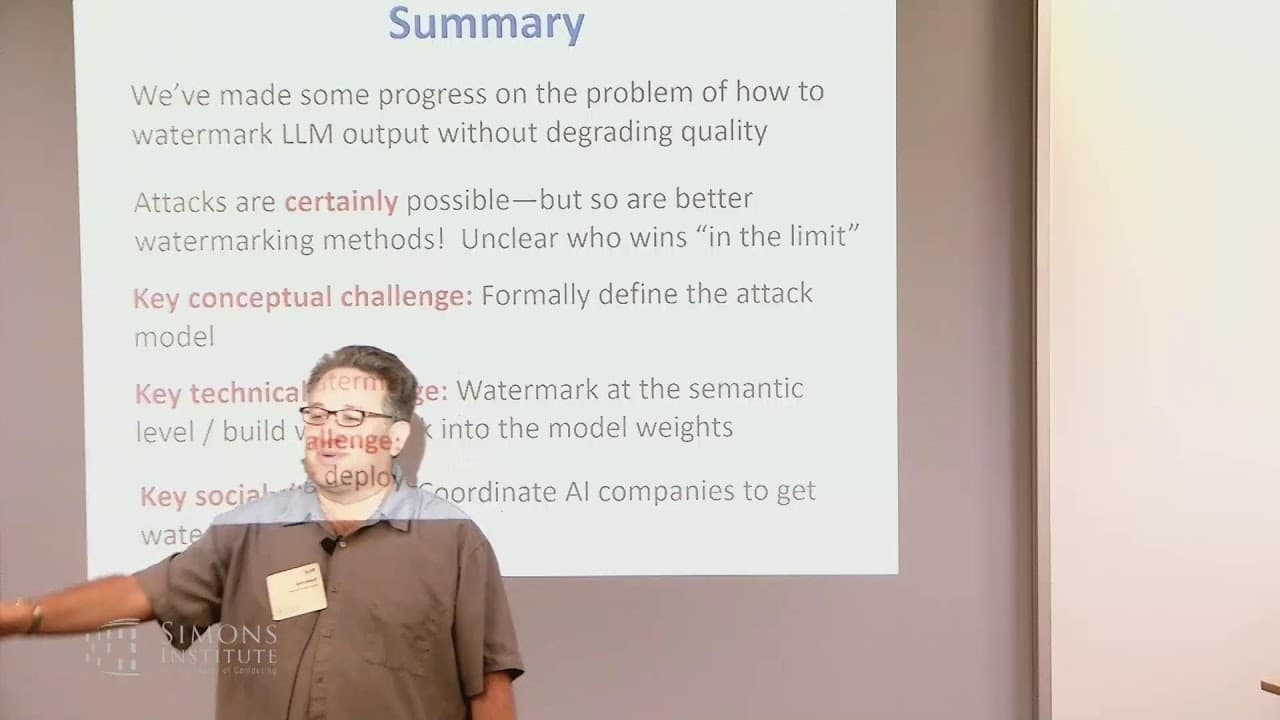
TL;DR
Watermarking large language models involves subtly altering their token selection process to embed a detectable signal indicating AI-generated text. This technique, based on the Gumbel-Softmax rule, aims to balance identification of AI outputs while preserving output quality. Effective watermarking is influenced by the average entropy of tokens, with higher entropy requiring fewer tokens for reliable detection.
Transcript
CREW: Can you hear me today? [SIDE CONVERSATIONS] SCOTT AARONSON: Oh, it the wrong one. CREW: Right here. SCOTT AARONSON: Oh, perfect. [SIDE CONVERSATIONS] I mean, normally, I don't have to do anything. SPEAKER: Physical intelligence is still needed. [SIDE CONVERSATIONS] SCOTT AARONSON: No. No, I don't. [SIDE CONVERSATIONS] SPEAKER: For that space,... Read More
Key Insights
- 🔍 The development of a watermarking scheme for language models is a promising approach to address the issue of misuses of generative AI.
- 💼 There are challenges surrounding the deployment of the watermarking scheme, such as customer backlash and coordination among AI companies.
- 💡 The watermarking scheme does not degrade the quality of the language model's output, debunking the belief that there is an inherent trade-off between watermarking and quality.
- ⚖️ There is a need to define the attack model and establish a clear line between acceptable use and academic cheating.
- 🔐 The watermarking scheme provides privacy benefits as it does not require access to past user data.
- 📚 The scheme can be further improved to watermark at the semantic level and encode additional information beyond simple detection.
- 🌍 International collaboration and legal frameworks may be necessary to implement watermarking effectively and ethically.
- 🔎 Further research should focus on the conceptual, technical, and social challenges involved in watermarking language models.
- 🔢 The number of tokens needed to detect a watermark decreases with higher average entropy per token.
- 💡 It is difficult to define the attack model and determine the extent of acceptable use vs. academic cheating.
- 🔐 The watermarking scheme does not require access to past user data, making it more privacy-friendly compared to database approaches.
- 💡 Watermarking can be extended to encode additional information beyond detection, but the capacity is limited by entropy.
- 🔬 Research should explore the possibilities of watermarking at the producing end and improving the scheme with model access.
Install to Summarize YouTube Videos and Get Transcripts
Explore YouTube Video Summarizer or Get YouTube Transcript Extractor
Questions & Answers
Q: What is the Gumbel-Softmax rule and how is it used in watermarking language models?
The Gumbel-Softmax rule is a method used in watermarking language models to select tokens based on their probabilities. It involves choosing the token that maximizes the value of rt,i to the power of 1 over pt,i, where rt,i is a pseudorandom number generated by a function and pt,i is the probability of the token. This rule ensures that the selected tokens appear to be drawn according to their probabilities, while also allowing for the insertion of a watermark signal.
Q: How does the number of tokens required for watermarking scale with the average entropy per token?
The number of tokens required for watermarking scales inversely with the average entropy per token. As the average entropy per token decreases (indicating less randomness), a larger number of tokens is needed to generate a detectable watermark signal. Conversely, as the average entropy per token increases, fewer tokens are needed to achieve a strong watermark signal. This relationship allows for a trade-off between the strength of the watermark and the length of the document.
Q: Can watermarking be used in low-entropy scenarios where there is a definitive right answer?
Watermarking is less relevant in low-entropy scenarios where there is a definitive right answer, such as listing prime numbers or copying a known document. In these cases, the watermark is not necessary as it is already clear that the content is generated by AI. Watermarking becomes useful when there is uncertainty or multiple possible answers, allowing for the identification of AI-generated content in a more nuanced way.
Q: How can watermarking be extended beyond a 1-bit detection to encode additional information?
It is possible to extend watermarking to encode additional information beyond a 1-bit detection. By modifying the watermarking method, metadata or other characteristics can be encoded into the watermark, providing more detailed information about the language model or its outputs. However, the information-carrying capacity of the watermark is limited by the entropy of the distribution and the length of the document. Increasing the complexity of the watermark may require a larger number of tokens to maintain detectability.
Summary & Key Takeaways
-
Watermarking language models is a method to identify AI-generated content by inserting a statistical signal into the choice of words or tokens.
-
The Gumbel-Softmax rule is a suitable method for watermarking, allowing the selection of tokens that appear to be drawn based on their probabilities.
-
The effectiveness of the watermarking scheme depends on the average entropy per token, with the number of tokens required for a strong signal scaling inversely with the entropy.
-
While watermarking can help detect AI-generated content, there are challenges in coordinating its deployment and addressing privacy concerns.
-
Future research should focus on defining attack models, exploring semantic-level watermarking, and coordinating among AI companies.
Read in Other Languages (beta)
Share This Summary 📚
Summarize YouTube Videos and Get Video Transcripts with 1-Click
Try YouTube Summary with ChatGPT & Claude or YouTube Transcript Generator
Explore More Summaries from Simons Institute 📚

Summarize YouTube Videos and Get Video Transcripts with 1-Click
Try YouTube Summary with ChatGPT & Claude or YouTube Transcript Generator