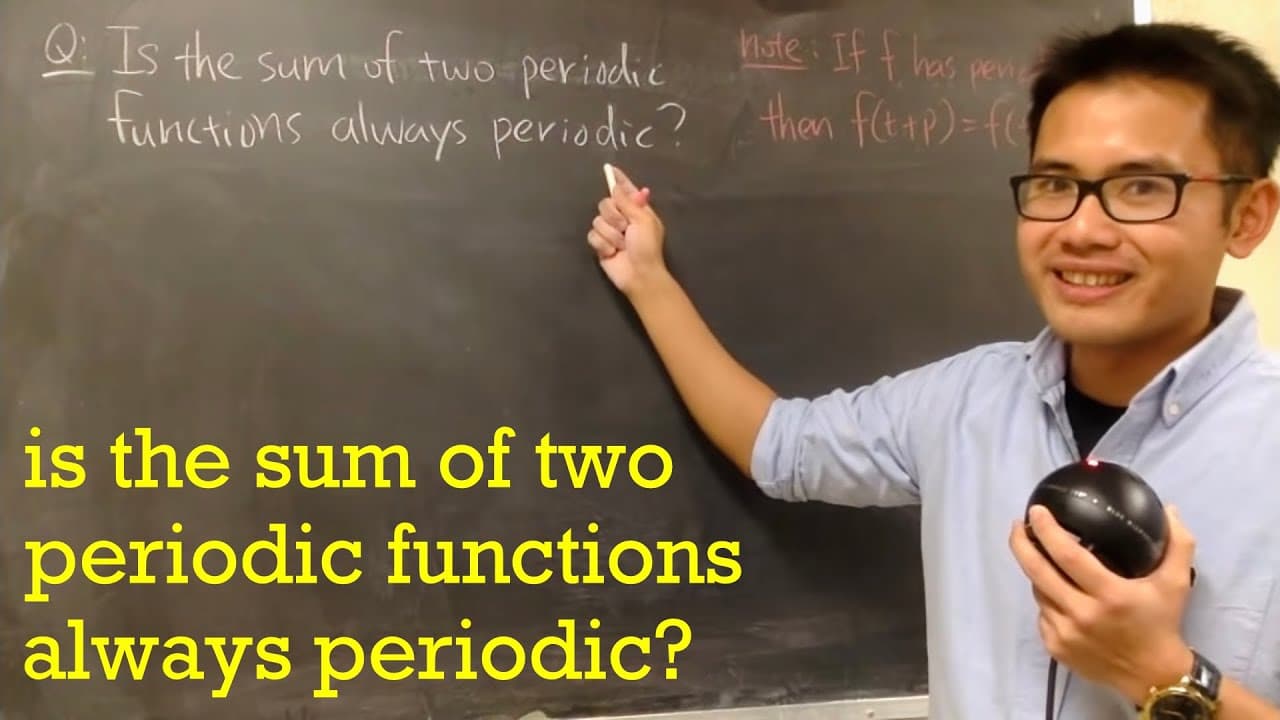
Is the Sum of Two Periodic Functions Periodic?
TL;DR
The sum of two periodic functions is not always periodic; it can fail to be periodic when one function's period involves π while the other's does not. However, if the least common multiples of their periods satisfy a certain condition, their sum can be periodic.
Transcript
okay up this question for you guys is the sum of two periodic functions always periodic and right here this is the open end equation for now right so if you think that the answer to this is yes you will have to provide proof but if you think the answer to this is no you will have to come up with a counter example and it's really interesting if you ... Read More
Key Insights
- 🍹 The sum of two periodic functions is not always periodic; counter examples exist.
- 🍹 If one function has a period involving π and the other does not, their sum will not be periodic.
- 😃 The period of a periodic function can be found by dividing 2π by the coefficient of T in the function.
- 🍹 The sum of two periodic functions can be periodic if certain integer multiples of their periods satisfy a specific equation.
- 😥 The least common multiple is used to find when two quantities will meet at the same point again.
- 🏃 In the context of running, the least common multiple is used to find when two runners will meet at the same point again.
- 🍹 After a certain number of periods, the sum of two periodic functions will return to the original state.
Install to Summarize YouTube Videos and Get Transcripts
Explore YouTube Video Summarizer or Get YouTube Transcript Extractor
Questions & Answers
Q: Is the sum of two periodic functions always periodic?
No, the sum of two periodic functions is not always periodic. A counter example is provided where one function has a period of 2π and the other has a period of π, resulting in a non-periodic sum.
Q: How do you determine the period of a periodic function?
To determine the period of a periodic function, divide 2π by the coefficient of T in the function. This gives the length of one period.
Q: Can you find a period for the sum of two periodic functions when it is periodic?
Yes, it is possible to find the period of the sum of two periodic functions when their sum is periodic. By finding integers that satisfy a certain equation, the smallest positive integer multiplied by the first period gives the period of the sum.
Q: How does finding the least common multiple relate to finding when two runners will meet?
Finding the least common multiple is similar to finding the time at which two runners will meet. By using the least common multiple of their individual times, it gives the time after which they will meet at the same point again.
Summary & Key Takeaways
-
The sum of two periodic functions is not always periodic, despite the periods of the individual functions.
-
Using a counter example, it is shown that if one function has a period with a multiple of π and the other function does not, their sum will not be periodic.
-
However, a method is provided to find the period of the sum of two periodic functions when it is periodic.
Read in Other Languages (beta)
Share This Summary 📚
Summarize YouTube Videos and Get Video Transcripts with 1-Click
Try YouTube Summary with ChatGPT & Claude or YouTube Transcript Generator
Explore More Summaries from blackpenredpen 📚
Summarize YouTube Videos and Get Video Transcripts with 1-Click
Try YouTube Summary with ChatGPT & Claude or YouTube Transcript Generator