Deep-sea mining - 6 Minute English
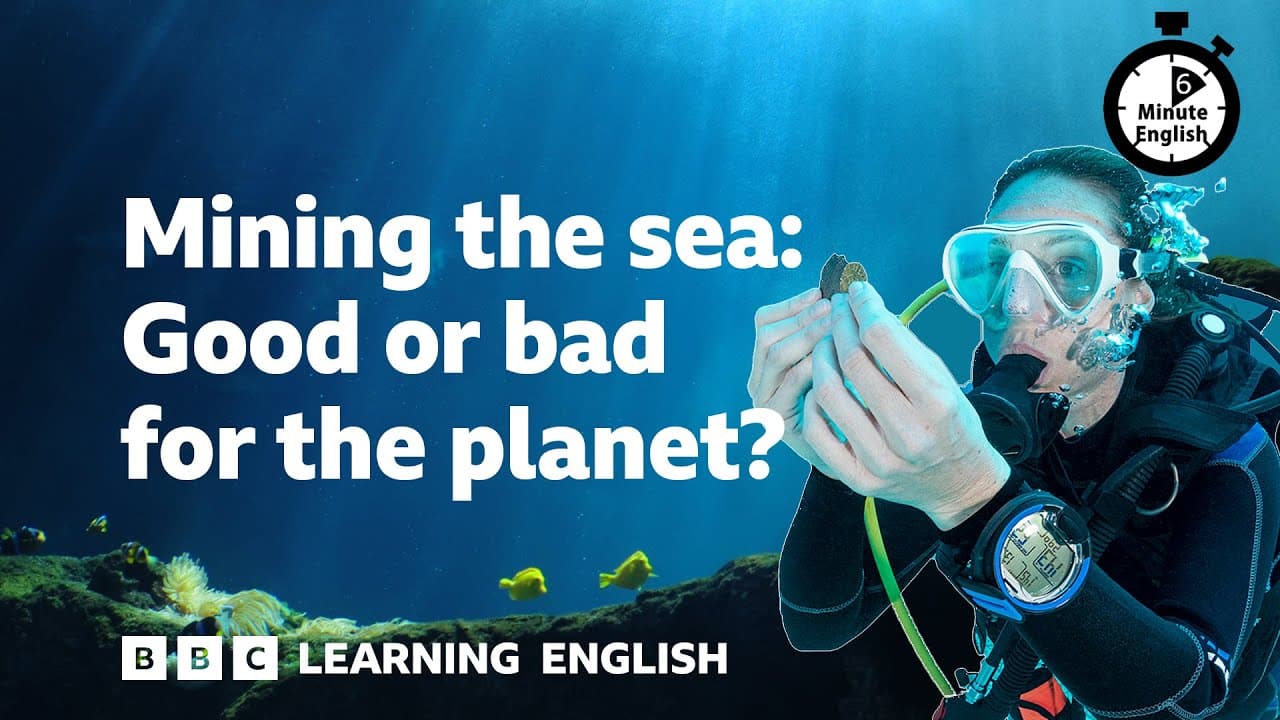
TL;DR
Deep-sea mining could harm ocean ecosystems despite aiding green technology.
Transcript
Hello. This is 6 Minute English from BBC Learning English. I’m Neil. And I’m Sam. Here at Six Minute English, we often discuss the new inventions and ideas scientists dream up to fight climate change – technologies like geo-engineering which could reduce global warming by reflecting sunlight back into space. Often these ideas are controversial beca... Read More
Key Insights
- Deep-sea mining involves extracting metals like copper and nickel from ocean floors, essential for green technologies such as electric car batteries.
- The practice is controversial due to potential harm to delicate ocean ecosystems, raising concerns among environmentalists and scientists.
- Professor Bramley Murton highlights a paradox: deep-sea mining could provide necessary metals for decarbonization but damage marine environments.
- Helen Scales warns against viewing deep-sea mining as a 'silver bullet' for climate change, fearing it could lead to large-scale environmental damage.
- The concept of a 'slippery slope' is used to describe how initial mining tests might lead to widespread commercial exploitation of ocean resources.
- There are an estimated 700,000 marine species, yet only 226,000 have been identified, emphasizing the vast biodiversity at risk.
- The need for metals is driven by projected increases in electric car ownership and renewable energy, complicating the environmental impact debate.
- The program introduces vocabulary related to complex problems, like 'conundrum' and 'paradox', to explain the deep-sea mining dilemma.
Install to Summarize YouTube Videos and Get Transcripts
Explore YouTube Video Summarizer or Get YouTube Transcript Extractor
Questions & Answers
Q: What is deep-sea mining and why is it considered controversial?
Deep-sea mining involves extracting metals like copper, nickel, and cobalt from the ocean floor, which are crucial for green technologies. It is controversial because, while it promises to supply essential materials for decarbonization, it also poses significant risks to fragile marine ecosystems, potentially causing irreversible environmental damage.
Q: Why does Professor Bramley Murton refer to deep-sea mining as a paradox?
Professor Murton describes deep-sea mining as a paradox because it presents a situation where the need to obtain metals for decarbonizing the planet conflicts with the potential harm to marine environments. The paradox lies in the simultaneous necessity and risk of mining, as it could aid climate goals but damage ocean biodiversity.
Q: What concerns does Helen Scales have about deep-sea mining?
Helen Scales is concerned that deep-sea mining is perceived as a 'silver bullet' for climate change, offering a simple solution to a complex problem. She warns that this perception could lead to large-scale mining operations, which might irreparably harm marine ecosystems and biodiversity, emphasizing the need for cautious evaluation.
Q: How does the concept of a 'slippery slope' apply to deep-sea mining?
The 'slippery slope' concept applies to deep-sea mining as initial small-scale tests might pave the way for extensive commercial mining. This progression could lead to escalating environmental damage, making it difficult to halt the exploitation of ocean resources once it begins, posing long-term risks to marine life.
Q: What role do metals from deep-sea mining play in green technology?
Metals extracted from deep-sea mining, such as copper, nickel, and cobalt, are vital for green technologies, including electric car batteries and renewable energy systems. As demand for these technologies grows, so does the need for these metals, complicating the balance between environmental conservation and technological advancement.
Q: How many marine species are estimated to exist, and what does this imply?
There are estimated to be around 700,000 marine species, but only about 226,000 have been identified. This vast, largely unexplored biodiversity highlights the potential impact of deep-sea mining on unknown species and ecosystems, underscoring the importance of cautious and informed decision-making in marine resource management.
Q: What does the term 'silver bullet' mean in the context of the discussion?
In this context, 'silver bullet' refers to the mistaken belief that deep-sea mining offers a simple, immediate solution to the climate crisis. It suggests that mining could quickly address material shortages for green technology, ignoring the complex environmental and ethical considerations involved in such an approach.
Q: What vocabulary does the program introduce to explain the deep-sea mining issue?
The program introduces vocabulary like 'conundrum' and 'paradox' to describe the complex challenges of deep-sea mining. 'Conundrum' refers to a difficult problem, while 'paradox' highlights the contradictory nature of mining's benefits and risks. These terms help articulate the nuanced debate surrounding environmental and technological priorities.
Summary & Key Takeaways
-
Deep-sea mining is proposed as a way to obtain metals needed for green technologies, but it risks damaging ocean ecosystems. The debate involves weighing the benefits of decarbonization against potential environmental harm, with experts divided on the issue's impact.
-
Professor Murton sees deep-sea mining as a necessary step for decarbonization, despite the environmental risks. He describes the situation as a paradox where the need for metals conflicts with marine conservation efforts, highlighting the complexity of addressing climate change.
-
Helen Scales argues that deep-sea mining is mistakenly viewed as a quick fix for climate issues, warning it could lead to large-scale environmental damage. She emphasizes the importance of considering long-term impacts over immediate solutions, advocating for cautious exploration.
Read in Other Languages (beta)
Share This Summary 📚
Summarize YouTube Videos and Get Video Transcripts with 1-Click
Try YouTube Summary with ChatGPT & Claude or YouTube Transcript Generator
Explore More Summaries from BBC Learning English 📚

Summarize YouTube Videos and Get Video Transcripts with 1-Click
Try YouTube Summary with ChatGPT & Claude or YouTube Transcript Generator