L22.5 The Mean and Variance of the Number of Arrivals
TL;DR
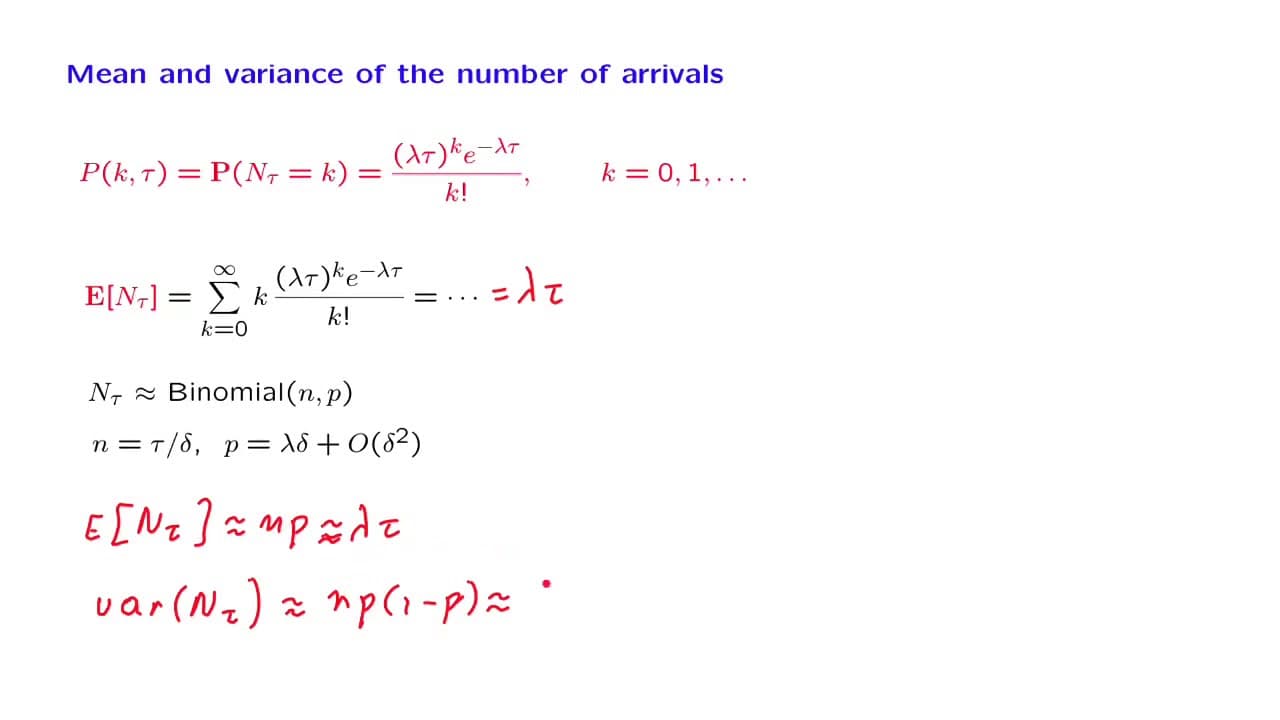
The mean number of arrivals in a Poisson process is equal to lambda times tau, while the variance is also lambda times tau.
Transcript
Now that we have in our hands the PMF of the random variable N tau, which is the number of arrivals during an interval of length tau, we can go ahead and try to calculate the mean and variance of this quantity. Regarding the mean, we could use just the definition of the expected value and then carry out of this calculation, which is not too hard. A... Read More
Key Insights
- 🍆 The expected value of the number of arrivals in a Poisson process is lambda times tau.
- 🛩️ The Poisson process can be well approximated by a binomial random variable in the limit of small time intervals.
- 🍆 The variance of the number of arrivals in a Poisson process is also lambda times tau.
- ☠️ The formulas for the mean and variance have intuitive interpretations in terms of the arrival rate and the length of the time interval.
- 🛬 Lambda represents the expected number of arrivals per unit time in a Poisson process.
Install to Summarize YouTube Videos and Get Transcripts
Explore YouTube Video Summarizer or Get YouTube Transcript Extractor
Questions & Answers
Q: What is the formula for the expected value of the number of arrivals in a Poisson process?
The expected value of the number of arrivals in a Poisson process is lambda times tau, where lambda is the arrival rate and tau is the length of the time interval.
Q: How does the binomial approximation help in calculating the expected value of the number of arrivals?
The Poisson process can be approximated by a binomial random variable with n and p parameters, and the expected value of the binomial random variable is n times p. In this case, n times p evaluates to lambda times tau.
Q: What is the formula for the variance of the number of arrivals in a Poisson process?
The variance of the number of arrivals in a Poisson process is also lambda times tau, where lambda is the arrival rate and tau is the length of the time interval.
Q: Why is lambda referred to as the arrival rate or the intensity of the arrival process?
Lambda represents the expected number of arrivals per unit time in a Poisson process. Since it is the expected number of arrivals divided by the length of time, it is a natural interpretation of the arrival rate or intensity.
Summary & Key Takeaways
-
The expected value of the number of arrivals in a Poisson process is lambda times tau, based on a discretization argument and the approximation by a binomial random variable.
-
The variance of the number of arrivals in a Poisson process is also lambda times tau, with a small impact from the approximation of the binomial distribution.
Read in Other Languages (beta)
Share This Summary 📚
Summarize YouTube Videos and Get Video Transcripts with 1-Click
Try YouTube Summary with ChatGPT & Claude or YouTube Transcript Generator
Explore More Summaries from MIT OpenCourseWare 📚



Summarize YouTube Videos and Get Video Transcripts with 1-Click
Try YouTube Summary with ChatGPT & Claude or YouTube Transcript Generator