Disproportionation Reaction
TL;DR
Disproportionate reactions occur when an element undergoes simultaneous oxidation and reduction, resulting in two different oxidation states.
Transcript
click the bell icon to get latest videos from akira elephants in the previous topic we have discussed about the structure of magnet hazardous per magnet iron and now in this topic I am going to talk about the disproportionate reaction so what is this proposition reaction and what are the example involving it this is what I'm going to talk about in ... Read More
Key Insights
- ❓ Disproportionate reactions involve an element undergoing simultaneous oxidation and reduction.
- 💱 The oxidation state of the element changes, resulting in different products with varying oxidation states.
- ❓ Potassium manganate and nitrous acid are examples of compounds that undergo disproportionate reactions.
- 🔉 These reactions occur in aqueous mediums.
- ❓ Disproportionate reactions are characterized by the presence of an oxidizing agent.
- ❓ The oxidizing agent can undergo both oxidation and reduction simultaneously.
- ❓ Understanding disproportionate reactions is important in understanding redox reactions.
Install to Summarize YouTube Videos and Get Transcripts
Explore YouTube Video Summarizer or Get YouTube Transcript Extractor
Questions & Answers
Q: What is a disproportionate reaction in chemistry?
A disproportionate reaction occurs when an element is both oxidized and reduced simultaneously, resulting in two different oxidation states.
Q: Can you give an example of a disproportionate reaction?
One example is the reaction of potassium manganate (MnO4-) in an acidic medium, producing MnO4-, MnO2, and water.
Q: How does the oxidation state of the element change in a disproportionate reaction?
In the example of potassium manganate, the oxidation state of manganese changes from +6 to +7 in MnO4- and to +4 in MnO2, showing simultaneous oxidation and reduction.
Q: Are there any other examples of disproportionate reactions?
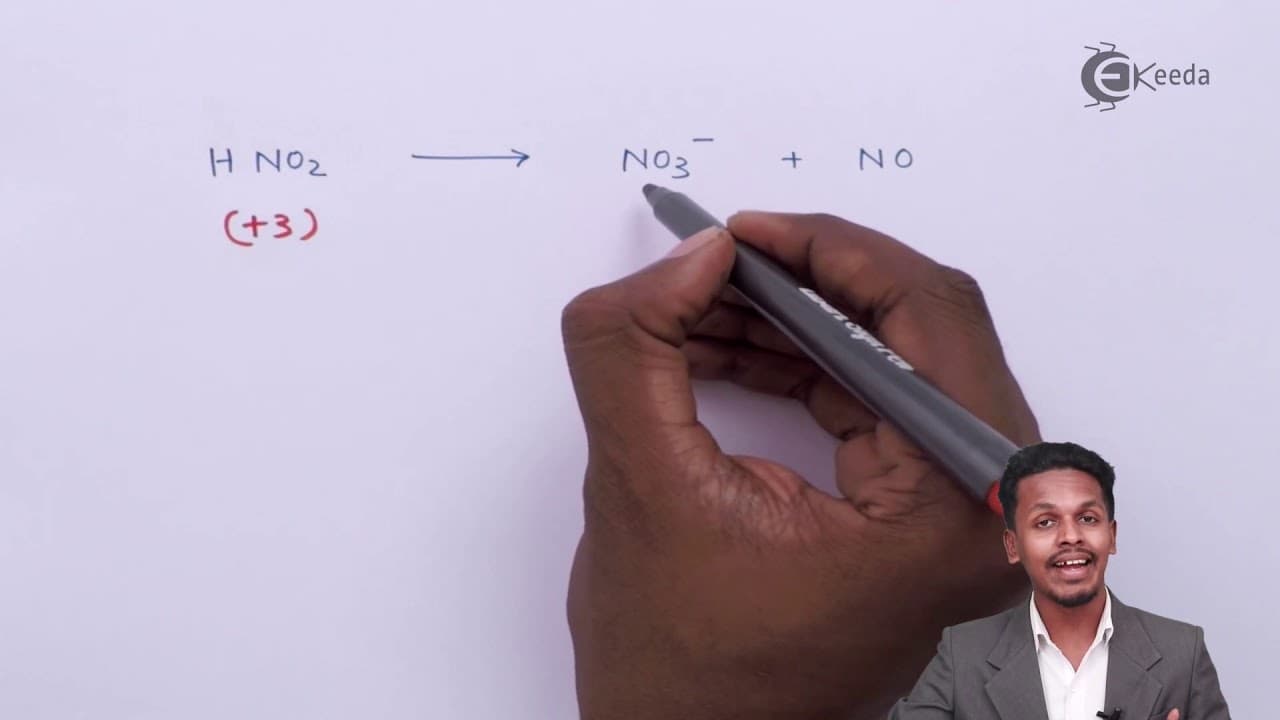
Yes, another example is the reaction of nitrous acid (HNO2), which produces nitrate (NO3-) and nitric oxide (NO), with nitrogen in different oxidation states of +3 and +2, respectively.
Summary & Key Takeaways
-
Disproportionate reactions involve an element in one oxidation state being both oxidized and reduced.
-
Examples include the reaction of potassium manganate (MnO4-) in an acidic medium, resulting in MnO4-, MnO2, and water.
-
Another example is the reaction of nitrous acid (HNO2) to form nitrate (NO3-) and nitric oxide (NO).
Read in Other Languages (beta)
Share This Summary 📚
Summarize YouTube Videos and Get Video Transcripts with 1-Click
Try YouTube Summary with ChatGPT & Claude or YouTube Transcript Generator
Explore More Summaries from Ekeeda 📚





Summarize YouTube Videos and Get Video Transcripts with 1-Click
Try YouTube Summary with ChatGPT & Claude or YouTube Transcript Generator