Exclusive: BACCH Stratos Atmos Processing System Listening Preview
TL;DR
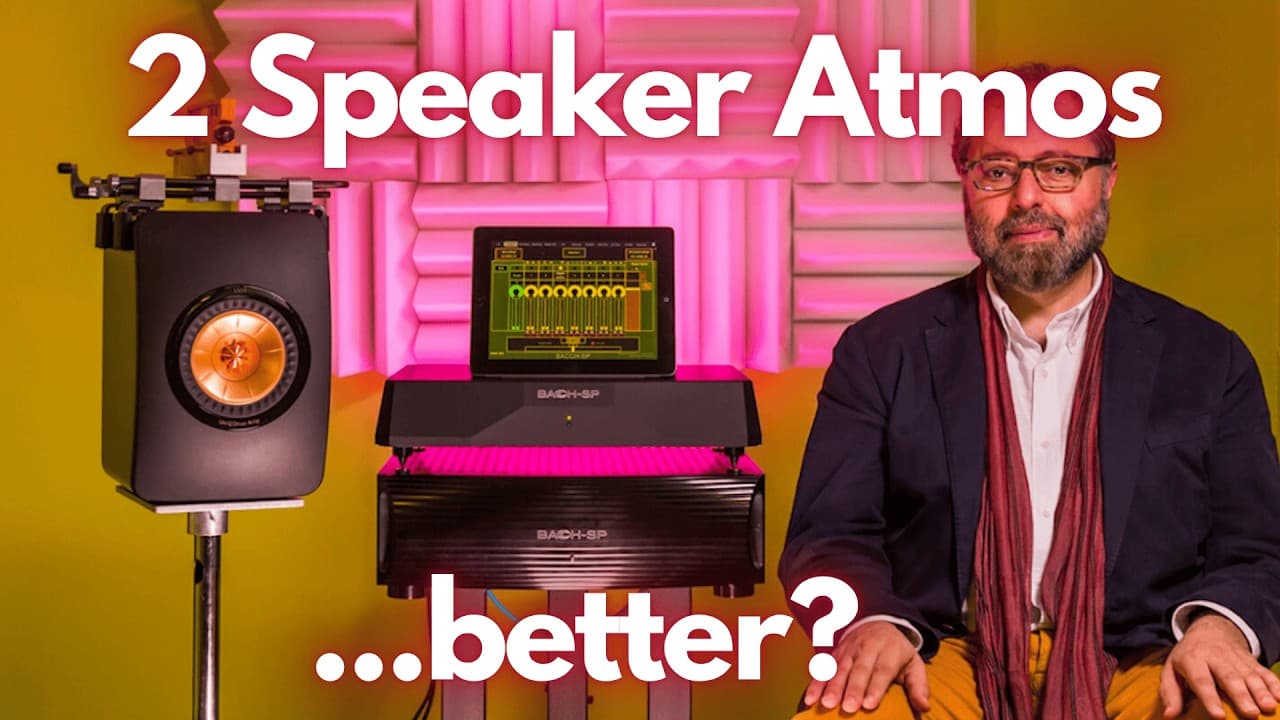
Stratos offers immersive audio with just two speakers.
Transcript
Read and summarize the transcript of this video on Glasp Reader (beta).
Key Insights
- Stratos is a software developed by Theoretica Applied Physics and BACCH Labs aimed at revolutionizing audio experiences by providing immersive sound through two speakers.
- The technology addresses longstanding issues with multi-channel audio systems, such as cost, complexity, and the need for multiple speakers, making it more accessible for home use.
- Stratos employs a unique method using head-related binaural measurements and frequency sweeps to create an immersive audio experience without the need for an anechoic chamber.
- The software has been tested against a traditional 5.1.4 Atmos system, showing comparable results in terms of sound quality and immersive experience.
- Stratos is designed to work with existing audio setups, requiring only a one-time calibration unless significant changes are made to the listening environment.
- The technology allows for adjustments to virtual speaker levels, enhancing the immersive experience and closely mimicking a full Atmos setup.
- Stratos is expected to be transformative for audiophiles, offering a practical and less obtrusive way to enjoy immersive sound in domestic settings.
- The software will be available to Bach for Mac users at $2,000, with an option for Bach SP processor owners to port the software for $3,000.
Install to Summarize YouTube Videos and Get Transcripts
Explore YouTube Video Summarizer or Get YouTube Transcript Extractor
Questions & Answers
Q: What is the main innovation of Stratos?
The main innovation of Stratos is its ability to deliver an immersive audio experience using just two speakers. It achieves this by utilizing head-related binaural measurements and frequency sweeps, which allow it to mimic the sound quality and immersion of a multi-channel audio system without the need for numerous speakers and complex setups.
Q: How does Stratos compare to traditional Atmos systems?
Stratos compares favorably to traditional Atmos systems, offering a similar quality of sound and immersion. While it slightly lags in terms of envelopment, adjustments in virtual speaker levels can bring it to within 10-15% of a full Atmos setup. It provides superior spatial resolution, tonal consistency, and musical detail, making it a viable alternative for audiophiles.
Q: What are the benefits of using Stratos over a multi-channel system?
The benefits of using Stratos over a multi-channel system include reduced complexity and cost, as it eliminates the need for multiple speakers and extensive wiring. It offers an immersive audio experience with just two speakers, making it more accessible and less intrusive in home environments. Additionally, it provides superior sound quality and consistency across the frequency range.
Q: What is required for setting up Stratos in a listening room?
Setting up Stratos in a listening room requires a one-time calibration process using the Stratos software module. This involves a series of acoustic measurements with in-ear microphones and the user's head oriented in different directions. The process is automated and takes about 10 minutes, with no need for an anechoic chamber, making it user-friendly and efficient.
Q: Who can benefit most from Stratos technology?
Audiophiles and music enthusiasts who seek high-quality, immersive sound experiences without the complexity and cost of traditional multi-channel systems can benefit most from Stratos technology. It offers a practical and less obtrusive solution for those who want to enjoy immersive audio in a domestic setting, making it appealing to a broader audience.
Q: What are the potential limitations of Stratos?
Potential limitations of Stratos include its reliance on a specific setup and calibration process, which may not be suitable for all environments. While it offers impressive sound quality, it may not fully replicate the envelopment of a full Atmos system. Additionally, its effectiveness can vary based on room acoustics and speaker placement, requiring careful setup and adjustments.
Q: How does the Stratos software enhance audio experiences?
The Stratos software enhances audio experiences by employing a unique combination of head-related binaural measurements and frequency sweeps to create a detailed and immersive sound field. It allows users to adjust virtual speaker levels, providing a customizable experience that closely mimics a full Atmos setup, enhancing spatial resolution, tonal consistency, and musical detail.
Q: What is the anticipated cost of Stratos, and who is it available to?
The anticipated cost of Stratos is $2,000 for users of the Bach for Mac software, with setup assistance included. Owners of Theoretica's Bach SP processor can port the software to their device for $3,000. This pricing makes it accessible to audiophiles seeking a high-quality immersive sound experience without the need for extensive hardware investments.
Summary & Key Takeaways
-
Stratos is a groundbreaking software from Theoretica Applied Physics and BACCH Labs that promises to deliver an immersive audio experience using just two speakers. It addresses the complexity and cost issues associated with multi-channel audio systems, making high-quality sound more accessible to audiophiles.
-
The technology utilizes head-related binaural measurements and frequency sweeps, eliminating the need for an anechoic chamber. Tested against a traditional Atmos system, Stratos offers comparable sound quality and immersion, with the added benefit of being less intrusive in a home setting.
-
Available to Bach for Mac users at $2,000, Stratos is poised to transform the way audiophiles experience sound. It provides a practical solution for those seeking an immersive audio experience without the need for multiple speakers and complex setups.
Read in Other Languages (beta)
Share This Summary 📚
Summarize YouTube Videos and Get Video Transcripts with 1-Click
Try YouTube Summary with ChatGPT & Claude or YouTube Transcript Generator