How to Use the DI Method for Integration by Parts
TL;DR
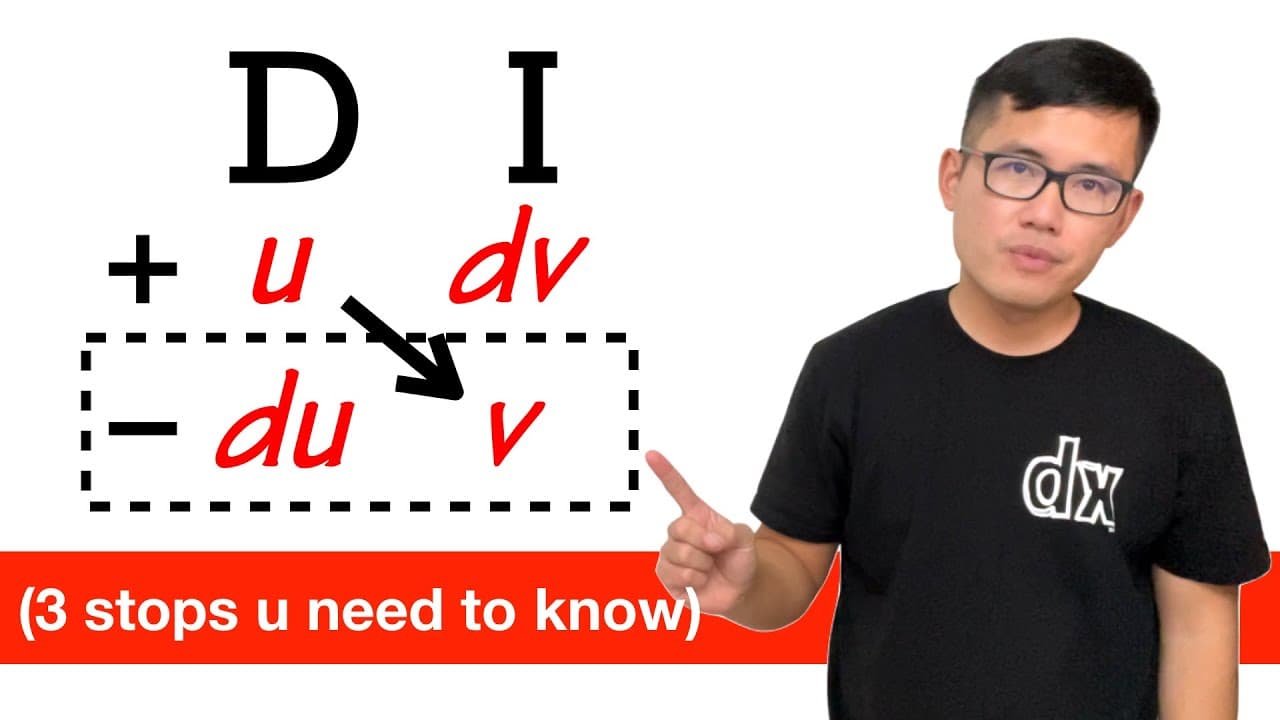
The DI method simplifies integration by parts by dividing the integral into two parts: one to differentiate and one to integrate. You stop when the function part in a row repeats, allowing you to easily construct the answer using the product of the diagonals and the associated signs.
Transcript
I'm going to show you guys the easiest way to do integration by parts so check this out this is the D I method so here's my first example we have the integral X to a second power times sine of 3x we all unfortunately use substitution wouldn't work because if we let u equals two inside function 3x the derivative dies just as three we cannot... Read More
Key Insights
- 🥳 The DI method involves breaking down the integral into two parts: one to differentiate and one to integrate.
- 🫤 The product of the diagonals along with the sign on the side gives the first part of the answer.
- 👻 The DI method allows for easier integration of complex functions.
- ❓ It is important to choose the part to integrate and differentiate wisely for a smoother integration process.
- ❓ The DI method can be used for integrals involving trigonometric, exponential, and logarithmic functions.
- 🥳 Repeating function parts in the DI table indicate when to stop the integration process.
- 🫤 The answer to the integral is obtained by multiplying the product of the diagonals.
- 🙃 Adding the integral on both sides of the equation cancels out the extra terms.
Install to Summarize YouTube Videos and Get Transcripts
Explore YouTube Video Summarizer or Get YouTube Transcript Extractor
Questions & Answers
Q: What is the DI method used for in integration by parts?
The DI method is used to break down the original integral into two parts: one to differentiate and one to integrate, making the integration process easier.
Q: How do we determine which part to integrate and differentiate in the DI method?
Generally, we choose the part that we can easily integrate to be differentiated and the part that is harder to integrate to be integrated.
Q: What are the key steps in the DI method?
The key steps in the DI method include differentiating one part of the function, integrating the other part, constructing the answer using the product of the diagonals, and stopping when the function part repeats.
Q: Can the DI method be applied to all types of integrals?
Yes, the DI method can be applied to various types of integrals, including those involving trigonometric functions, logarithmic functions, and exponential functions.
Summary & Key Takeaways
-
The DI method involves breaking down the original integral into two parts: one to differentiate and one to integrate.
-
The product of the diagonals along with the sign on the side gives the first part of the answer.
-
When a row in the table repeats the function part, the integration stops, and the answer can be constructed.
Read in Other Languages (beta)
Share This Summary 📚
Summarize YouTube Videos and Get Video Transcripts with 1-Click
Try YouTube Summary with ChatGPT & Claude or YouTube Transcript Generator
Explore More Summaries from blackpenredpen 📚
Summarize YouTube Videos and Get Video Transcripts with 1-Click
Try YouTube Summary with ChatGPT & Claude or YouTube Transcript Generator