Circular wave guide | Problems | Microwave Engineering | Lec-42
TL;DR
A step-by-step guide to calculating key parameters of circular waveguides and resonant frequencies.
Transcript
hi everyone in this video let us see some problems on this circular waveguide so first problem is going to be on a dominant mode of the circle waveguide so in the case of dominant mode so the first problem is on dominant mode is on dominant mode so an air filled circular waveguide and Airfield circular wave guide with a is equal to 2.5 centimeters ... Read More
Key Insights
- 📡 The dominant mode TE11 is critical for maximum signal transmission efficiency in circular waveguides.
- 🧑🏭 The cutoff frequency acts as a threshold for signal propagation within waveguides, where frequencies below it are unable to transmit.
- 👋 Guide wavelength (Lambda G) calculation is essential for understanding electromagnetic wave behavior in waveguides.
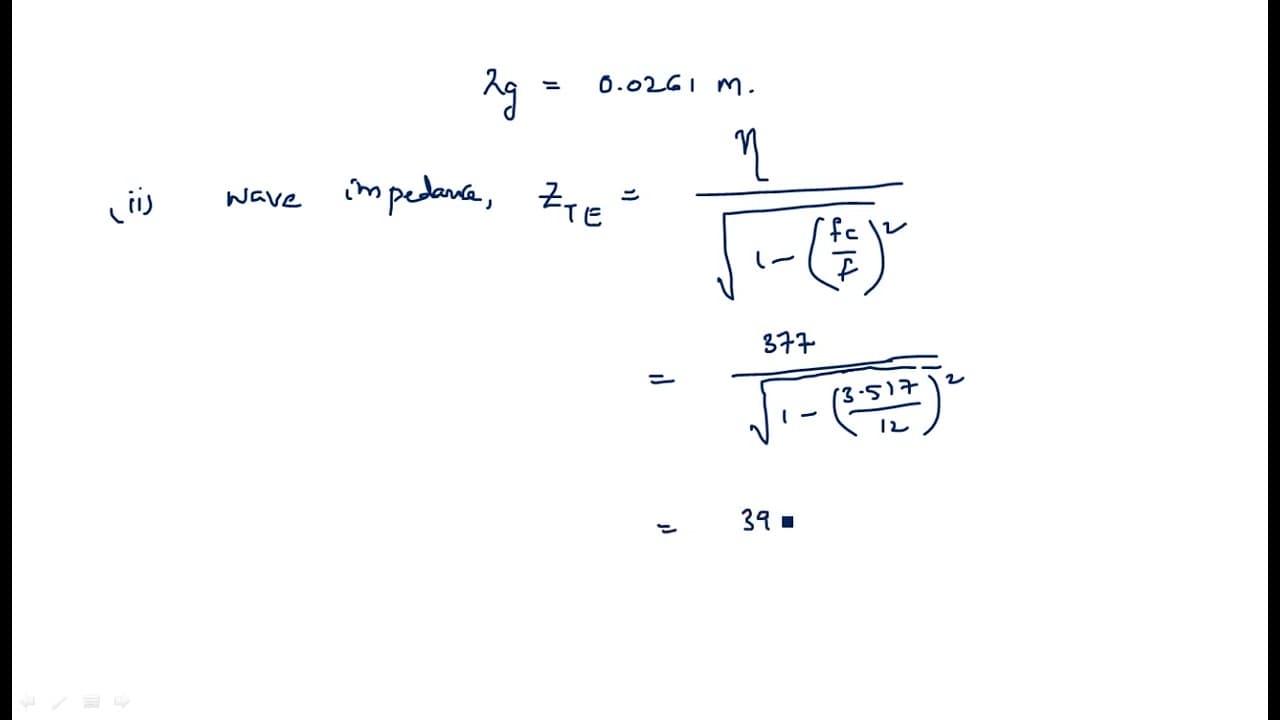
- 👋 Wave impedance values vary based on the dominant mode, affecting the transmission of signals.
- 🎨 Resonant frequencies in rectangular waveguides are determined using specific dimensions, highlighting a systematic approach to waveguide design.
- 😘 Identifying the three lowest resonating frequencies is important for designing effective resonators in microwave engineering applications.
- 🇦🇪 Accurate calculations rely on using standardized units, ensuring uniformity across waveguide parameters for reliable performance.
Install to Summarize YouTube Videos and Get Transcripts
Explore YouTube Video Summarizer or Get YouTube Transcript Extractor
Questions & Answers
Q: What is the dominant mode in a circular waveguide, and why is it significant?
The dominant mode in a circular waveguide is TE11, which is significant because it is the lowest order mode, enabling the most efficient transmission of electromagnetic waves through the waveguide. This mode's characteristics must be understood to calculate crucial parameters like cutoff frequency, guide wavelength, and wave impedance effectively.
Q: How do you compute the cutoff frequency for a circular waveguide?
The cutoff frequency for a circular waveguide can be computed using the formula C*(p'(NM))/2πa, where C is the speed of light, p'(NM) is a specific value for the dominant mode (TE11 has a value of 2.405), and 'a' is the radius of the waveguide. This frequency determines whether a signal can propagate through the waveguide.
Q: What is the formula for calculating the guide wavelength (Lambda G) in waveguides?
The guide wavelength (Lambda G) can be calculated using the formula Lambda G = Lambda_0 / sqrt(1 - (FC/F)^2), where Lambda_0 is the wavelength in free space, FC is the cutoff frequency, and F is the operating frequency. This formula helps determine how the wave propagates within the waveguide.
Q: Can you describe the relationship between wave impedance and mode in a waveguide?
Wave impedance in a waveguide varies by mode. For the TE11 mode, wave impedance (Z_TE) relates to the intrinsic impedance of free space through the formula Z_TE = 120π/sqrt(1 - (FC/F)^2). Understanding this relationship is crucial for predicting how the wave will behave when interacting with other materials or mediums.
Q: What calculations are involved in finding resonant frequencies in a rectangular waveguide?
To calculate resonant frequencies in a rectangular waveguide, one uses the formula FR = C/(2√(M/a)^2 + (N/b)^2 + (P/d)^2), where C is the speed of light, and a, b, and d are the waveguide dimensions. M, N, and P represent the harmonic indices to find specific frequencies for each mode, enabling the identification of the lowest resonating frequencies.
Q: Why is it necessary to convert dimensions into consistent units in waveguide calculations?
It is crucial to convert dimensions into consistent units (e.g., meters or centimeters) to avoid errors in calculations since physical constants and derived values, such as wavelength and frequency, depend on unit consistency. Invalid calculations can lead to incorrect results, impacting the design and functionality of waveguides.
Summary & Key Takeaways
-
The video focuses on solving problems related to circular waveguides, specifically through dominant mode calculations. The parameters discussed include cutoff frequency, guide wavelength, and wave impedance, with numerical examples provided.
-
The dominant mode for the circular waveguide is TE11, and specific equations are used to calculate parameters like the guide wavelength and wave impedance based on the radius and operating frequency.
-
Further analysis includes calculating resonant frequencies for a rectangular waveguide cavity resonator, using specified dimensions and the TE mode, leading to the identification of the three lowest resonating frequencies.
Read in Other Languages (beta)
Share This Summary 📚
Summarize YouTube Videos and Get Video Transcripts with 1-Click
Try YouTube Summary with ChatGPT & Claude or YouTube Transcript Generator