What Ancient Techniques Did Our Ancestors Use for Navigation?
TL;DR
Ancient navigators utilized various techniques to traverse the oceans, including stick charts to depict ocean patterns, the kamal and cross staff for measuring latitude, and the astrolabe for celestial navigation without a visible horizon. Additionally, the magnetic compass aided Chinese explorers, while sunstones potentially helped Vikings locate the sun even when obscured.
Transcript
It's pretty hard to get lost these days, no matter where you are in the world. All you have to do is fire up your favorite navigation app and you're good. Even ships in the middle of the ocean have GPS. But back before all that technology existed, getting lost was a real danger, especially at sea. To the untrained eye, the ocean looks a whole lot l... Read More
Key Insights
- 🍁 Stick charts were used by Marshalees for navigation, depicting ocean patterns and behaviors instead of geographical maps.
- 🚥 The kamal, a simple wooden and string device, helped sailors determine latitude by aligning it with Polaris and the horizon.
- 😵 European sailors used the cross staff, similar to the kamal, to measure latitude using the sun or Polaris.
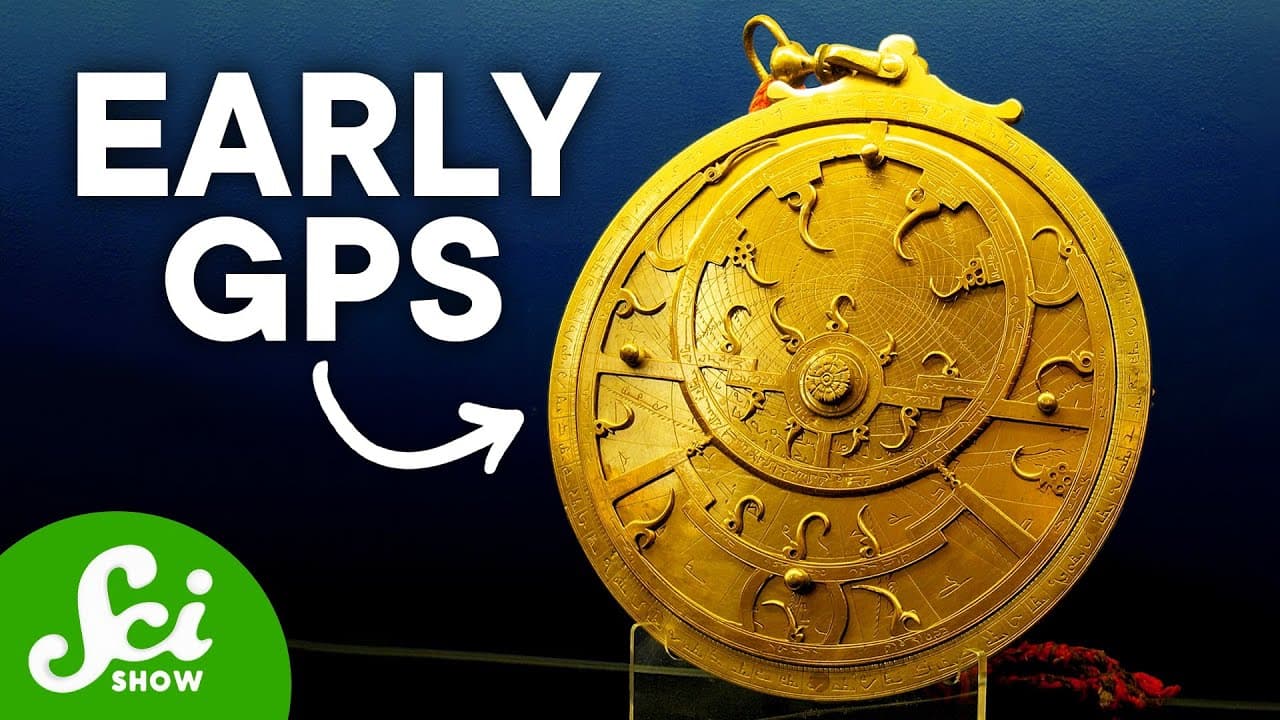
- 🫥 The astrolabe allowed sailors to measure latitude without a visible horizon, making it useful in foggy or dark conditions.
- 🧭 Magnetic compasses were essential for Chinese navigator Zheng He during his expeditions.
- 🔮 The existence of sunstones, possibly calcite crystals, as Viking navigational tools has been supported by experiments.
- 🖐️ These ancient navigational techniques played a crucial role in maritime exploration and trade.
Install to Summarize YouTube Videos and Get Transcripts
Explore YouTube Video Summarizer or Get YouTube Transcript Extractor
Questions & Answers
Q: How did the Marshalees use stick charts for navigation?
Stick charts were not actual maps but depicted ocean swells and patterns, guiding navigators in their travels between islands. Small shells marked islands, and navigators memorized the information before setting out on voyages.
Q: How did sailors use the kamal to determine latitude?
By aligning the kamal with Polaris and the horizon, sailors measured the angle between them. The distance from their face to the kamal helped them determine their latitude.
Q: What was the advantage of using the astrolabe for navigation?
Unlike the kamal and cross staff, the astrolabe did not require a visible horizon. It used the sun or stars as references to measure altitude, allowing for navigation even in foggy or dark conditions.
Q: How did the magnetic compass aid navigation during Zheng He's expeditions?
The compass, made with a magnetized needle, aligned with the Earth's magnetic field, indicating the north-south direction. Zheng He's fleet utilized it to navigate across the oceans.
Summary & Key Takeaways
-
The Marshalees on the Marshall Islands used stick charts to navigate the Pacific Ocean, which depicted ocean patterns and swells instead of geographical maps.
-
Arab explorers used the kamal, a simple device made of wood and string, to determine latitude by aligning it with Polaris and the horizon.
-
European sailors adopted the cross staff, a device similar to the kamal, to measure latitude by aligning it with the sun or Polaris.
-
The astrolabe, a more advanced version of the kamal and cross staff, enabled sailors to measure latitude without the need for a visible horizon.
-
Chinese navigator Zheng He used the magnetic compass, an ancient Chinese invention, for navigation during his expeditions.
-
The existence of sunstones, believed to be ancient Viking navigational tools that could determine the direction of the sun, has been supported by recent experiments.
Read in Other Languages (beta)
Share This Summary 📚
Summarize YouTube Videos and Get Video Transcripts with 1-Click
Try YouTube Summary with ChatGPT & Claude or YouTube Transcript Generator
Explore More Summaries from SciShow 📚


Summarize YouTube Videos and Get Video Transcripts with 1-Click
Try YouTube Summary with ChatGPT & Claude or YouTube Transcript Generator