How to Use All 4 Present Tenses in English
TL;DR
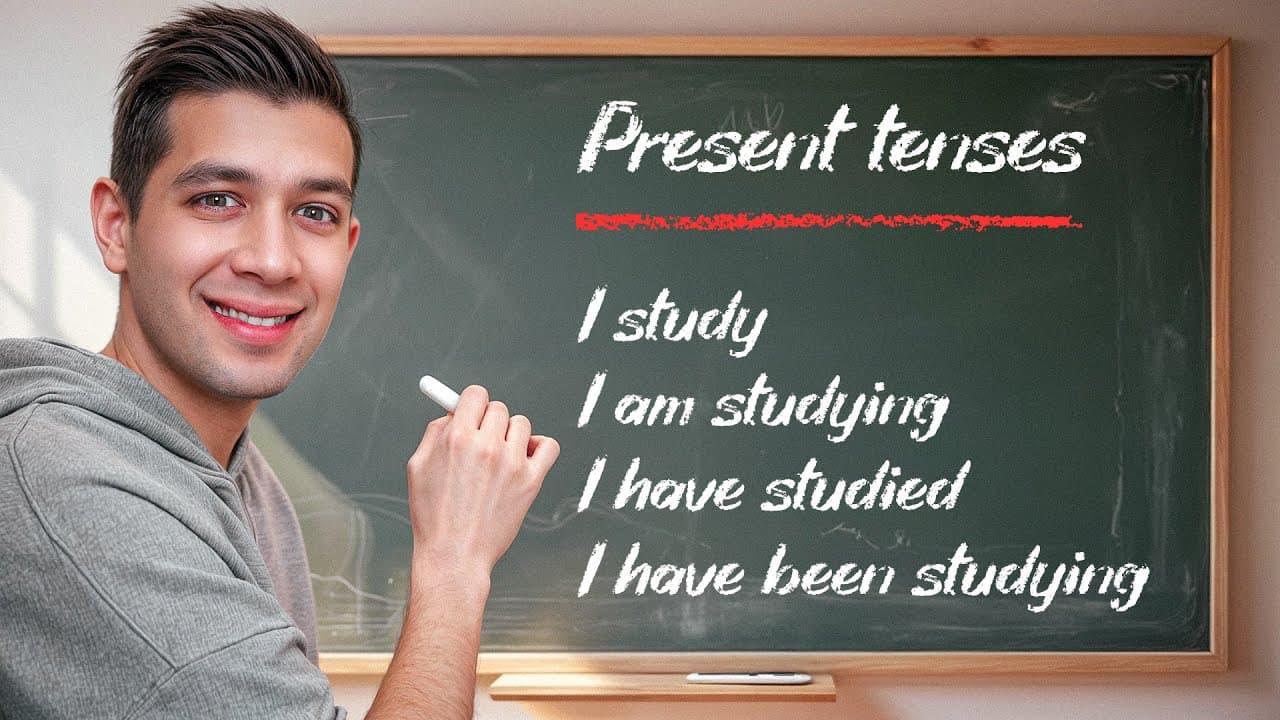
The four present tenses in English are present simple, present continuous, present perfect, and present perfect continuous. Present simple describes general facts and habits, while present continuous is for ongoing actions. Present perfect connects past actions to the present, and present perfect continuous describes actions that began in the past and continue now.
Transcript
hello i wake up at 8:00 a.m every morning right now I'm drinking my cup of coffee i've answered many emails this morning i've been working on my new lesson since 9:00 a.m what do all these four sentences have in common all of them are in the present tense present simple present continuous present perfect and present perfect continuous in English te... Read More
Key Insights
- Present simple is used for facts, habits, hobbies, and schedules. It follows the formula: subject + verb.
- Present continuous describes actions happening right now or around now, and uses: subject + to be verb + verb+ing.
- Present perfect connects past actions to the present, focusing on achievements and experiences without exact time.
- Present perfect continuous is for actions that started in the past and continue now, using: subject + have/has been + verb+ing.
- The present perfect tense does not specify when an action occurred, focusing instead on the action's relevance now.
- Present perfect continuous can also describe actions that have recently stopped but still have visible effects.
- Using 'for' specifies the duration of an action, while 'since' indicates the starting point in present perfect continuous.
- Examples of each tense help illustrate their distinct uses and structures, aiding in comprehension and application.
Install to Summarize YouTube Videos and Get Transcripts
Explore YouTube Video Summarizer or Get YouTube Transcript Extractor
Questions & Answers
Q: How to use present simple tense in English?
The present simple tense is used to describe facts, habits, hobbies, and schedules. It follows the structure: subject + verb. For instance, 'He lives in Los Angeles' is a fact, and 'He drinks coffee every morning' indicates a habit. This tense is the most common in English and is essential for expressing regular actions.
Q: What is the purpose of the present continuous tense?
The present continuous tense is used to describe actions that are happening right now or around the current time. It follows the structure: subject + to be verb + verb+ing. For example, 'He is filming a new movie right now' shows an ongoing action, while 'He is working on several projects this year' indicates actions around the present.
Q: When should you use the present perfect tense?
The present perfect tense is used to connect past actions or events to the present, often highlighting achievements or experiences. It follows the structure: subject + have/has + past participle. For example, 'He has won an Oscar' shows a past achievement that remains relevant. This tense does not specify exact times, focusing on ongoing relevance.
Q: How does present perfect continuous tense function?
Present perfect continuous tense describes actions that began in the past and continue into the present. It uses the structure: subject + have/has been + verb+ing. For instance, 'He has been acting for over 30 years' indicates a long-term activity. This tense can also show actions that recently stopped but have present effects, like 'He has been filming all week'.
Q: What is the difference between 'for' and 'since' in present perfect continuous?
In present perfect continuous tense, 'for' is used to specify the duration of an action, such as 'He has been acting for over 30 years'. 'Since' indicates the starting point of the action, like 'He has been acting since he was a teenager'. Both terms help clarify the time frame of ongoing actions.
Q: Why is present perfect tense used without specifying time?
Present perfect tense focuses on the relevance of past actions to the present rather than the exact time they occurred. This is because it highlights achievements and experiences that have ongoing significance. For example, saying 'He has won an Oscar' emphasizes the achievement itself, not when it happened, maintaining its present relevance.
Q: How are pictures described using present continuous tense?
Present continuous tense is used to describe ongoing actions in pictures. The structure is subject + to be verb + verb+ing. For example, 'In this picture, he is wearing a black jacket' describes an action captured in the image. This use of present continuous helps convey what is happening at the moment the picture was taken.
Q: What are common mistakes with present perfect tense?
A common mistake with present perfect tense is using it with specific time expressions, which is incorrect. This tense should not specify when an action occurred, as its purpose is to connect past actions to the present. Instead of saying 'He has won an Oscar in 2006', the correct form is 'He has won an Oscar', focusing on the achievement itself.
Summary & Key Takeaways
-
The video explains the four present tenses in English: present simple, present continuous, present perfect, and present perfect continuous. Present simple is used for facts and habits, while present continuous describes ongoing actions. Present perfect links past actions to the present, and present perfect continuous indicates actions that began in the past and continue now.
-
Present simple follows the formula: subject + verb, and is used for facts, habits, and schedules. Present continuous uses subject + to be verb + verb+ing for actions happening now or around now. Present perfect, using subject + have/has + past participle, highlights achievements and experiences.
-
Present perfect continuous, structured as subject + have/has been + verb+ing, describes actions that started in the past and are ongoing. It can also show actions that have recently stopped but still have effects. 'For' and 'since' are used to specify time durations and starting points, respectively.
Read in Other Languages (beta)
Share This Summary 📚
Summarize YouTube Videos and Get Video Transcripts with 1-Click
Try YouTube Summary with ChatGPT & Claude or YouTube Transcript Generator
Explore More Summaries from POC English 📚

Summarize YouTube Videos and Get Video Transcripts with 1-Click
Try YouTube Summary with ChatGPT & Claude or YouTube Transcript Generator