Instagram co-founders team up for new startup + Magic Spoon’s Gabi Lewis | E1669
TL;DR
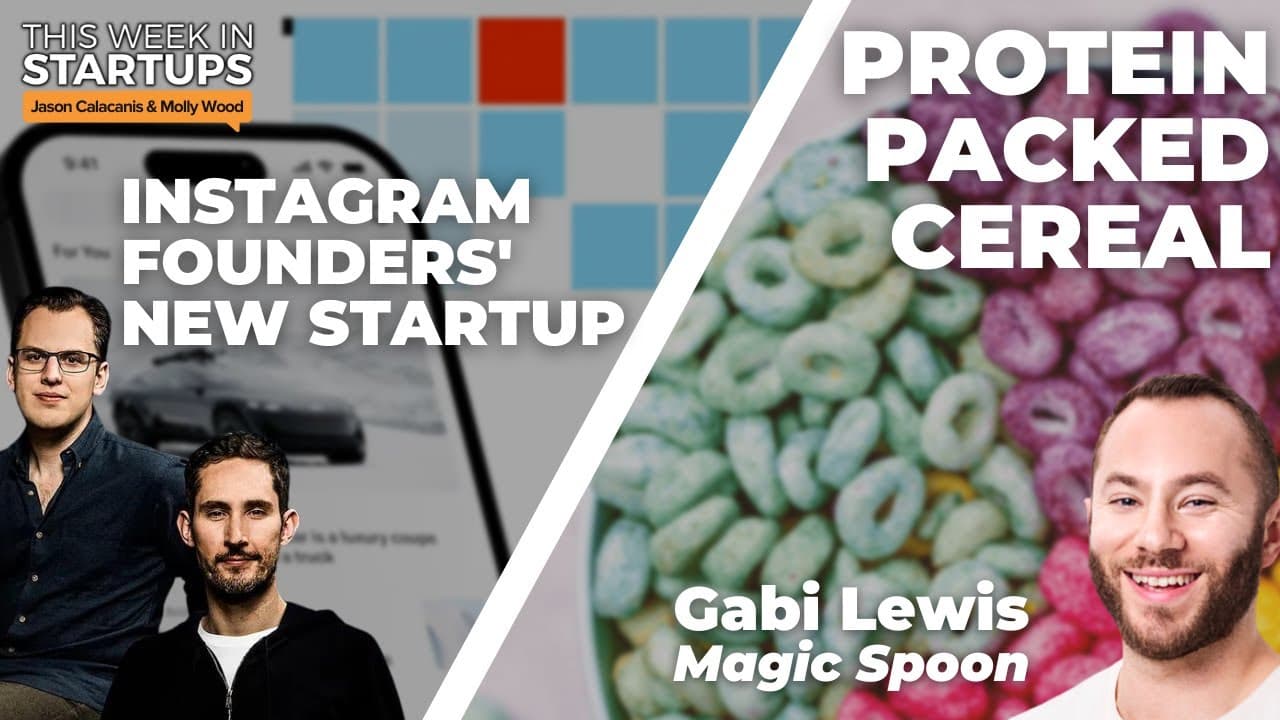
Instagram co-founders launch new social startup called Artifact; Magic Spoon, the protein-packed cereal brand, expands into big-box retail stores, experiencing rapid growth in a short period.
Transcript
hey everybody welcome to this week in startups you're going to understand this in a minute but I pretty much had to kick Jason out so I could get through the intro without us offending anybody or just at all it's gonna be a great show today first of all Jason and I will break down a little bit of news the original Instagram co-founders are back and... Read More
Key Insights
- 🏪 Magic Spoon's entry into major retail stores showcases the demand for healthier cereal alternatives in the market.
- 👾 The company's success in the d2c space has paved the way for expansion into brick-and-mortar retail, leveraging its online marketing and customer insights.
- 😘 Magic Spoon's high protein, low carb offerings cater to health-conscious consumers seeking nutritious breakfast options without sacrificing taste.
- 🎙️ The brand's endorsement strategy, which includes partnerships with celebrities, influencers, and podcasts, has been instrumental in customer acquisition.
Install to Summarize YouTube Videos and Get Transcripts
Explore YouTube Video Summarizer or Get YouTube Transcript Extractor
Questions & Answers
Q: How has Magic Spoon positioned itself in the cereal market?
Magic Spoon offers high protein, low carb alternatives to traditional cereals, focusing on creating flavors reminiscent of childhood favorites. The brand targets health-conscious consumers looking to enjoy cereal without the negative nutritional impact.
Q: What has been the impact of entering the retail market for Magic Spoon?
The company's expansion into major retail stores, including Target, Walmart, and Kroger, has driven significant growth. Within six months, Magic Spoon went from being exclusively available online to having a presence in nearly 7,000 stores. The brand's robust d2c business has contributed to its success in retail.
Q: How has Magic Spoon navigated the challenges of the Apple privacy changes?
Magic Spoon has not been heavily reliant on paid social channels like Facebook, which has mitigated the impact of the Apple privacy changes compared to other brands. The company has diversified its acquisition channels, focusing on endorsement from influencers, podcasts, TV, and other platforms to drive customer acquisition.
Q: What other marketing strategies does Magic Spoon employ?
In addition to endorsement from influencers and celebrities, Magic Spoon uses alternative channels such as linear TV, radio, and direct mail. The company takes a multi-channel approach to marketing, avoiding over-reliance on any single platform or strategy.
Summary
In this episode of "This Week in Startups," the hosts discuss the return of the original Instagram co-founders and their new Social startup called artifact. They also touch on the current state of the information economy and the challenges of curating news content. The conversation then takes a turn to the dangers of extreme content and the impact of content moderation. The hosts also discuss the potential monetization strategies for the new news app and the need for algorithmic curation.
Questions & Answers
Q: Who are the original Instagram co-founders and what is their new startup called?
The original Instagram co-founders are Mike Krieger and Kevin Systrom. Their new startup is called artifact, which is a text-based version of TikTok for news articles.
Q: What are the challenges of curating news content and how do these challenges relate to the current state of the information economy?
The challenges of curating news content include issues of bias, accuracy, and algorithmic engagement. In the current information economy, there is a flood of contradictory information, which makes it difficult for consumers to determine what is true and trustworthy. This has led to polarization and the spread of disinformation.
Q: How does the new news app plan to address content moderation and fake news?
The app, artifact, plans to exercise its own judgment about which publishers belong and which don't. They aim to include only publishers who adhere to editorial standards of quality. However, there is still a question of how effective these measures will be in curbing the spread of fake news.
Q: How does the monetization of news aggregators like artifact pose a challenge?
Monetizing news aggregators is challenging because people are generally unwilling to pay for news, and the engagement with ads is typically lower when people are reading news content. This makes it difficult to generate revenue through advertising.
Q: How does extreme content and the dangers of imitation play a role in the conversation?
The hosts discuss the dangers of extreme content, such as shark diving without a cage or climbing buildings without safety equipment. The concern is that these extreme acts can inspire others to do the same, leading to potential harm or even death. There is a fine line between entertainment and dangerous content.
Q: What are the implications of content moderation and the responsibility of platforms?
The discussion raises questions about the role of content moderation and the responsibility of platforms. While content moderation can help filter out harmful or false information, the challenge lies in finding the right balance between allowing free expression and preventing the spread of misinformation or dangerous behavior.
Q: How does the conversation on content moderation relate to the interview conducted on the show?
The hosts reflect on the interview with the Instagram co-founders and note that the discussion did not touch on content moderation or the potential risks associated with their new app. They highlight the need for these tough questions to be addressed in future interviews.
Q: How does the conversation about extreme content tie into the discussion on news aggregators?
The conversation about extreme content brings up the point that news aggregators need to navigate the line between engaging content and responsible content. By providing a curated feed, aggregators have the potential to influence what users consume, which raises concerns about the ethics of promoting extreme or unverified news sources.
Q: How does the current state of the information economy impact the success of a news app like artifact?
The hosts discuss the challenges of entering a saturated market where there have been previous attempts at news reader apps that have not been successful. The success of artifact will rely on its ability to differentiate and provide a compelling value proposition to users who are already inundated with news options.
Q: What are the potential implications of algorithmic curation in the context of news aggregation?
Algorithmic curation has the potential to reinforce echo chambers and create filter bubbles where users only see content that aligns with their existing beliefs. Balancing personalization and presenting diverse perspectives will be crucial for ensuring ethical and accurate news consumption.
Takeaways
The conversation highlights the challenges of curating news content in the current information economy, particularly in relation to polarization, disinformation, and algorithmic engagement. The hosts question the potential success of a news aggregator like artifact, given the saturation of the market and the need for effective content moderation. The discussion also raises concerns about the dangers of extreme content and the responsibility of platforms to prevent harm and misinformation. Overall, the episode emphasizes the complexities and ethical considerations that come with news aggregation and the importance of addressing these issues in the development and promotion of new startups and platforms.
Summary & Key Takeaways
-
Magic Spoon, a healthy alternative to traditional cereal, offers high protein, low carb options that mimic the flavors of childhood favorites.
-
The brand recently expanded into the retail market, entering major stores like Target, Walmart, and Kroger.
-
Magic Spoon's direct-to-consumer (DTC) business has been a major driver of its success, with over 90% of sales coming from online channels.
-
The company has leveraged its online marketing and d2c expertise to fuel growth in the brick-and-mortar retail space.
Read in Other Languages (beta)
Share This Summary 📚
Summarize YouTube Videos and Get Video Transcripts with 1-Click
Try YouTube Summary with ChatGPT & Claude or YouTube Transcript Generator
Explore More Summaries from This Week in Startups 📚






Summarize YouTube Videos and Get Video Transcripts with 1-Click
Try YouTube Summary with ChatGPT & Claude or YouTube Transcript Generator