How Does Dirichlet's Test Prove Convergence of Sums?
TL;DR
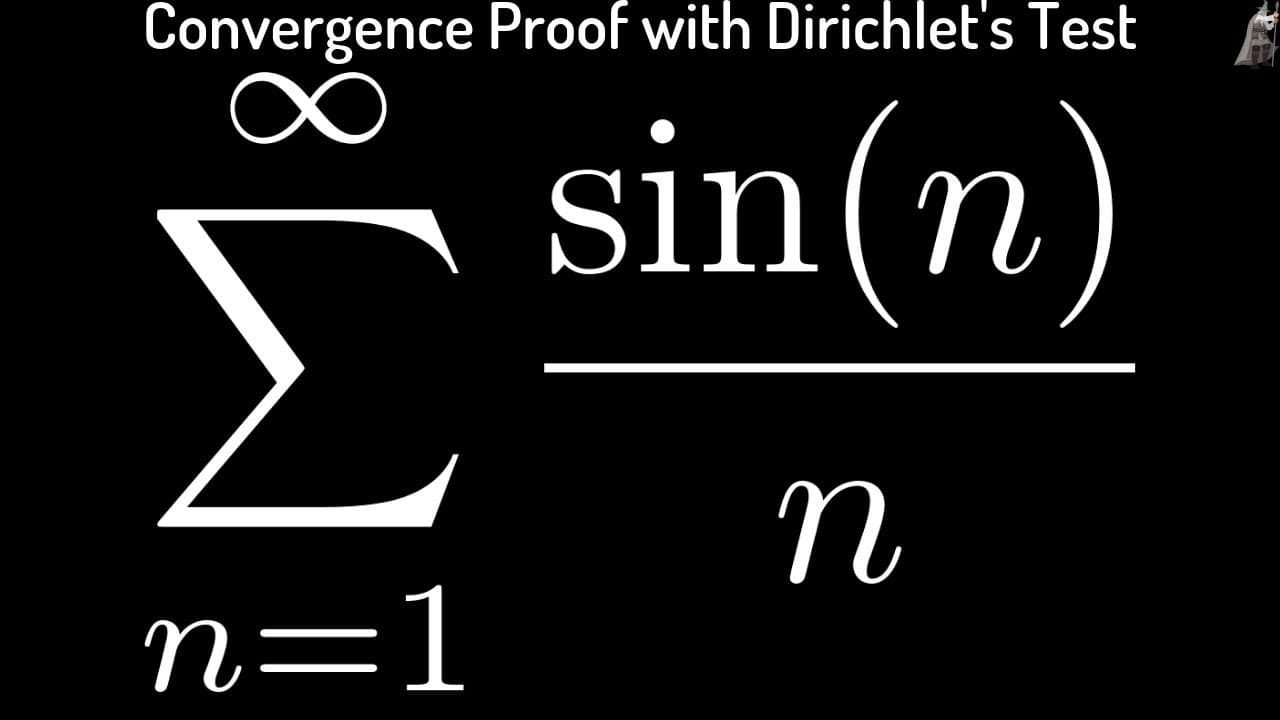
Dirichlet's test proves the convergence of an infinite sum when the sequence converges to zero and decreases steadily, while the finite sum of a related series is bounded. The video specifically shows that the infinite sum of sin(n)/n converges conditionally, utilizing trigonometric identities to demonstrate that the necessary conditions are met.
Transcript
in this video we're going to prove that this infinite sum uh converges to do it we're going to use something called derish lays test so derish lays test so I'm quickly going to State uh the test in case you're not familiar with it so there's two conditions in the test the first one says that if you have a sequence say a subk that it converges to ze... Read More
Key Insights
- 🍹 D'Alembert's test provides a method to determine the convergence of infinite sums by checking two conditions.
- 🍹 The first condition requires that the sequence approaches zero in a decreasing manner, while the second condition involves bounding the finite sum.
- 👍 The proof in the video shows the application of D'Alembert's test to prove convergence of a specific infinite sum.
- 🏆 Trigonometric identities and careful analysis are employed to satisfy the conditions of D'Alembert's test.
- 😒 The use of patterns and cancellation allows for simplification and finding the bound of the finite sum.
- 🍹 The proof concludes that the infinite sum converges, but it does not address whether it converges absolutely or conditionally.
Install to Summarize YouTube Videos and Get Transcripts
Explore YouTube Video Summarizer or Get YouTube Transcript Extractor
Questions & Answers
Q: What is D'Alembert's test and what are its conditions?
D'Alembert's test is a method to determine the convergence of an infinite sum. It has two conditions: the sequence must approach zero in a decreasing manner, and the finite sum must be bounded by a constant.
Q: How is the first condition of D'Alembert's test satisfied in the proof?
The first condition is satisfied by setting the sequence to 1/k, which converges to zero as k approaches infinity. Additionally, the sequence is decreasing.
Q: How is the second condition of D'Alembert's test shown to hold in the proof?
The second condition of boundedness is proven by using trigonometric identities and careful analysis. By manipulating the expression and identifying patterns, the finite sum is shown to be bounded.
Q: Does the proof show that the infinite sum converges absolutely or conditionally?
The proof only demonstrates convergence of the infinite sum. To determine whether it converges absolutely or conditionally, it would be necessary to show that the absolute value of the sum diverges.
Summary & Key Takeaways
-
The video introduces D'Alembert's test, which has two conditions: the sequence must converge to zero in a decreasing way, and the finite sum must be bounded by a constant.
-
The content uses D'Alembert's test to prove that a specific infinite sum converges.
-
The first condition is satisfied by setting the sequence to 1/k and the second condition is shown to hold by using trigonometric identities and careful analysis.
Read in Other Languages (beta)
Share This Summary 📚
Summarize YouTube Videos and Get Video Transcripts with 1-Click
Try YouTube Summary with ChatGPT & Claude or YouTube Transcript Generator
Explore More Summaries from The Math Sorcerer 📚



Summarize YouTube Videos and Get Video Transcripts with 1-Click
Try YouTube Summary with ChatGPT & Claude or YouTube Transcript Generator