What Are Uncoupled and Coupled Basis States in Quantum Mechanics?
TL;DR
Uncoupled basis states are defined by quantum numbers n, l, and m to uniquely describe an electron's state in an atom. Coupled basis states involve adding angular momentum, allowing states to be expressed as eigenstates of total angular momentum. Understanding these concepts is crucial for analyzing the hydrogen atom's spectrum and electron behavior.
Transcript
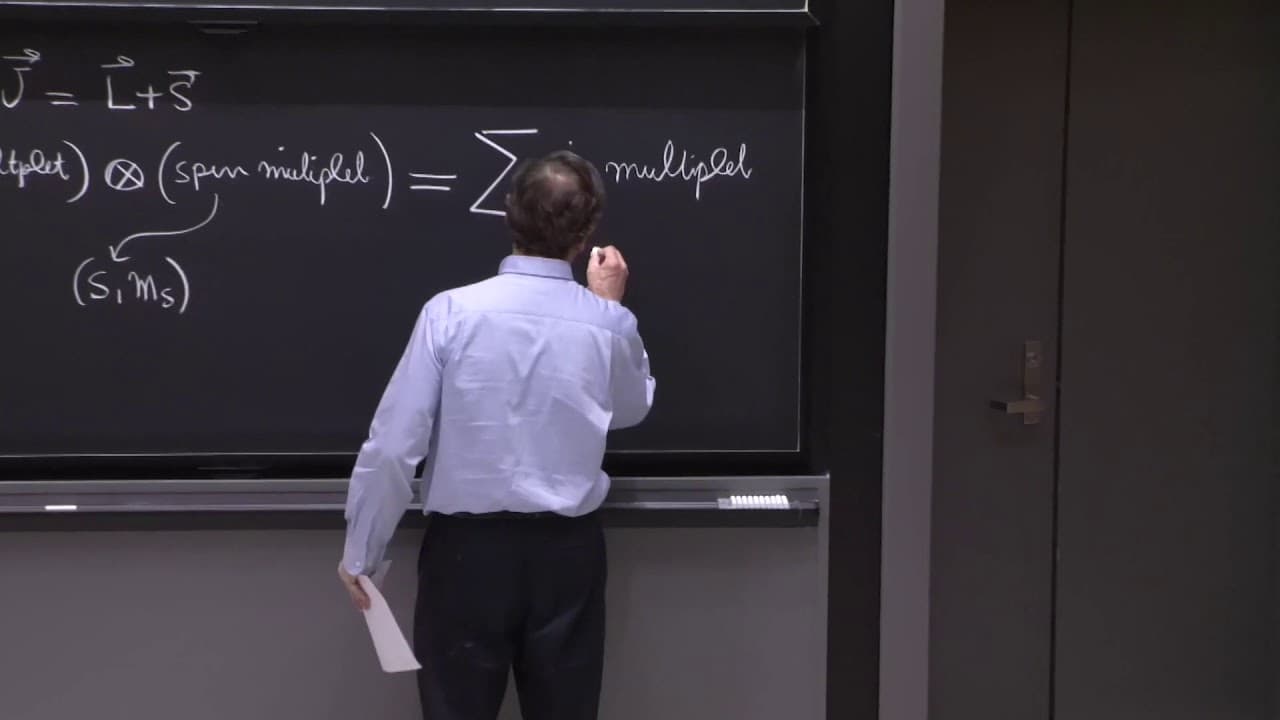
PROFESSOR: OK, so this is the picture you've studied so far. And now we will consider the next thing. So basis states. What's going to happen? We have to deal with basis states. We have electron spin. We have electron angular momentum. What is the total angular momentum? The sum of them. We will have to deal with that. So we will have to deal with ... Read More
Key Insights
- ❓ Basis states are quantum states that uniquely describe the state of an electron.
- 😒 Uncoupled basis states use quantum numbers to specify the position, orbital angular momentum, and spin of an electron.
- 📐 Coupled basis states involve adding angular momentum and expressing states as eigenstates of total angular momentum.
- 📐 Electron spin is always 1/2, while orbital angular momentum (l) can take different values.
Install to Summarize YouTube Videos and Get Transcripts
Explore YouTube Video Summarizer or Get YouTube Transcript Extractor
Questions & Answers
Q: What are basis states and why are they important in the hydrogen atom?
Basis states are quantum states that uniquely describe the state of an electron in the hydrogen atom. They are important because they allow us to understand and manipulate the properties of electrons, such as angular momentum and spin.
Q: How are uncoupled basis states described and why is electron spin always 1/2?
Uncoupled basis states are described using quantum numbers n, l, and m to specify the electron's position and orbital angular momentum. Electron spin is always 1/2 because it is an inherent property of electrons and does not change with different orbital angular momentum values.
Q: What is the difference between coupled and uncoupled basis states?
Coupled basis states involve adding angular momentum, allowing us to express the states as eigenstates of total angular momentum. Uncoupled basis states, on the other hand, do not consider the addition of angular momentum and only focus on the individual values of orbital angular momentum and spin.
Q: How do coupled basis states in the hydrogen atom correlate with the spectroscopic notation?
Coupled basis states in the hydrogen atom are represented using the spectroscopic notation, which includes the principal quantum number (n), the capital L (representative of the value of l), and the value of j. For example, the state 2p 3/2 corresponds to a coupled basis state with n=2, l=1, and j=3/2.
Summary & Key Takeaways
-
The content introduces the concept of basis states and discusses the importance of considering electron spin and angular momentum in the hydrogen atom.
-
Uncoupled basis states are defined using quantum numbers such as n, l, and m to uniquely describe the state of an electron.
-
Coupled basis states involve adding angular momentum and expressing states as eigenstates of total angular momentum.
Read in Other Languages (beta)
Share This Summary 📚
Summarize YouTube Videos and Get Video Transcripts with 1-Click
Try YouTube Summary with ChatGPT & Claude or YouTube Transcript Generator
Explore More Summaries from MIT OpenCourseWare 📚


Summarize YouTube Videos and Get Video Transcripts with 1-Click
Try YouTube Summary with ChatGPT & Claude or YouTube Transcript Generator