How to Transform and Analyze Crystal Structures
TL;DR
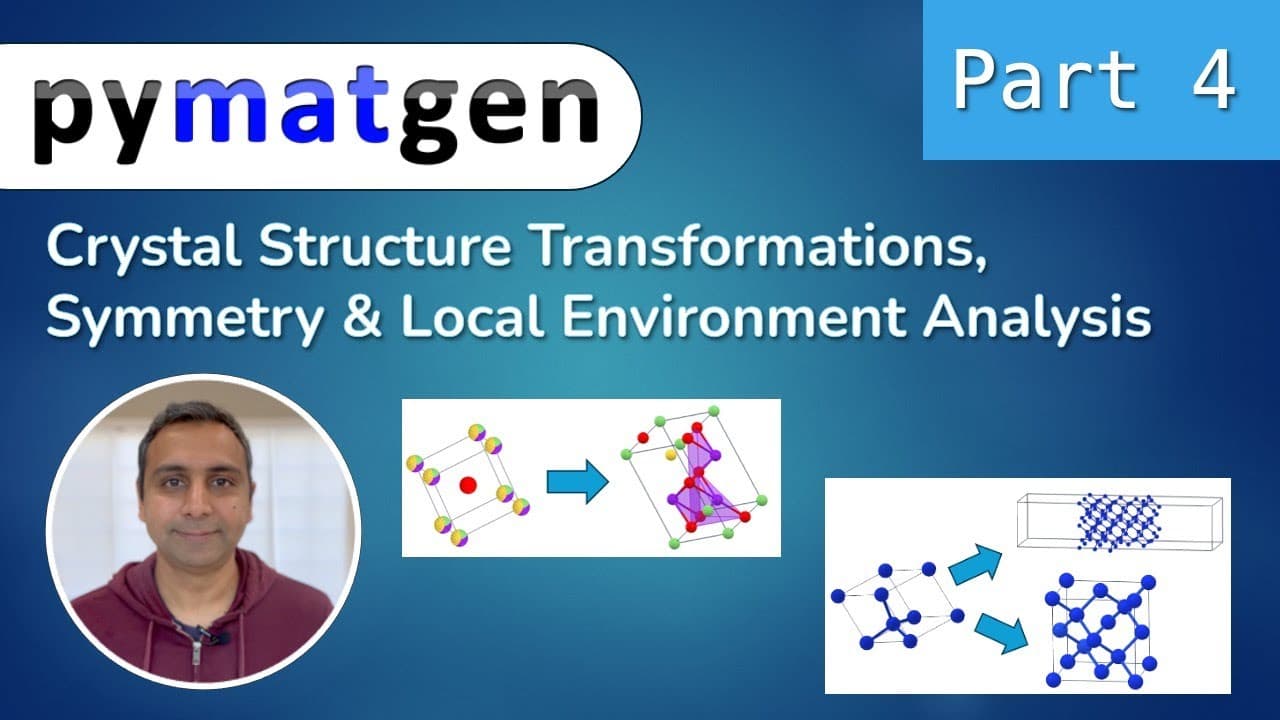
Pymatgen offers advanced tools for manipulating and analyzing crystal structures. Key features include transforming bulk to surface structures, symmetry analysis with SpaceGroupAnalyzer, and local environment assessment with coordination number and polyhedra detection. These functionalities are crucial for researchers needing precise structural modifications and analyses.
Transcript
all right everyone welcome to part four of the learn Pat gen Series today we're going to be talking about some of the more advanced things that Pat genen can do with Crystal structures things like turn bulk Crystal structures into surface structures uh analyze Global Symmetry and also analyze local environments and coordination polyhedra so let's D... Read More
Key Insights
- Pymatgen can transform bulk crystal structures into surface structures, allowing for detailed surface analysis.
- The Transformations package enables modifications like perturbing atomic positions and creating supercells.
- SpaceGroupAnalyzer in pymatgen uses SPG lib for symmetry analysis, identifying space groups and converting between crystal settings.
- Enumlib supports ordering and doping transformations, useful for structures with site disorder.
- Local environment analysis determines coordination numbers and polyhedra, using algorithms like Minimum Distance and CrystalNN.
- The Chemenv package in pymatgen detects coordination polyhedra, identifying environments like octahedral and tetrahedral.
- Pymatgen's tools are essential for researchers needing precise control over crystal structure modifications.
- Understanding crystal symmetry and local environments can significantly impact material property predictions and research outcomes.
Install to Summarize YouTube Videos and Get Transcripts
Explore YouTube Video Summarizer or Get YouTube Transcript Extractor
Questions & Answers
Q: How to transform bulk crystal structures into surface structures?
To transform bulk crystal structures into surface structures using pymatgen, utilize the slab transformation feature. Specify the Miller index for the desired surface plane, slab size, and vacuum layer thickness. Apply the transformation to the bulk structure to create a surface slab with the specified parameters, enabling detailed surface analysis.
Q: What is the purpose of the SpaceGroupAnalyzer in pymatgen?
SpaceGroupAnalyzer in pymatgen is used for symmetry analysis of crystal structures. It identifies the space group and converts between different crystal settings, such as Primitive and conventional cells. This tool is essential for understanding the symmetry properties of a crystal, which can influence material behavior and properties.
Q: How does pymatgen handle site disorder in crystal structures?
Pymatgen handles site disorder using the Enumlib package, which can create ordered structures from disordered ones. It generates various orderings based on site occupancy, allowing researchers to perform calculations and analyses on ordered structures. This capability is crucial for studying materials with mixed site occupancy.
Q: What are the key features of the Transformations package in pymatgen?
The Transformations package in pymatgen allows for various modifications of crystal structures. Key features include perturbing atomic positions, creating supercells, adding oxidation states, and generating surface structures. These transformations enable researchers to customize structures for specific analyses or simulations, enhancing the study of material properties.
Q: How does pymatgen determine coordination numbers and polyhedra?
Pymatgen determines coordination numbers and polyhedra using local environment analysis. It employs algorithms like Minimum Distance, Voronoi neighbors, and CrystalNN to identify nearest neighbors. The Chemenv package further analyzes these neighbors to detect coordination polyhedra, such as octahedral or tetrahedral environments, providing insights into local atomic arrangements.
Q: What is the role of the Chemenv package in pymatgen?
The Chemenv package in pymatgen analyzes coordination environments in crystal structures. It identifies the type of polyhedral arrangement around a site, such as octahedral or tetrahedral. This analysis is crucial for understanding the local atomic environment, which can influence the material's physical and chemical properties.
Q: How can pymatgen's tools impact material science research?
Pymatgen's tools impact material science research by providing advanced functionalities for crystal structure transformation and analysis. These tools allow precise structural modifications, symmetry analysis, and local environment assessment, enabling researchers to predict material properties more accurately and tailor materials for specific applications, thus advancing material science research.
Q: What are the benefits of using pymatgen for crystal structure analysis?
Using pymatgen for crystal structure analysis offers benefits like precise control over structural modifications, comprehensive symmetry analysis, and detailed local environment assessment. These capabilities facilitate accurate material property predictions and enable researchers to explore a wide range of structural configurations, enhancing the understanding and development of new materials.
Summary & Key Takeaways
-
Pymatgen provides tools for transforming and analyzing crystal structures, including converting bulk to surface structures and symmetry analysis. It employs SpaceGroupAnalyzer for identifying space groups and Enumlib for ordering and doping transformations. These capabilities are essential for researchers needing precise structural modifications.
-
Local environment analysis in pymatgen determines coordination numbers and polyhedral environments using algorithms like Minimum Distance and CrystalNN. The Chemenv package detects coordination polyhedra, identifying environments such as octahedral and tetrahedral. These tools are crucial for understanding material properties.
-
Pymatgen's advanced functionalities, including transformations, symmetry analysis, and local environment assessment, are vital for researchers in material science. They allow for precise modifications and analyses of crystal structures, impacting material property predictions and research outcomes significantly.
Read in Other Languages (beta)
Share This Summary 📚
Summarize YouTube Videos and Get Video Transcripts with 1-Click
Try YouTube Summary with ChatGPT & Claude or YouTube Transcript Generator
Explore More Summaries from Atoms to Materials 📚
Summarize YouTube Videos and Get Video Transcripts with 1-Click
Try YouTube Summary with ChatGPT & Claude or YouTube Transcript Generator