Ilya Sutskever: "Sequence to sequence learning with neural networks: what a decade"
TL;DR
Ilya Sutskever reflects on a decade of sequence-to-sequence learning advancements.
Transcript
Read and summarize the transcript of this video on Glasp Reader (beta).
Key Insights
- The paper discussed by Ilya Sutskever received recognition for its impact on the AI field, emphasizing the importance of collaboration and the evolution of ideas over a decade.
- The concept of large neural networks performing tasks quickly, akin to human intuition, has been foundational in AI development, highlighting the potential of deep learning models.
- Auto-regressive models have been pivotal in capturing sequence distributions, with early applications in translation demonstrating their capability.
- The transition from LSTMs to transformers marked a significant evolution in neural network design, improving computational efficiency and model performance.
- Pipelining and parallelization, though initially beneficial, were later reconsidered as AI researchers gained more experience and understanding of their limitations.
- The scaling hypothesis suggests that larger datasets and neural networks guarantee success, a concept that has driven recent AI advancements.
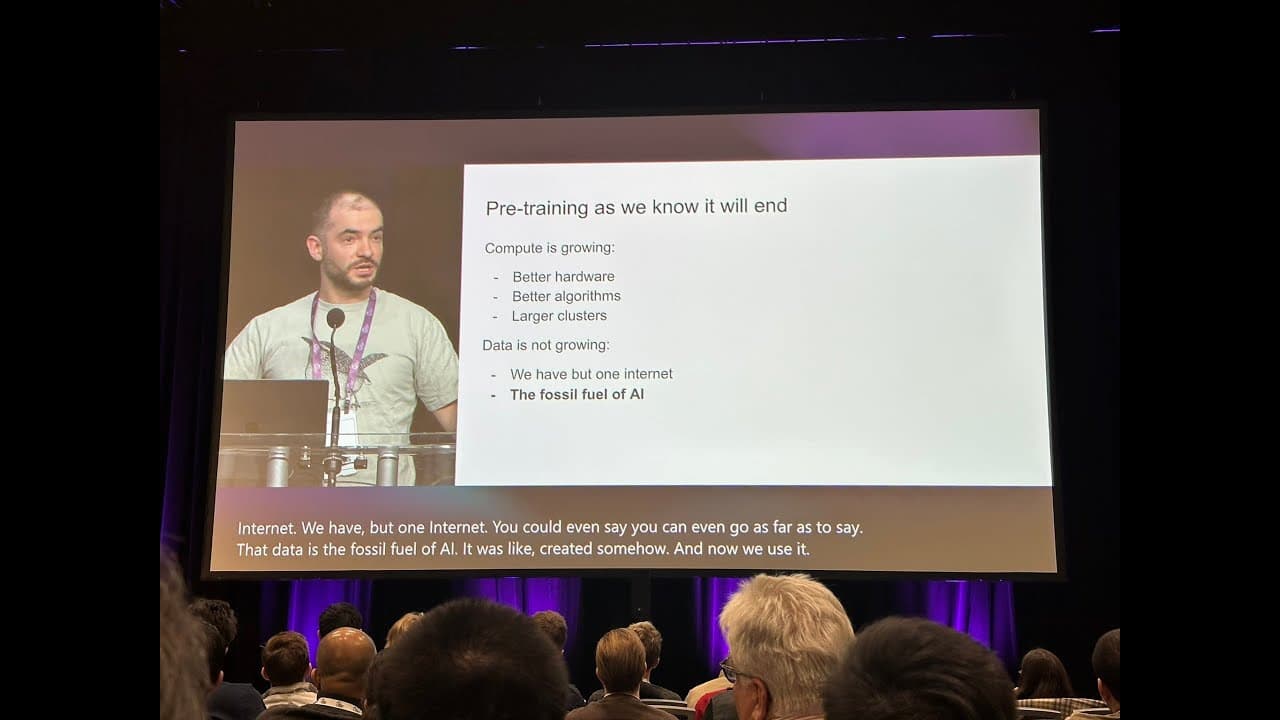
- Pre-training has been a cornerstone of AI progress, but limitations in data availability suggest a future shift towards new methods like synthetic data generation.
- The future of AI may involve agentic systems that reason and are self-aware, posing new challenges and opportunities for understanding and managing AI capabilities.
Install to Summarize YouTube Videos and Get Transcripts
Explore YouTube Video Summarizer or Get YouTube Transcript Extractor
Questions & Answers
Q: What was the main focus of Ilya Sutskever's talk?
Ilya Sutskever's talk focused on the retrospective analysis of sequence-to-sequence learning with neural networks over the past decade. He reflected on the evolution of AI technologies, the transition from LSTMs to transformers, and the impact of large neural networks and pre-training on the field. He also speculated on the future of AI, highlighting the potential for agentic, reasoning, and self-aware systems.
Q: How did the transition from LSTMs to transformers impact neural network design?
The transition from LSTMs to transformers marked a significant evolution in neural network design. Transformers improved computational efficiency and model performance by introducing a more effective way to handle long-range dependencies in data. This shift allowed for the development of more powerful and scalable models, which have become the foundation for many modern AI applications, including natural language processing and machine translation.
Q: What is the scaling hypothesis in AI, and why is it important?
The scaling hypothesis in AI suggests that success is guaranteed when large datasets are used to train large neural networks. This concept has been a driving force behind recent AI advancements, as it emphasizes the importance of data and model size in achieving superior performance. The hypothesis has led to the development of increasingly larger models, such as GPT-3, which have demonstrated remarkable capabilities in various tasks.
Q: Why does Ilya Sutskever believe pre-training will end, and what might replace it?
Ilya Sutskever believes pre-training will end due to the finite nature of available data, as the internet provides a limited source of information. As AI models continue to grow, the demand for data will exceed what is currently available. To address this challenge, researchers are exploring new approaches, such as synthetic data generation and agentic systems, which could provide alternative ways to train AI models and drive future advancements.
Q: What are the potential characteristics of future AI systems according to Sutskever?
According to Sutskever, future AI systems may possess characteristics such as agency, reasoning, understanding, and self-awareness. These systems would be capable of more complex and unpredictable behavior, surpassing current AI capabilities. Such advancements could lead to AI systems that are more autonomous and capable of making decisions in a manner similar to humans, posing new challenges and opportunities for managing AI.
Q: How does Sutskever view the relationship between biological and artificial neurons?
Sutskever views the relationship between biological and artificial neurons as foundational to the concept of connectionism in AI. He suggests that while artificial neurons are inspired by biological ones, the level of biological inspiration in AI has been modest. The focus has primarily been on using neurons as a model for computation, with more detailed biological inspiration being challenging to integrate into AI systems.
Q: What role does reasoning play in the future of AI, according to Sutskever?
Reasoning plays a crucial role in the future of AI, as it represents a shift from replicating human intuition to developing systems capable of more complex thought processes. Sutskever suggests that reasoning will make AI systems more unpredictable, as they will be able to analyze and interpret information in novel ways. This capability could lead to AI systems that can autonomously solve problems and make decisions, enhancing their utility and versatility.
Q: What challenges does Sutskever foresee with the development of superintelligent AI?
Sutskever foresees several challenges with the development of superintelligent AI, including managing the unpredictability and autonomy of such systems. As AI becomes more agentic and capable of reasoning, it may exhibit behaviors that are difficult to anticipate and control. Additionally, ethical considerations, such as the rights and coexistence of AI with humans, will need to be addressed as AI systems become more integrated into society and potentially possess qualities akin to sentience.
Summary & Key Takeaways
-
Ilya Sutskever reflects on the advancements in sequence-to-sequence learning over the past decade, acknowledging the contributions of his collaborators and the evolution of neural network models. He emphasizes the role of large neural networks and the scaling hypothesis in driving AI progress.
-
The transition from LSTMs to transformers marked a significant shift in neural network architecture, improving performance and efficiency. Pre-training has been central to AI development, but the finite nature of data suggests a need for new approaches like synthetic data generation.
-
Looking ahead, Sutskever speculates on the emergence of agentic, reasoning, and self-aware AI systems. These advancements could lead to unpredictable AI behavior, necessitating new strategies for managing and understanding AI capabilities in the context of superintelligence.
Read in Other Languages (beta)
Share This Summary 📚
Summarize YouTube Videos and Get Video Transcripts with 1-Click
Try YouTube Summary with ChatGPT & Claude or YouTube Transcript Generator
Explore More Summaries from seremot 📚
Summarize YouTube Videos and Get Video Transcripts with 1-Click
Try YouTube Summary with ChatGPT & Claude or YouTube Transcript Generator