What Are the Major Schools of Economic Thought?
TL;DR
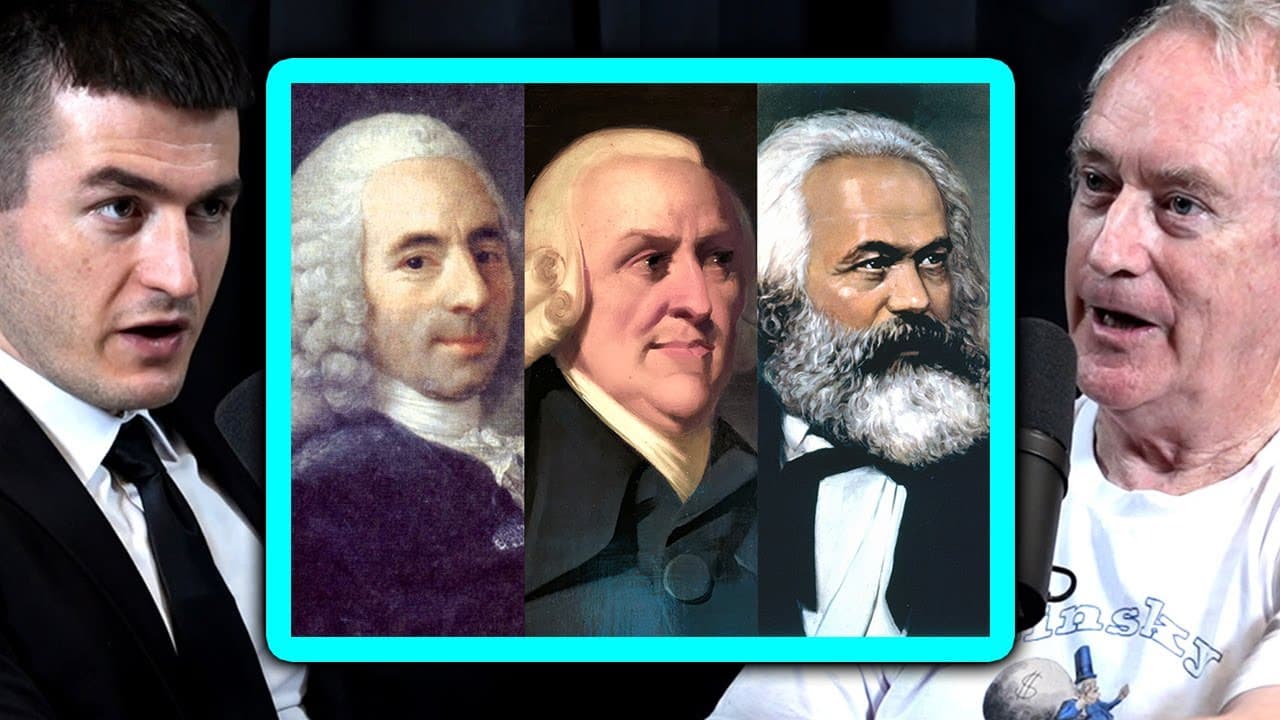
The video explores various schools of economics, beginning with the physiocrats who attributed value to agriculture and the sun, leading to the classical focus on labor as the source of value. It discusses how the neoclassical school shifted to a subjective theory of value, emphasizing individual satisfaction, while Keynesian and post-Keynesian economics highlighted uncertainty and the dynamic nature of capitalism.
Transcript
can you describe at a high level what are the different schools of economics perhaps ones that are interesting to you perhaps ones that the difference between which reveals something useful or insightful for our conversation okay so you know you could neoclassical post-keynesian austrian i like the biophysical uh economics and so on other heterodox... Read More
Key Insights
- 😎 The physiocrats saw agriculture as the primary source of value, attributing it to the sun's energy absorbed by the soil.
- 🫵 The classical school shifted the focus to human labor as the source of value, challenging the physiocrats' views.
- ❓ Neoclassical economics defended capitalism using the subjective theory of value, emphasizing individual satisfaction over effort.
- ❓ Keynesian economics emphasized the role of uncertainty and instability in capitalist economies.
Install to Summarize YouTube Videos and Get Transcripts
Explore YouTube Video Summarizer or Get YouTube Transcript Extractor
Questions & Answers
Q: How did the physiocrats view the source of value in the economy?
The physiocrats believed that all wealth came from the sun, which was absorbed by the soil, making agriculture the primary source of value.
Q: What was Adam Smith's contribution to economics?
Adam Smith, part of the classical school, argued that the source of value was human labor, challenging the physiocrats' view that value came solely from agriculture.
Q: How did the neoclassical school defend capitalism?
The neoclassical school defended capitalism using the subjective theory of value, which stated that value is determined by individuals' satisfaction with different objects rather than the effort put into their production.
Q: What did Keynes introduce to economics?
Keynes introduced the concept of uncertainty in economic decision-making, highlighting that forecasting the future is inherently challenging, leading to volatility in investments and economic fluctuations.
Summary & Key Takeaways
-
The physiocrats believed that all wealth came from the sun and that agriculture was the source of value, while manufacturing was considered sterile.
-
The classical school, influenced by Adam Smith, argued that the source of value was human labor, and the neoclassical school defended capitalism using the subjective theory of value.
-
Keynesian economics introduced the concept of uncertainty into economic decision-making, emphasizing the limitations of forecasting and the inherent instability of capitalist economies.
-
Post-Keynesian economics embraces the dynamic, non-equilibrium nature of capitalism and seeks to analyze it while acknowledging the role of money.
Read in Other Languages (beta)
Share This Summary 📚
Summarize YouTube Videos and Get Video Transcripts with 1-Click
Try YouTube Summary with ChatGPT & Claude or YouTube Transcript Generator
Explore More Summaries from Lex Clips 📚




Summarize YouTube Videos and Get Video Transcripts with 1-Click
Try YouTube Summary with ChatGPT & Claude or YouTube Transcript Generator