What Is the Universal Turing Machine and Its Importance?
TL;DR
The Universal Turing Machine is a theoretical construct that can emulate any Turing Machine and compute any computable function, proving the universality of computation. It laid the groundwork for modern general-purpose computers by demonstrating that any realizable computation can be accomplished with a suitable programming and encoding method.
Transcript
There are many other models of computation, each of which describes a class of integer functions where a computation is performed on an integer input to produce an integer answer. Kleene, Post and Turing were all students of Alonzo Church at Princeton University in the mid-1930's. They explored many other formulations for modeling computation: recu... Read More
Key Insights
- 👍 Different models of computation, including recursive functions and the lambda calculus, were explored by early computer scientists but ultimately proved to have the same computational power as Turing Machines.
- 🎰 Church's Thesis postulates that every computable function on a realizable machine is computable by some Turing Machine.
- 💁 The Universal Turing Machine, capable of emulating any other Turing Machine, forms the basis for modern general-purpose computers.
- 💻 The concept of encoding programs as data for other programs, demonstrated by the Universal Turing Machine, is fundamental in computer science.
- 💨 The development of the Universal Turing Machine paved the way for modern stored-program computers.
- 🎭 The universality of computation assures that any desired computation can be performed using a Turing Machine or an equivalent computational model.
- 💻 The Beta Instruction Set Architecture (ISA) is deemed Turing Universal, meaning it can emulate any other Turing Machine and compute any computable function.
Install to Summarize YouTube Videos and Get Transcripts
Explore YouTube Video Summarizer or Get YouTube Transcript Extractor
Questions & Answers
Q: What were some of the different models of computation explored by early computer scientists?
Early computer scientists explored various models of computation, including recursive functions, rule-based systems for string rewriting, and the lambda calculus.
Q: What does Church's Thesis state?
Church's Thesis states that every discrete function computable by any realizable machine is computable by some Turing Machine.
Q: Is there a Universal Turing Machine?
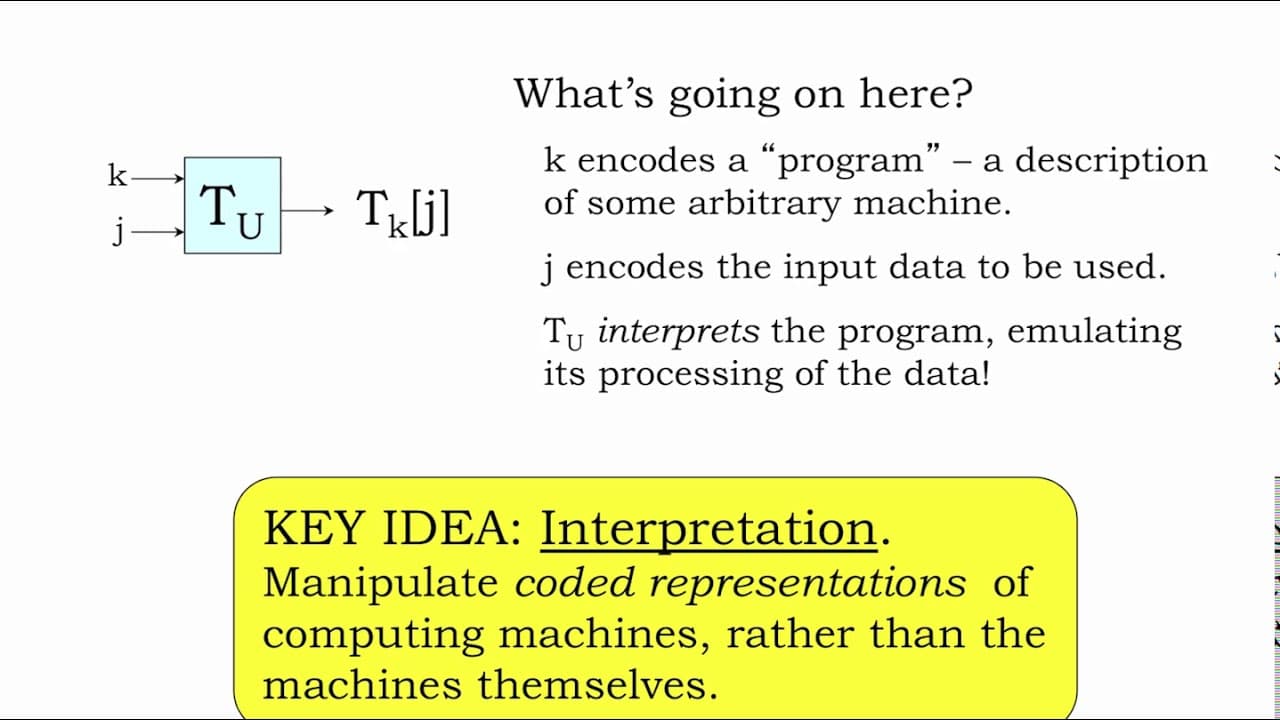
Yes, a Universal Turing Machine (T_U) exists, capable of emulating any other Turing Machine and performing any computable function.
Q: How does the Universal Turing Machine work?
The Universal Turing Machine interprets a coded representation of a computation. It takes a program description (encoded by k) and an input (encoded by j) and emulates the steps of a specific Turing Machine to process the input and produce an output.
Summary & Key Takeaways
-
Early computer scientists explored different models for computation, including recursive functions, rule-based systems, and the lambda calculus, all of which could compute the same set of integer functions.
-
Church's Thesis states that every discrete function computable by any realizable machine can be computed by a Turing Machine.
-
A Universal Turing Machine exists, capable of emulating any other Turing Machine and performing any computable function.
Read in Other Languages (beta)
Share This Summary 📚
Summarize YouTube Videos and Get Video Transcripts with 1-Click
Try YouTube Summary with ChatGPT & Claude or YouTube Transcript Generator
Explore More Summaries from MIT OpenCourseWare 📚


Summarize YouTube Videos and Get Video Transcripts with 1-Click
Try YouTube Summary with ChatGPT & Claude or YouTube Transcript Generator