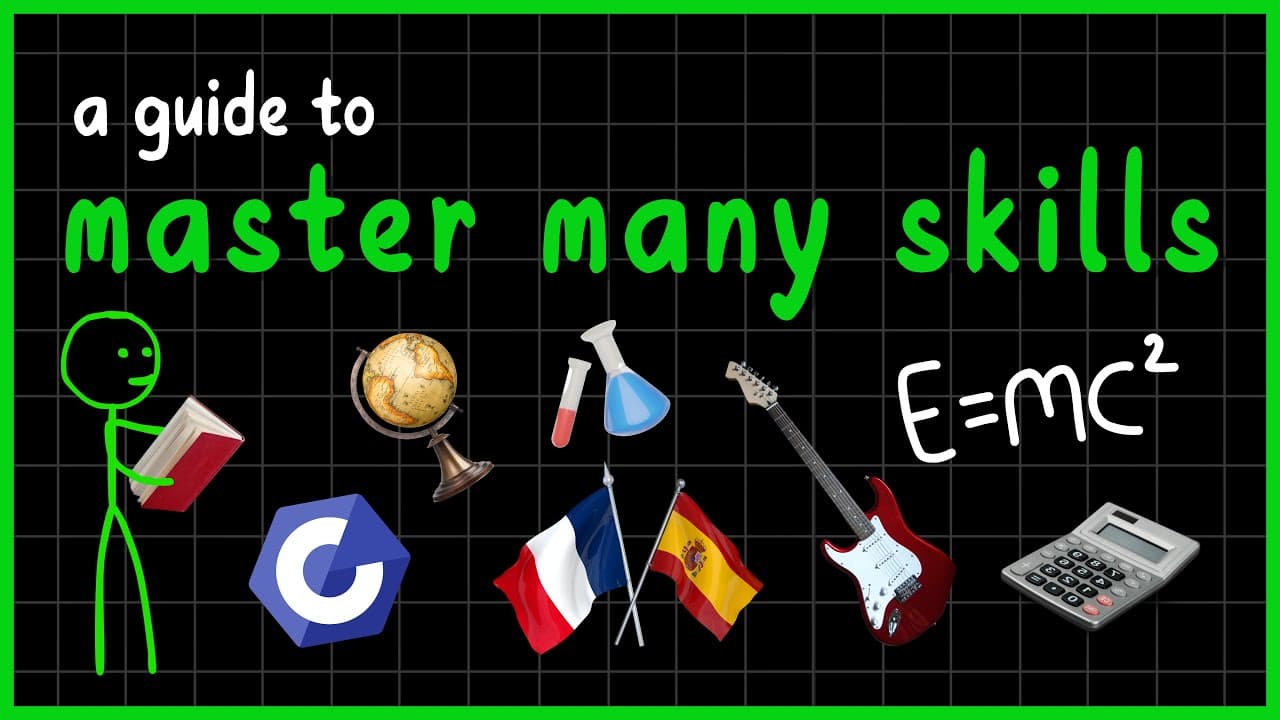
How to Become a Polymath (The Smart Way)
TL;DR
Guide to becoming a polymath by building diverse skills.
Transcript
Read and summarize the transcript of this video on Glasp Reader (beta).
Key Insights
- Polymaths are influential individuals who excel in multiple disciplines, challenging the societal norm of specialization.
- To become a polymath, start by building a skill stack, focusing on personal interest, applicability, and complementarity.
- Learning fast involves breaking down disciplines into core principles and focusing on the most impactful 20% of knowledge.
- Effective time management through time blocking is crucial for consistent learning and skill development.
- Active learning is essential; apply new knowledge immediately to reinforce learning and prevent concept fading.
- Skill transfer, both near and far, is a key ability for polymaths, enabling the application of knowledge in diverse contexts.
- Creating real projects helps solidify knowledge and encourages the integration of different skills and fields.
- Exposure to varied learning materials and real-world examples accelerates the learning process and enhances comprehension.
Install to Summarize YouTube Videos and Get Transcripts
Explore YouTube Video Summarizer or Get YouTube Transcript Extractor
Questions & Answers
Q: What is the first step to becoming a polymath?
The first step to becoming a polymath is building a skill stack. This involves choosing fields to focus on based on personal interest, applicability, and complementarity. By selecting areas that are enjoyable and relevant, learners can sustain their motivation and ensure that their knowledge has a practical impact.
Q: How can one learn new disciplines quickly?
To learn new disciplines quickly, it's important to break them down into core principles and focus on the most impactful 20% of knowledge, as per the Pareto Principle. This approach helps prioritize learning efforts on the elements that yield the most significant results, making the learning process more efficient.
Q: Why is time management crucial for polymaths?
Time management is crucial for polymaths because it ensures consistent learning and skill development. By using techniques like time blocking, individuals can dedicate specific periods to different tasks, optimizing their daily routine to balance deep work, skill stacking, and review, thereby maximizing productivity and learning outcomes.
Q: What role does active learning play in becoming a polymath?
Active learning plays a critical role in becoming a polymath by reinforcing knowledge through immediate application. By actively using new concepts, learners prevent them from fading away and deepen their understanding. This approach transforms theoretical knowledge into practical skills, essential for multidisciplinary expertise.
Q: How does skill transfer contribute to polymathy?
Skill transfer contributes to polymathy by enabling individuals to apply knowledge from one field to another, enhancing creativity and problem-solving abilities. It involves both near transfer, within similar contexts, and far transfer, across different domains, allowing polymaths to innovate and create original solutions by connecting disparate ideas.
Q: Why are real-world projects important in this learning approach?
Real-world projects are important because they provide practical experience and immediate feedback, helping learners integrate and apply their diverse skills. By tackling real-world problems, individuals can test their knowledge, refine their abilities, and gain insights into what works and what doesn't, fostering a deeper understanding of their fields.
Q: How can exposure to varied materials enhance learning?
Exposure to varied materials enhances learning by broadening understanding and accelerating the absorption of new information. Engaging with different formats, such as interviews, stories, and technical books, provides diverse perspectives and insights, enriching the learning experience and facilitating the integration of knowledge from multiple sources.
Q: What is the significance of complementarity in building a skill stack?
Complementarity is significant in building a skill stack because it ensures that the chosen skills work well together, leading to a coherent and professional outcome. By combining related skills, learners can create synergies that enhance their expertise and make their knowledge more applicable and impactful in their chosen fields.
Summary & Key Takeaways
-
This content provides a step-by-step guide to becoming a polymath, emphasizing the importance of building a skill stack based on interest, applicability, and complementarity. It highlights the need for effective time management and active learning to reinforce new knowledge.
-
Becoming a polymath requires the ability to transfer skills across different contexts, known as skill transfer. This process involves applying knowledge from one field to another, enhancing creativity and problem-solving capabilities.
-
Real-world projects are essential for integrating and applying diverse skills, offering practical experience and immediate feedback. The guide encourages using varied learning materials to broaden understanding and accelerate the learning process.
Read in Other Languages (beta)
Share This Summary 📚
Summarize YouTube Videos and Get Video Transcripts with 1-Click
Try YouTube Summary with ChatGPT & Claude or YouTube Transcript Generator
Explore More Summaries from Rise Above Reality 📚




Summarize YouTube Videos and Get Video Transcripts with 1-Click
Try YouTube Summary with ChatGPT & Claude or YouTube Transcript Generator