What Are Circulant Matrices and Their Importance in ML?
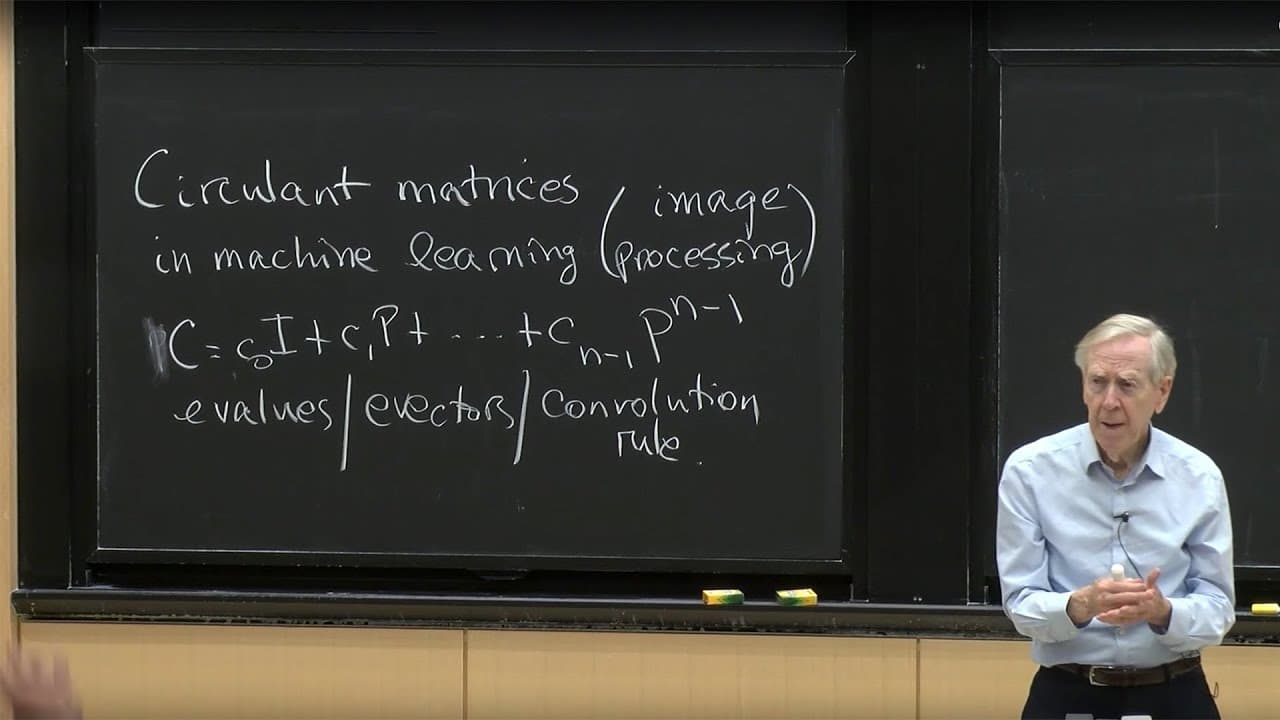
TL;DR
Circulant matrices exhibit a cyclic structure, where each row is a shifted version of the previous one, and they are intrinsically linked to the discrete Fourier transform. This connection makes them vital in fields like machine learning and image processing, where they simplify computations and help manage large datasets by reducing dimensionality.
Transcript
NARRATOR: The following content is provided under a Creative Commons license. Your support will help MIT OpenCourseWare continue to offer high-quality educational resources for free. To make a donation or to view additional materials from hundreds of MIT courses, visit MIT OpenCourseWare at ocw.mit.edu. GILBERT STRANG: OK. So, I'd like to pick up a... Read More
Key Insights
- ❓ Circulant matrices have a cyclic structure and are closely connected to the discrete Fourier transform.
- 🎰 They are used in applications such as machine learning and image processing to reduce dimensionality and simplify computations.
- ✊ Circulant matrices have eigenvectors that are orthogonal and can be described using powers of a complex number.
- ❓ Permutation matrices share the same eigenvectors as circulant matrices.
Install to Summarize YouTube Videos and Get Transcripts
Explore YouTube Video Summarizer or Get YouTube Transcript Extractor
Questions & Answers
Q: What is the significance of circulant matrices in machine learning and image processing?
Circulant matrices are used to reduce the dimensionality of data in machine learning and image processing. By using a circulant matrix, it is possible to describe an image using a smaller feature vector, which simplifies computations and makes the processing more efficient.
Q: How are circulant matrices related to the discrete Fourier transform?
Circulant matrices are connected to the discrete Fourier transform because they share similar properties. Like the discrete Fourier transform, circulant matrices have a cyclic structure and can be used to compute circular convolutions. This makes circulant matrices useful in applications where shifting and convolution operations are important, such as signal processing and image analysis.
Q: How do circulant matrices differ from other types of matrices?
Circulant matrices have a special structure where each row or column is a cyclic shift of the previous row or column. This is different from general matrices, which can have arbitrary entries in each position. Circulant matrices also have certain properties, such as commuting with each other and having orthogonal eigenvectors, that make them useful in various applications.
Q: How are circulant matrices related to the eigenvectors of the permutation matrix?
Permutation matrices can be expressed as a combination of powers of the permutation matrix, and thus share the same eigenvectors. The eigenvector matrix for all circulant matrices of size N is the same as the eigenvector matrix for the permutation matrix of size N. The eigenvectors of circulant matrices are orthogonal and have specific patterns based on the eigenvalues.
Summary & Key Takeaways
-
Circulant matrices have a special form where each row or column is a cyclic shift of the previous row or column.
-
These matrices are closely connected to the discrete Fourier transform, which is a key algorithm in engineering and mathematics.
-
Circulant matrices are used in applications such as machine learning and image processing to reduce the dimensionality of data and simplify computations.
Read in Other Languages (beta)
Share This Summary 📚
Summarize YouTube Videos and Get Video Transcripts with 1-Click
Try YouTube Summary with ChatGPT & Claude or YouTube Transcript Generator
Explore More Summaries from MIT OpenCourseWare 📚


Summarize YouTube Videos and Get Video Transcripts with 1-Click
Try YouTube Summary with ChatGPT & Claude or YouTube Transcript Generator