What Drives Flexibility in Engineering Decisions?
TL;DR
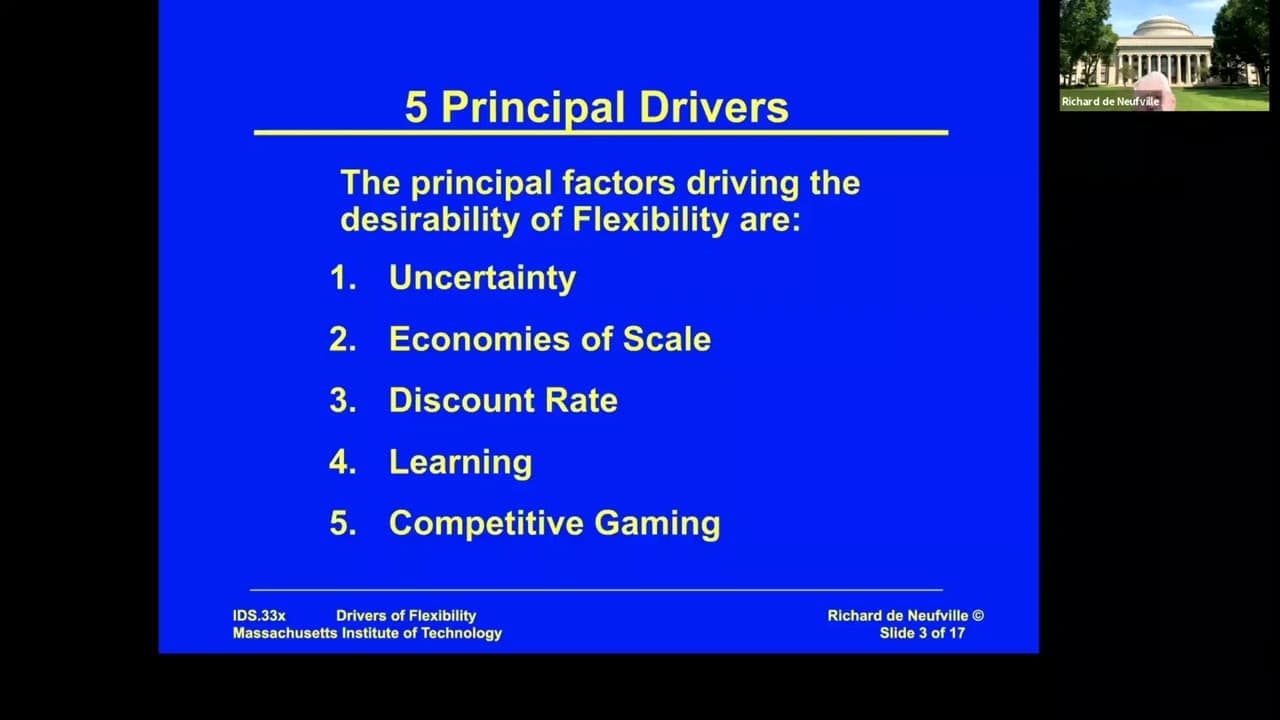
Flexibility in engineering is primarily driven by uncertainty, which necessitates adaptability in decision-making. Key factors include economies of scale, discounted future costs, learning effects, and competitive gaming strategies that influence whether to delay or act immediately.
Transcript
[SQUEAKING] [RUSTLING] [CLICKING] RICHARD DE NEUFVILLE: So the first portions of it, the title is the "Drivers of Flexibility." That is, through our exploration of the fact that the forecast is always wrong, that there's uncertainty, and the observation that we need to explore what might happen, there are certain factors that make it much more like... Read More
Key Insights
- 🪛 Uncertainty is a central driver of flexibility, as the unknown future necessitates adaptability to different possibilities.
- 🌥️ Considering economies of scale can create a tension between immediate action and the potential for cost savings through larger capacities.
- 😘 The discount rate encourages delaying decisions to take advantage of lower present value costs in the future.
- 👻 Learning effects from repeated designs or modules incentivize flexibility by allowing for improvements and cost reductions.
- 🉐 Competitive gaming, where acting first to gain a strategic advantage, can either encourage immediate action or support flexibility depending on the context.
- 🙃 Differentiating uncertainty from risk helps to recognize the potential benefits of uncertainty, particularly in situations like startups where upside uncertainty can drive success.
- 🧡 Encouraging discussions about uncertainties rather than just risks promotes a better understanding of the range of future possibilities.
Install to Summarize YouTube Videos and Get Transcripts
Explore YouTube Video Summarizer or Get YouTube Transcript Extractor
Questions & Answers
Q: Why is uncertainty a key factor affecting the desirability of flexibility in engineering?
Uncertainty in future events makes it impossible to optimize for one particular state, necessitating flexibility to accommodate different possibilities. Flexibility allows for adaptation to changing circumstances and minimizes the impact of uncertainty on decision-making.
Q: How do economies of scale impact the decision for flexibility in engineering projects?
Building larger capacities can be more cost-effective per unit, making smaller, uneconomical units of capacity less desirable. This may create a preference for immediate action rather than delaying decisions for flexibility.
Q: How does the discount rate influence the consideration of flexibility in engineering decisions?
By delaying decisions and building capacity in the future, costs can be discounted, making it cheaper to build at a later date. This creates an incentive to postpone actions and prioritize flexibility.
Q: What is the role of learning effects in the discussion of flexibility in engineering?
When a design or module is repeated, the cost per unit often decreases due to organizational and design improvements. This incentivizes flexibility by allowing for learning and improvement over time.
Summary & Key Takeaways
-
Flexibility in design and management decisions involves delaying actions until certainty is established.
-
Factors for flexibility include uncertainty in future events, potential economies of scale, discounted future costs, learning effects, and strategic competitive advantages.
-
Factors against flexibility include the desire to optimize for known conditions and the risk of making mistakes by delaying decisions.
Read in Other Languages (beta)
Share This Summary 📚
Summarize YouTube Videos and Get Video Transcripts with 1-Click
Try YouTube Summary with ChatGPT & Claude or YouTube Transcript Generator
Explore More Summaries from MIT OpenCourseWare 📚


Summarize YouTube Videos and Get Video Transcripts with 1-Click
Try YouTube Summary with ChatGPT & Claude or YouTube Transcript Generator