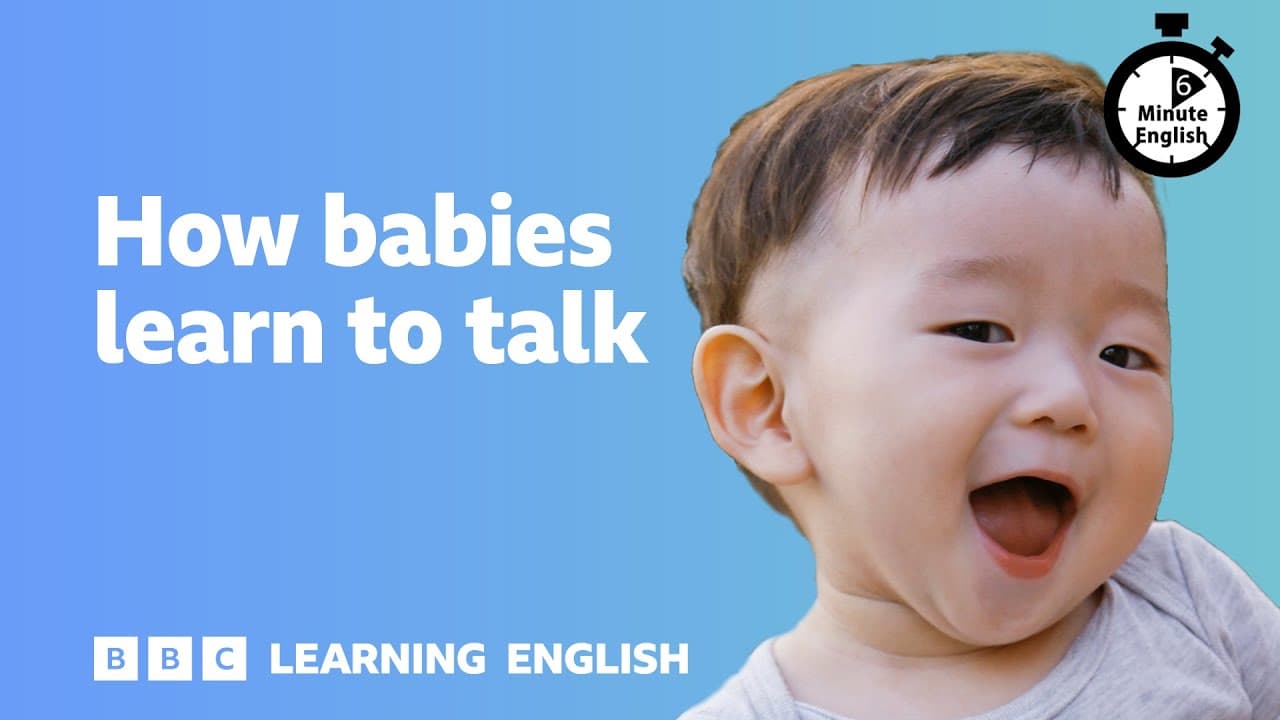
How babies learn to talk ⏲️ 6 Minute English
TL;DR
Babies learn to talk by babbling and imitating adults.
Transcript
Hello, this is 6 Minute English from BBC Learning English. I'm Phil, and I'm Georgie. For most parents, their baby's first word is a special moment. This happens after an early stage of language development called 'babble', when babies start making simple sounds like 'ga' or 'ma'. Babies have to learn to use their mouth muscles to make specific sou... Read More
Key Insights
- Babies begin their language development with babbling, making simple sounds like 'ga' or 'ma', which are crucial for learning to speak.
- The process of learning to speak involves babies experimenting with different sounds and mouth shapes to master specific sounds.
- A key skill in language development is breaking down speech into words and linking them to objects in the environment.
- Babies often make errors by omitting unstressed syllables, such as saying 'raffe' instead of 'giraffe', which reflects typical language learning patterns.
- Understanding word meanings is challenging for babies as they must determine what a word refers to among many possibilities.
- Adults take for granted the clear link between words and their meanings, but for babies, these links are ambiguous and require learning.
- Babbling typically starts around six months old, marking an important milestone in a child's speech development.
- The discussion highlights the complexity of language acquisition and the remarkable cognitive processes involved in babies' learning.
Install to Summarize YouTube Videos and Get Transcripts
Explore YouTube Video Summarizer or Get YouTube Transcript Extractor
Questions & Answers
Q: What is the first stage of language development in babies?
The first stage of language development in babies is babbling. During this stage, babies make simple sounds like 'ga' or 'ma'. It is a crucial phase where they begin experimenting with different sounds and mouth shapes, which helps them learn to produce specific sounds necessary for speech.
Q: How do babies learn to link words to objects?
Babies learn to link words to objects by breaking down the speech stream into individual words and associating them with objects in their environment. This process involves understanding what words mean, which is challenging as the speech signal is often ambiguous, requiring babies to determine the correct reference among many possibilities.
Q: What are some common errors babies make when learning to speak?
Common errors babies make include omitting unstressed syllables in words, such as saying 'raffe' instead of 'giraffe'. These errors reflect typical language learning patterns where children focus on stressed syllables, which are more prominent in English, and may not yet fully grasp the complete word structure.
Q: Why is understanding word meanings challenging for babies?
Understanding word meanings is challenging for babies because they must determine what a word refers to in their environment, which is not always obvious. The speech signal can be ambiguous, meaning it has more than one possible meaning, and babies need to learn to associate words with the correct objects among many possibilities.
Q: At what age do babies typically start babbling?
Babies typically start babbling around six months old. This stage is an important milestone in their speech development, marking the beginning of their journey to learning to speak. Babbling involves making simple sounds and is essential for developing the mouth muscles and sound patterns needed for speech.
Q: What does 'taking something for granted' mean in the context of language learning?
In the context of language learning, 'taking something for granted' refers to assuming something without question. Adults often take for granted the clear link between words and their meanings, but for babies, these links are not obvious and require learning and understanding, as the speech signal can be ambiguous.
Q: What role do stressed syllables play in language development?
Stressed syllables play a significant role in language development as they are the sounds in words that are emphasised by being spoken longer or louder. Recognising stressed syllables helps babies identify where individual words start and end, which is crucial for breaking down the speech stream and learning word structures.
Q: How do babies' brains process sounds during language acquisition?
Babies' brains process sounds during language acquisition by absorbing and experimenting with the sounds they hear in their environment. Their brains are highly receptive, or 'sponge-like', allowing them to soak up the sounds and patterns of speech, which they then use to develop their ability to produce and understand language.
Summary & Key Takeaways
-
Babies begin their journey to speaking with babbling, a stage where they produce simple sounds. This process involves experimenting with different sounds and mouth shapes. Key skills include breaking down speech into words and linking them to objects, which are crucial for understanding language.
-
Children often make errors like omitting unstressed syllables in words, such as saying 'raffe' instead of 'giraffe'. Understanding the meaning of words is challenging for babies as they must learn to associate words with the correct objects in their environment.
-
Babbling starts around six months old, and this marks a significant milestone in speech development. The discussion highlights the complexity of language acquisition and how babies' brains absorb and process the sounds they hear to learn to speak.
Read in Other Languages (beta)
Share This Summary 📚
Summarize YouTube Videos and Get Video Transcripts with 1-Click
Try YouTube Summary with ChatGPT & Claude or YouTube Transcript Generator
Explore More Summaries from BBC Learning English 📚
Summarize YouTube Videos and Get Video Transcripts with 1-Click
Try YouTube Summary with ChatGPT & Claude or YouTube Transcript Generator