What Are the Key Challenges in Self-Driving Car Technology?
TL;DR
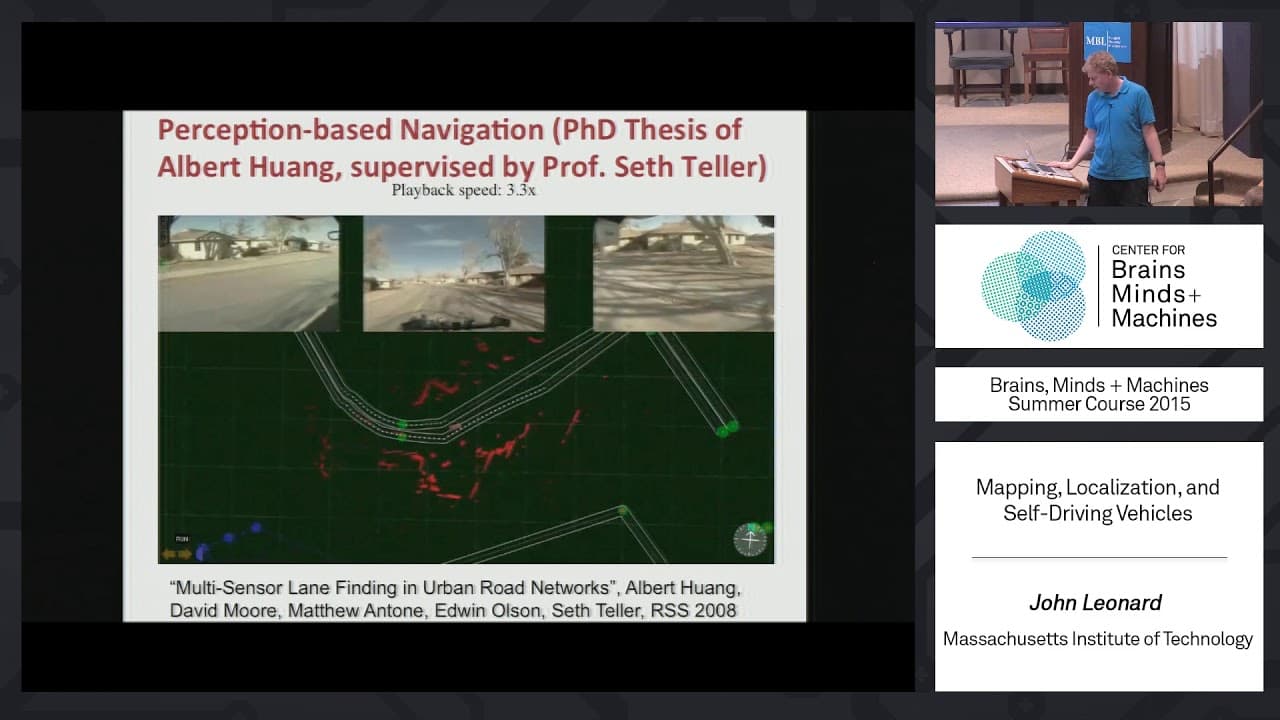
The key challenges in self-driving car technology include accurate localization, effective mapping, handling adverse weather conditions, and enabling smooth human interaction. While significant advancements have been made, issues like representation errors and the need for robust computer vision algorithms remain critical hurdles that must be addressed for full autonomy.
Transcript
The following content is provided under a Creative Commons license. Your support will help MIT OpenCourseWare continue to offer high quality educational resources for free. To make a donation or view additional materials from hundreds of MIT courses, visit MIT OpenCourseWare at ocw.mit.edu. JOHN LEONARD: OK, thanks. Thanks for the opportunity to ta... Read More
Key Insights
- 😨 Self-driving cars face challenges in representation, localization, mapping, adverse weather conditions, and human interaction.
- 🤖 Dense representations and object-based understanding can improve robot perception and mapping capabilities.
Install to Summarize YouTube Videos and Get Transcripts
Explore YouTube Video Summarizer or Get YouTube Transcript Extractor
Questions & Answers
Q: Is self-driving technology for cars already solved?
Leonard believes that while companies like Tesla and Google have made significant progress, self-driving cars are far from being completely solved. The challenges of representation, localization, and interaction with complex environments, weather conditions, and human interactions must be addressed.
Q: How does perception in self-driving cars differ from human perception?
Self-driving cars rely on sensors like LiDAR and cameras for perception. However, they still struggle with challenging vision conditions, such as looking into the sun, detecting slow-moving objects, and perceiving complex scenes. Humans, on the other hand, have the ability to make sense of these situations more effectively.
Q: What is the importance of representation and mapping in robotics?
Representation and mapping are crucial for autonomous robots to understand their environments and navigate effectively. Robots need to build accurate maps and use them for localization and decision-making. Dense representations and object-based understanding can enhance the perception capabilities of robots.
Q: How do brain representations in grid cells relate to robot mapping?
The discovery of grid cells, which provide metrical position information, is an exciting concept in neuroscience. Leonard suggests that grid cells may play a role in memory formation, navigation, and map building in robots. Grid cells could serve as an indexing mechanism for search and linking what and where information.
Summary & Key Takeaways
-
John Leonard discusses the challenges of self-driving cars, including representation for localization and mapping.
-
He shares his experience working with autonomous underwater vehicles and the constraints they face with poor communications and real-time processing.
-
Leonard highlights the advancements and limitations of self-driving car technology, as well as his own work on dense representations and object-based mapping.
Read in Other Languages (beta)
Share This Summary 📚
Summarize YouTube Videos and Get Video Transcripts with 1-Click
Try YouTube Summary with ChatGPT & Claude or YouTube Transcript Generator
Explore More Summaries from MIT OpenCourseWare 📚


Summarize YouTube Videos and Get Video Transcripts with 1-Click
Try YouTube Summary with ChatGPT & Claude or YouTube Transcript Generator