How to Conduct Sensitivity Analysis in Google AdWords
TL;DR
To conduct sensitivity analysis in Google AdWords, adjust data values like click-through rates and budgets in a linear optimization model to observe changes in allocations and revenue. For example, increasing AT&T's budget or click-through rate illustrates how these factors influence the overall solution and objective, demonstrating the significance of binding constraints in optimization.
Transcript
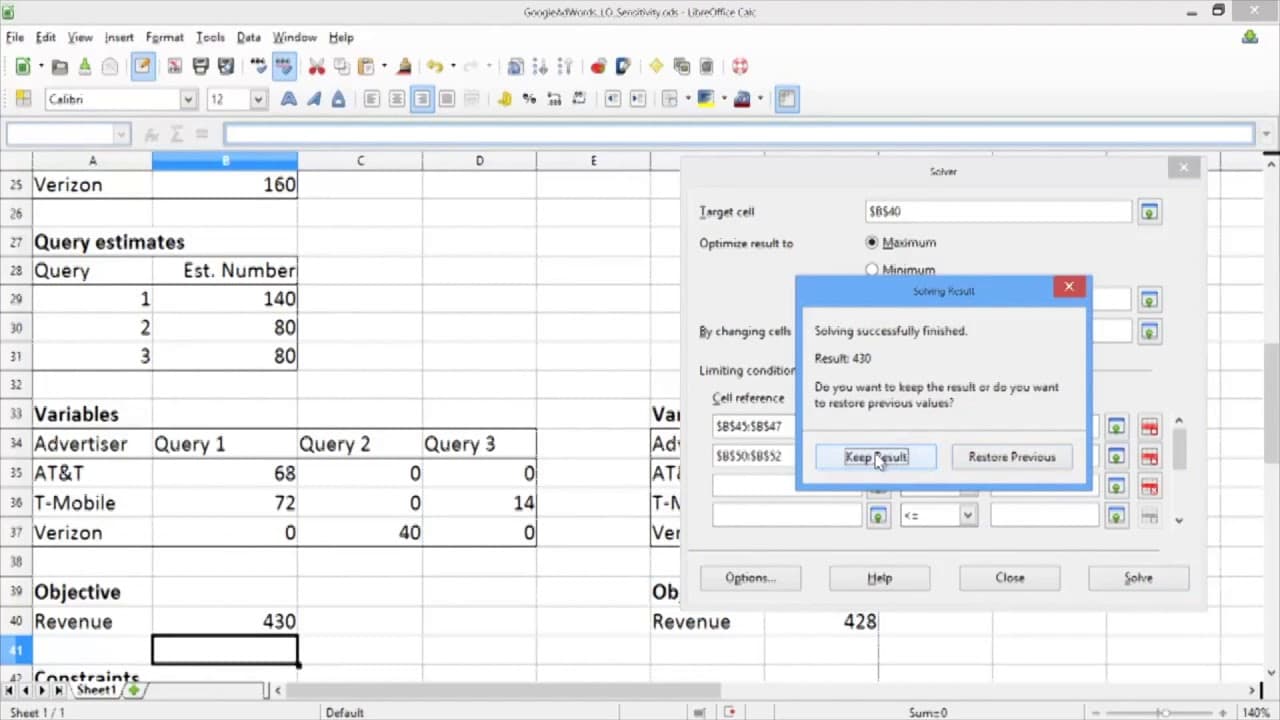
In this video, we're going to explore our linear optimization model further. We're going to use it to answer some "what if" questions and to conduct some sensitivity analysis. So here, we have a spreadsheet that is formatted very similarly to the spreadsheets that we've used in Video 5 and Video 6. So we have the data up here, we have the price-per... Read More
Key Insights
- 👻 Linear optimization models allow for "what if" analysis and sensitivity analysis by altering data values and observing the corresponding changes in the solution.
- ☠️ The average price per display is directly influenced by the click-through-rate and price-per-click.
- ☠️ Changes in the input data, such as click-through-rates and budgets, can result in different allocations and revenue outcomes.
- 💱 Not all changes in the input data will have an impact on the solution if the corresponding constraint is not binding.
- 🍹 The maximum attainable revenue in this model is equal to the sum of the budgets for each advertiser.
- 🈸 Linear optimization models can be explored further to extend their application and solve more complex problems.
- 🎮 The analysis in the video was conducted using LibreOffice, but the concepts and techniques apply to other spreadsheet software and optimization tools.
Install to Summarize YouTube Videos and Get Transcripts
Explore YouTube Video Summarizer or Get YouTube Transcript Extractor
Questions & Answers
Q: How can a linear optimization model be used to answer "what if" questions?
A linear optimization model allows for changing data values and observing how the solution and objective value respond to these changes. By varying inputs, we can analyze the impact of different scenarios on the optimal solution.
Q: What is the relationship between click-through-rate and average price per display?
The average price per display is calculated by multiplying the click-through-rate with the price-per-click. Increasing the click-through-rate will lead to a corresponding change in the average price per display.
Q: Why didn't increasing AT&T's budget result in a change in the solution?
The previous solution did not fully utilize AT&T's budget, meaning that the constraint was not binding. Increasing the budget beyond the previously used amount does not have an effect on the solution in this case.
Q: What determines the maximum revenue that can be attained in this optimization model?
The sum of the budgets for each advertiser represents the maximum revenue achievable because Google earns from each advertiser only what they spend. If the sum of the budgets is the highest possible expenditure, then the revenue will also be maximized.
Summary & Key Takeaways
-
The video demonstrates how to use a spreadsheet to change data values and observe the corresponding changes in the solution and objective value.
-
It showcases an example of increasing the click-through-rate for AT&T with query one and analyzes the effects on the average price per display, solution allocations, and revenue.
-
Another example is given, where the budget for AT&T is increased, but the solution remains unchanged due to the constraint not being binding.
Read in Other Languages (beta)
Share This Summary 📚
Summarize YouTube Videos and Get Video Transcripts with 1-Click
Try YouTube Summary with ChatGPT & Claude or YouTube Transcript Generator
Explore More Summaries from MIT OpenCourseWare 📚


Summarize YouTube Videos and Get Video Transcripts with 1-Click
Try YouTube Summary with ChatGPT & Claude or YouTube Transcript Generator