How Did Ayanokoji Become So Intelligent?

TL;DR
Ayanokoji's intelligence can be developed through four key pillars: cognitive traits, knowledge and articulation, goal-directed intelligence, and integration traits. Cognitive traits like working memory can be enhanced through practices such as yoga nidra and exercise, while knowledge is best expressed through active reading and emotional intelligence is crucial for long-term success.
Transcript
Read and summarize the transcript of this video on Glasp Reader (beta).
Key Insights
- Intelligence is not fixed by genetics but can be developed through cognitive enhancement techniques rooted in neuroscience.
- Working memory is crucial for intelligence, linked to dopamine activity, and can be improved through practices like yoga nidra.
- Processing speed, essential for quick thinking, can be enhanced with aerobic exercises that improve brain health.
- Pattern recognition is vital for intuition and creativity, stimulated by activities like nature walks and quality sleep.
- Logical reasoning is developed through questioning and studying complex subjects, enhancing clarity in thinking.
- Knowledge and articulation are key for expressing intelligence, best improved through active reading of challenging literature.
- Grit and emotional intelligence are essential for achieving long-term goals and understanding others, both trainable through specific techniques.
- Integration traits like systems thinking and abstraction allow for cross-domain thinking and foresight, trainable through practical exercises.
Install to Summarize YouTube Videos and Get Transcripts
Explore YouTube Video Summarizer or Get YouTube Transcript Extractor
Questions & Answers
Q: How can working memory be improved?
Working memory can be enhanced through practices like yoga nidra, which increases dopamine release in the brain, and by consuming foods rich in elyroine that support dopamine production. Additionally, listening to binaural beats in the alpha and beta range can modestly improve working memory tasks.
Q: What role does processing speed play in intelligence?
Processing speed is crucial for quick thinking and effective communication, allowing individuals to absorb, interpret, and respond to new information rapidly. It is essential for being quick-witted in conversations and debates, and can be improved through aerobic exercises that enhance neural signaling and brain health.
Q: How can pattern recognition be developed?
Pattern recognition, which underlies intuition and creativity, can be developed by stimulating the brain's default mode network. Activities such as long walks in nature without digital distractions and getting deep, uninterrupted sleep help enhance this ability by promoting creative thought and cognitive network integration.
Q: What is the significance of logical reasoning in intelligence?
Logical reasoning is the ability to make connections, form valid arguments, and discern truth from bias. It relies on the lateral prefrontal cortex and can be trained through Socratic questioning and studying complex subjects like math and philosophy, which enhance rational and clear thinking.
Q: How does reading contribute to intelligence?
Reading, especially challenging non-fiction literature, is a powerful tool for building knowledge and articulation. It helps absorb complex ideas and mimic high-level communication styles, increasing vocabulary and grammatical complexity, which support clearer and more flexible expression, making one sound sharp and trustworthy.
Q: What is grit and how can it be developed?
Grit is the ability to persist in pursuing long-term goals despite setbacks and frustrations. It is a key predictor of success and can be developed through techniques like implementation intentions, which involve defining specific moments for focused actions, tapping into the brain's habit system to increase follow-through.
Q: How can emotional intelligence be enhanced?
Emotional intelligence, which involves understanding and regulating emotions, can be enhanced by expanding one's emotional vocabulary through reflective practices. Asking oneself what emotions were felt strongly each day and why, along with perspective-taking exercises, helps develop emotional granularity and better interpersonal understanding.
Q: What are integration traits and how do they impact intelligence?
Integration traits like systems thinking and abstraction enable individuals to think across domains and predict complex outcomes. They involve understanding relationships between system elements and dealing with abstract concepts. These traits can be developed through exercises like second-order thinking and journaling from different perspectives, enhancing foresight and decision-making.
Summary & Key Takeaways
-
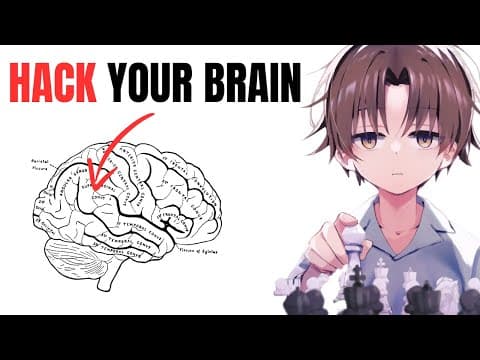
The video explores the concept of intelligence as a trainable skill rather than a fixed trait, using Ayanokoji as a fictional example. It emphasizes four pillars of intelligence: cognitive traits, knowledge and articulation, goal-directed intelligence, and integration traits.
-
Cognitive traits such as working memory, processing speed, pattern recognition, and logical reasoning are foundational to intelligence, each linked to specific brain functions and improvable through targeted activities like yoga nidra, exercise, and Socratic questioning.
-
Knowledge and articulation are crucial for expressing intelligence, enhanced by active reading. Goal-directed intelligence involves grit and emotional intelligence, essential for long-term success, while integration traits like systems thinking and abstraction enable complex problem-solving.
Read in Other Languages (beta)
Share This Summary 📚
Summarize YouTube Videos and Get Video Transcripts with 1-Click
Try YouTube Summary with ChatGPT & Claude or YouTube Transcript Generator
Explore More Summaries from Methodical Mind 📚





Summarize YouTube Videos and Get Video Transcripts with 1-Click
Try YouTube Summary with ChatGPT & Claude or YouTube Transcript Generator