How to Calculate Bound State Energy with Delta Function
TL;DR
Calculate the bound state energy for a quantum system with a delta function potential using the Schrodinger equation. By examining the continuity of the wave function and evaluating the discontinuity in its derivative, you can derive the relationship that defines the bound state energy.
Transcript
PROFESSOR: So, what is the wave function that we have? We must have a wave function now that is symmetric, and built with e to the k x, kappa x, and into the minus kappa x. This is the only possibility. E to the minus of kappa absolute value of x. This is psi of x for x different from 0. This is-- as you can quickly see-- this is e to get minus kap... Read More
Key Insights
- 🙃 The wave function for a system with a delta function potential is determined to be continuous and decaying exponentially on both sides of the origin.
- 🤘 The appearance of the delta function potential intensity in the numerator of the discontinuity equation is a positive sign for the behavior of the bound state.
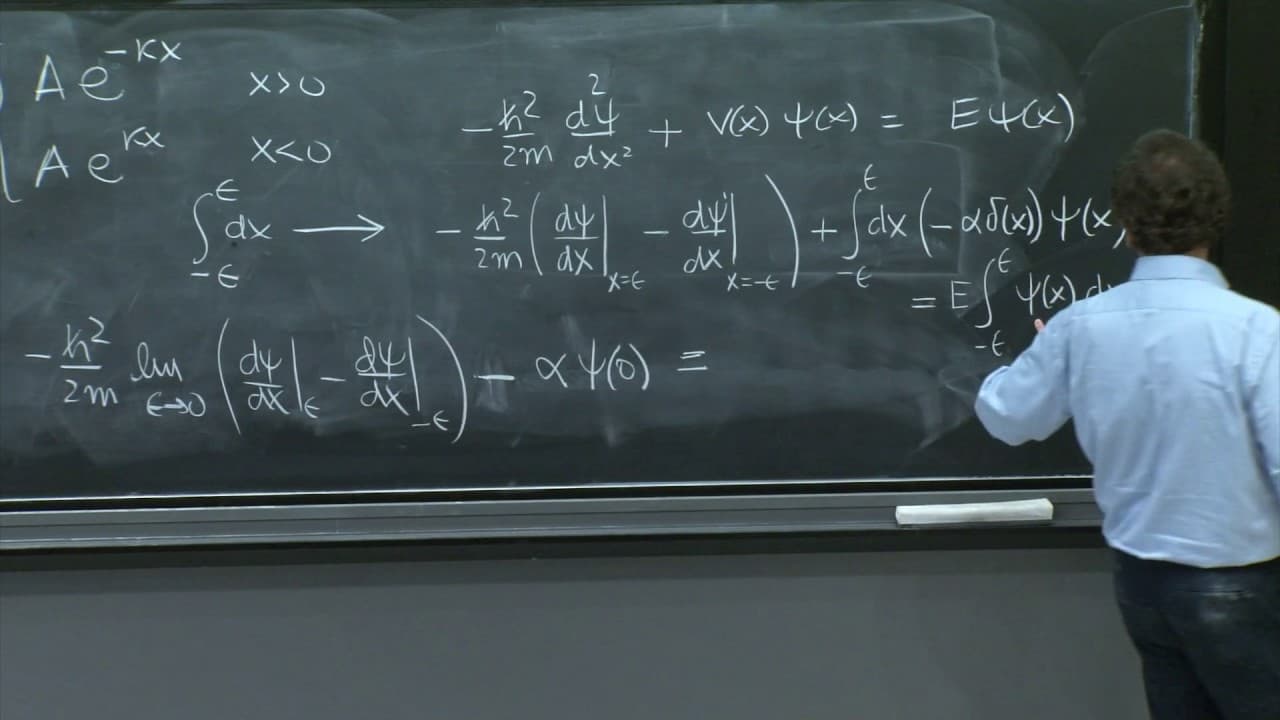
- 🙃 The discontinuity condition for the delta function potential is derived by integrating the Schrodinger equation and evaluating the derivative at both sides of zero.
Install to Summarize YouTube Videos and Get Transcripts
Explore YouTube Video Summarizer or Get YouTube Transcript Extractor
Questions & Answers
Q: How is the wave function for the system determined?
The wave function is determined to be a continuous function that decays exponentially on both sides of the origin. It is symmetric and can be represented as e to the minus kappa |x|, where kappa is a constant.
Q: What is the significance of the delta function potential intensity appearing in the numerator of the discontinuity equation?
The appearance of the delta function potential intensity in the numerator is a positive sign as it indicates that the bound state becomes deeper and more strongly bound as the potential becomes stronger. If it appeared in the denominator, it would imply an unphysical behavior where the bound state becomes less bound as the potential deepens.
Q: How is the discontinuity condition for the delta function potential derived?
The discontinuity condition is derived by integrating the Schrodinger equation from a small positive value to zero and taking the limit as the interval approaches zero. This results in a discontinuity in the derivative at zero, which is proportional to the value of the wave function at zero.
Q: How is the bound state energy calculated for the system?
The bound state energy is calculated by solving for the value of kappa, which is equal to m alpha over h squared, where m is the mass of the particle and alpha is the intensity of the delta function potential. The energy is then determined to be minus one half times m alpha squared.
Summary & Key Takeaways
-
The wave function for the system is determined to be a continuous function that decays exponentially on both sides of the origin.
-
The delta function potential is analyzed by integrating the Schrodinger equation from a small positive value to zero and taking the limit as the interval approaches zero.
-
By evaluating the discontinuity in the derivative at zero, it is found that the bound state energy is equal to minus one half times the proportional constant.
Read in Other Languages (beta)
Share This Summary 📚
Summarize YouTube Videos and Get Video Transcripts with 1-Click
Try YouTube Summary with ChatGPT & Claude or YouTube Transcript Generator
Explore More Summaries from MIT OpenCourseWare 📚


Summarize YouTube Videos and Get Video Transcripts with 1-Click
Try YouTube Summary with ChatGPT & Claude or YouTube Transcript Generator