Bakistry: The Science of Sweets | Lecture 9 (2012)

TL;DR
Recipes can be plotted as points on a graph by ignoring absolute amounts and charting only ingredient ratios, like flour on the x-axis and water on the y-axis. Brownie, sugar cookie, and pancake recipes each cluster in distinct regions, and empty spots between clusters hint at undiscovered foods a mathematician might invent.
Transcript
MICHAEL BRENNER: OK. So I guess we should start. Oops. Sorry, can I have my slide? OK, so I get to be the warm up act for Joanne tonight, which is really fun. So, OK, I promised Joanne this would be terrible. And it will be. So, OK, so it turns out that I've actually-- and I've never told her this. I've felt a kindred connection to Joanne ever sinc... Read More
Key Insights
- Recipe phase diagrams treat cooking like physics by plotting ingredient combinations as points on a graph, mapping where brownies, sugar cookies, and pancakes each cluster in ingredient space.
- The absolute amount of ingredients does not matter for these plots; only the relative ratios do, so a bread of 40% water and 60% flour becomes a single point on flour-versus-water axes.
- Only two or three ingredients can be plotted at once because a graph has at most three axes, so you pick favorite ingredients like sugar, cocoa powder, or flour to build each plot.
- The project downloaded every recipe from allrecipes.com into an Excel spreadsheet, requiring reading HTML source, finding patterns, and writing computer programs, a process Brenner calls a nightmare.
- Plotting all brownie recipes reveals they occupy only a small region of phase space, raising the question of what constrains recipes to that region rather than spreading everywhere.
- Two competing hypotheses explain recipe clustering: history, where a few creative chefs invent dishes others merely tinker with, and physics, where the laws of physics forbid untried combinations from working.
- Averaging two existing recipes, like Aunt Gail's oatmeal cookies and coconut rolled sugar cookies, does not clearly count as inventing a new recipe, though baker Joanne Chang says professionals do it all the time.
- Allrecipes.com enforces standards: when the team submitted a brownie recipe containing broccoli as a test, the site rejected it, showing recipe databases filter out implausible combinations.
Install to Summarize YouTube Videos and Get Transcripts
Explore YouTube Video Summarizer or Get YouTube Transcript Extractor
Questions & Answers
Q: What is a bakery phase diagram?
A bakery phase diagram is a plot that represents recipes as points based on their ingredient ratios. Michael Brenner explains you plot one ingredient on the x-axis, such as flour, and another on the y-axis, such as water, then place a dot where a given recipe falls. Because a graph has at most three axes, you pick a couple of favorite ingredients and chart how different recipes, like brownies or sugar cookies, cluster in that ingredient space.
Q: Why do only ingredient ratios matter and not absolute amounts?
Brenner states that the absolute amount of ingredients does not matter; all that really matters is the ratio, meaning the relative amounts of things. This lets a recipe be reduced to percentages that can be plotted as a single point. For example, a standard bread recipe of 40% water and 60% flour becomes one dot on a flour-versus-water plot, regardless of whether you make a small or large batch, because the proportions define the food.
Q: How did the team collect all the recipe data?
Elaine Angelino and Diana Cai downloaded all the recipes from allrecipes.com into an Excel spreadsheet, which Brenner notes may not have been legal. Turning the web pages into usable data was difficult: you have to look at the HTML source code, figure out the patterns, and write computer programs to extract the ingredients. Brenner repeatedly calls the process a nightmare, but once complete it let them plot every brownie, sugar cookie, and pancake recipe on the site.
Q: What are the two hypotheses for what constrains recipes?
Brenner proposes history and physics. Under history, only a few creative chefs in all of eternity invented new dishes, and everyone else just tinkers with them, so brownie recipes look the way they do simply because that is how brownies have always been. Under physics, the laws of physics are brutal: the recipes that can be invented have already been invented, and the recipes that have not been tried do not work. These explain why brownie recipes occupy only a small region of phase space.
Q: Who was involved in the bakery phase diagrams project?
The project was done with a graduate student and undergraduates at Harvard. Brenner highlights three people: Elaine Angelino, a computer science graduate student; Diana Cai, a computer science undergraduate; and Naveen, a graduate student he describes as a cooking extraordinaire and science and cooking person. He adds that a whole host of undergraduates also contributed. Brenner himself runs the Applied Math major at Harvard and led the effort as part of the science and cooking lecture series.
Q: Does averaging two recipes create a new recipe?
Brenner is skeptical. He gives the example of taking Aunt Gail's oatmeal cookies and coconut rolled sugar cookies and averaging them, then claiming you invented a new recipe. He argues that just taking two known things and averaging them is not genuinely new, since you would not call averaging new in any other part of life. Baker Joanne Chang counters twice that professionals do that all the time, and notes that mixing red and yellow makes a new color.
Q: How can you discover a new food using these plots?
According to Brenner, this is the only way a mathematician can create a new food. After plotting many existing recipes as points scattered across ingredient space, you look for a spot where there is a star, or gap, with no recipe present. Because no known food occupies that region, that empty point must correspond to a new, undiscovered food. He presents this half-jokingly as how mathematicians discover new foods, contrasting it with how actual chefs cook.
Q: What happened when the team submitted a broccoli brownie recipe?
To test whether allrecipes.com would accept any brownie recipe, Brenner and Elaine put up a recipe that contained broccoli as an ingredient. The site rejected it and would not take it. Brenner concludes that the database apparently does have some standards, meaning recipe collections filter out implausible or unappealing combinations rather than accepting anything. This experiment addressed how much the existing brownie recipes reflect real creativity versus being constrained by what counts as acceptable food.
Summary
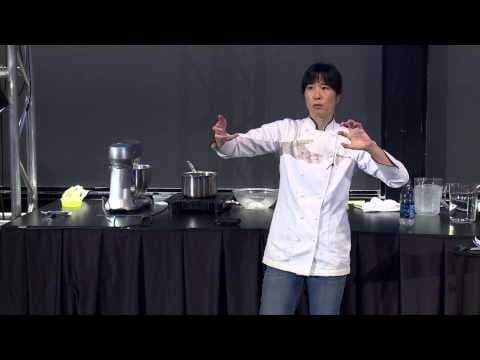
This video features a lecture by Joanne Chang and Professor David Weitz at Harvard University. Joanne, a baker and owner of Flour Bakery, discusses the relationship between science and baking, focusing mainly on cake. She explains the importance of leavening agents such as air, steam, yeast, and chemical leaveners like baking soda and baking powder. Joanne also talks about the role of eggs in emulsifying the cake batter and creating a light and airy texture. Additionally, she discusses the function of flour in providing structure to the cake.
Questions & Answers
Q: How does creaming butter and sugar together create air bubbles in the cake batter?
When butter and sugar are creamed together, the sugar crystals act like tiny garden hoes, aerating the butter and creating microscopic air bubbles. This process allows the cake batter to rise and become light and fluffy when heated in the oven.
Q: How do leavening agents like baking soda and baking powder work in a cake batter?
Baking soda reacts with acids, such as buttermilk or lemon juice, to create bubbles in the cake batter. This reaction occurs when the baking soda is mixed with liquid or heated in the oven. Baking powder, on the other hand, is a combination of baking soda and cream of tartar. It reacts with liquid and heat to create bubbles and leaven the cake batter.
Q: What is the role of eggs in cake baking?
Egg yolks act as emulsifiers, allowing the cake batter to mix with the liquid and fats more easily. They contribute to the texture, crumb, mouthfeel, and smoothness of the batter. Egg whites, when beaten, create a protein structure that can hold air, leading to a light and fluffy cake.
Q: How does flour contribute to the structure of a cake?
Flour provides the foundation and structure of the cake. When water is added to flour, the proteins within the flour gain strength and become elastic. This allows the cake to hold the weight of the sugar and fats in the batter.
Q: What are the different types of flour used in cake baking?
There are different types of flour, including bread flour, all-purpose flour, and cake flour. The main difference between these flours is the protein content. Bread flour has the highest protein content, all-purpose flour has a moderate protein content, and cake flour has the lowest protein content. The protein content affects the texture and structure of the cake.
Q: How does beating egg whites with sugar contribute to cake baking?
Adding sugar to beaten egg whites acts as a stiffener, allowing the protein strands to stay pulled and hold on to air. This results in a light and airy cake texture. However, if egg whites are overbeaten, the protein strands can snap and release water, resulting in a foamy texture.
Q: What are the different ways to leaven a cake batter?
Cake batters can be leavened by air, steam, yeast, and chemical leaveners. Air can be incorporated by creaming butter and sugar together or adding eggs to the batter. Steam is created when liquid in the batter turns to steam during baking. Yeast is a leavening agent that feeds on sugars in the dough, releasing carbon dioxide gas. Chemical leaveners like baking soda and baking powder create bubbles when they react with acids or heat.
Q: Can baking soda and baking powder be used interchangeably in cake baking?
Baking soda and baking powder are not interchangeable. Baking soda requires an acidic ingredient in the batter to react and create bubbles. Baking powder already contains an acidic ingredient (cream of tartar) and can produce bubbles with the addition of liquid or heat.
Q: How does the protein content of flour affect cake texture?
The protein content of flour affects the texture of the cake. Higher protein flours, like bread flour, create a firmer and chewier texture. Lower protein flours, like cake flour, create a softer and more delicate texture.
Q: What is the role of emulsification in cake baking?
Emulsification, achieved with the help of egg yolks, brings together disparate ingredients like oil/fat and water/liquid, allowing them to mix and create a homogeneous batter. This emulsified batter can hold more air, resulting in a lighter cake texture.
Takeaways
This lecture highlights the scientific aspects of baking, particularly focusing on cake baking. The importance of leavening agents, such as air, steam, yeast, and chemical leaveners, is emphasized in creating a light and fluffy texture. The role of eggs in emulsification and providing structure, as well as the function of flour in holding the cake together, is explained. Understanding these scientific principles can help achieve better baking results.
Summary & Key Takeaways
-
Michael Brenner, who runs the Applied Math major at Harvard, presents 'bakery phase diagrams' as a warm-up for Joanne Chang of Flour Bakery, joking that this is what happens when a mathematician thinks about baking, and noting Chang herself was a Harvard Applied Mathematics graduate.
-
The method focuses only on recipe ingredients, not directions, and treats only ratios as meaningful. Each recipe becomes a point plotted on axes like flour and water. Working with students Elaine Angelino, Diana Cai, and Naveen, the team downloaded all allrecipes.com recipes to plot them.
-
Plotting brownies, sugar cookies, and pancakes shows each recipe type clusters in a small region, prompting the question of what constrains them. Two hypotheses are offered, history versus physics, and a broccoli-brownie test rejected by the site suggests databases enforce real standards on what counts as food.
Read in Other Languages (beta)
Share This Summary 📚
Summarize YouTube Videos and Get Video Transcripts with 1-Click
Try YouTube Summary with ChatGPT & Claude or YouTube Transcript Generator
Explore More Summaries from Harvard University 📚

Summarize YouTube Videos and Get Video Transcripts with 1-Click
Try YouTube Summary with ChatGPT & Claude or YouTube Transcript Generator