Image analysis: homography: planar homography
TL;DR
Planar surfaces can be reconstructed from images using homography.
Transcript
Read and summarize the transcript of this video on Glasp Reader (beta).
Key Insights
- Planar homography allows for the reconstruction of flat surfaces from images, leveraging the known aspect ratio and image coordinates.
- The transformation matrix for planar surfaces is invertible, enabling reconstruction of the original world view from a distorted image.
- Homographies are particularly useful in scenarios where the object of interest is flat, such as signs, papers, or license plates.
- The process involves estimating a 3x3 matrix that maps world coordinates to image coordinates, allowing for perspective correction.
- Planar surfaces do not lose information during the imaging process, unlike three-dimensional objects, due to the nature of the homography matrix.
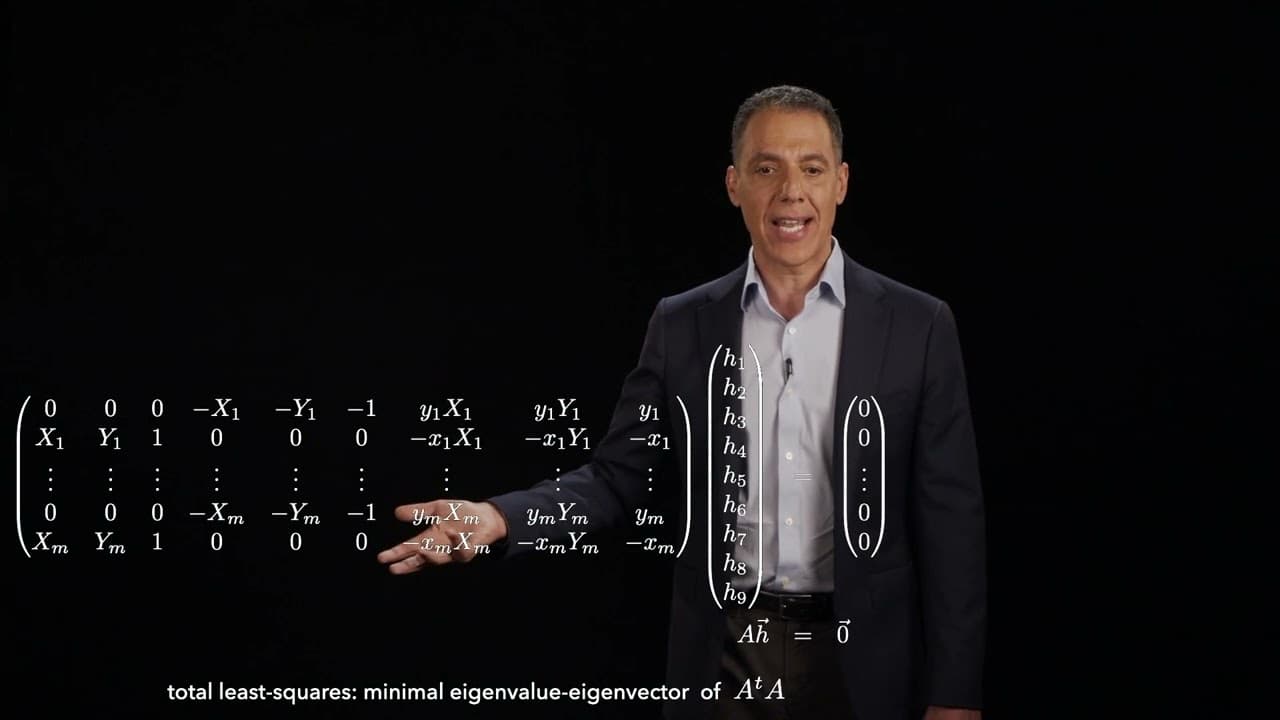
- The estimation of homography is performed using linear equations derived from known world and image points, solved via eigenvalue decomposition.
- Practical applications include forensics, where identifying objects like license plates from images taken at angles is crucial.
- Even without knowledge of the exact aspect ratio, assuming a square planar surface can still yield useful reconstruction results.
Install to Summarize YouTube Videos and Get Transcripts
Explore YouTube Video Summarizer or Get YouTube Transcript Extractor
Questions & Answers
Q: What is planar homography?
Planar homography is a mathematical technique used in computer vision to reconstruct flat surfaces from images. It involves using a 3x3 transformation matrix to map world coordinates to image coordinates, allowing for the correction of perspective distortions in images of planar objects.
Q: How does planar homography differ from 3D object imaging?
Planar homography differs from 3D object imaging in that it deals with flat surfaces, which do not lose information during the imaging process. The transformation matrix used in planar homography is invertible, unlike the 3x4 matrix used for 3D objects, which results in information loss due to dimensionality reduction.
Q: Why is the transformation matrix in planar homography invertible?
The transformation matrix in planar homography is invertible because it is a 3x3 matrix mapping a two-dimensional world to a two-dimensional image. This invertibility allows for the reconstruction of the original world view from a distorted image, unlike the 3D imaging process where information is lost.
Q: What are the practical applications of planar homography?
Practical applications of planar homography include forensics, where it is used to identify objects such as license plates from images taken at angles. It is also useful in any scenario where flat objects need to be analyzed or reconstructed from distorted images, such as signs or papers.
Q: How is the homography matrix estimated?
The homography matrix is estimated by setting up a system of linear equations using known world and image points. These equations are solved using techniques like eigenvalue decomposition to find the nine parameters of the homography matrix, which maps world coordinates to image coordinates.
Q: What role does aspect ratio play in planar homography?
Aspect ratio is crucial in planar homography as it helps define the world coordinates of the planar object being imaged. Knowing the aspect ratio allows for accurate mapping of world coordinates to image coordinates, enabling precise reconstruction of the object's original appearance.
Q: Can planar homography work without knowing the exact aspect ratio?
Yes, planar homography can still be effective without knowing the exact aspect ratio. Assuming a square planar surface can yield useful reconstruction results, allowing for analysis and correction of perspective distortions even when the precise dimensions are unknown.
Q: What challenges exist in applying planar homography?
Challenges in applying planar homography include accurately identifying corresponding points in the world and image, handling non-planar features that violate the homography assumptions, and ensuring that the estimated transformation matrix is precise enough for effective reconstruction.
Summary & Key Takeaways
-
Planar homography is a technique in computer vision that allows the reconstruction of flat surfaces from images. By knowing the aspect ratio and image coordinates, one can map world coordinates to image coordinates using a 3x3 matrix, enabling perspective correction.
-
Unlike three-dimensional objects, planar surfaces do not lose information during imaging, as the transformation matrix is invertible. This makes planar homography particularly useful for analyzing objects like signs or license plates in distorted images.
-
The estimation of homography involves solving linear equations derived from known world and image points. This process is crucial in applications such as forensics, where accurately identifying objects from images is important.
Read in Other Languages (beta)
Share This Summary 📚
Summarize YouTube Videos and Get Video Transcripts with 1-Click
Try YouTube Summary with ChatGPT & Claude or YouTube Transcript Generator