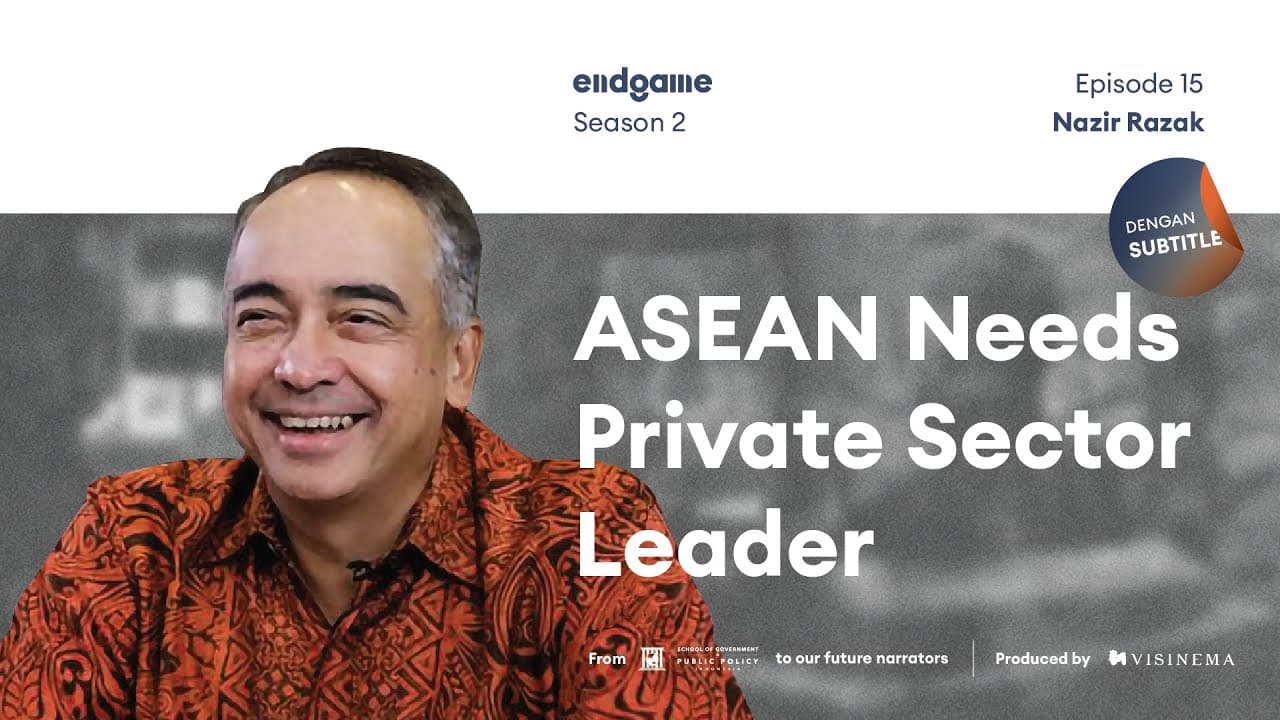
Nazir Razak: Reform and Recalibrate | Endgame #28
TL;DR
Nazir Razak discusses ASEAN's dynamics, Malaysia's politics, and CIMB's growth.
Transcript
All right. Now I look at ASEAN as being Indonesia's platform. It is by far the biggest country. It's today trying to take a leadership role, it has the largest economy, it has pretty stable democracy, it has quite strong institutions, ASEAN Secretariat is already there. But unfortunately I don't get a sense that Indonesia is very committed to ... Read More
Key Insights
- Nazir Razak views ASEAN as a platform for Indonesia to take a leadership role due to its size and economy, but expresses concern over Indonesia's commitment to ASEAN.
- Nazir's early life was shaped by his father's political career, leading to a unique upbringing and eventual shift from government aspirations to a successful career in banking.
- CIMB's transformation from a small merchant bank to a leading ASEAN bank was driven by strategic acquisitions and a focus on investment banking and fixed income during financial crises.
- The ASEAN Economic Community's promise of integration has not fully materialized, impacting cross-border banking synergies and regulatory challenges.
- Nazir highlights Malaysia's political transition and the need for systemic reform to address identity politics, economic policies, and institutional weaknesses.
- He advocates for a National Consultative Council to recalibrate Malaysia's political and economic systems, drawing from historical and international examples.
- Nazir discusses the challenges of digital transformation in banking, emphasizing the need for offline innovation and integration into traditional banking structures.
- He stresses the importance of regional integration in ASEAN to compete globally and suggests private sector involvement in ASEAN's economic leadership.
Install to Summarize YouTube Videos and Get Transcripts
Explore YouTube Video Summarizer or Get YouTube Transcript Extractor
Questions & Answers
Q: What role does Nazir Razak see for Indonesia in ASEAN?
Nazir Razak views Indonesia as having the potential to take a leadership role within ASEAN due to its size, economy, and stable democracy. However, he expresses concern over Indonesia's commitment to ASEAN, suggesting that strong political will from the top is needed to champion ASEAN integration and overcome local resistance to competition.
Q: How did Nazir Razak's upbringing influence his career path?
Nazir Razak's upbringing was heavily influenced by his father's political career, which exposed him to a unique environment of privilege and responsibility. Initially considering a career in government, he shifted to banking after realizing the private sector's growing importance in Malaysia during the late 1980s. His background instilled a sense of independence and a drive to challenge established systems, which he carried into his banking career.
Q: What were the key factors in CIMB's growth under Nazir Razak?
Under Nazir Razak's leadership, CIMB grew from a small merchant bank to a leading ASEAN bank through strategic acquisitions and a focus on investment banking. Key factors included capitalizing on the IPO market, investing in fixed income during financial crises, and expanding through acquisitions across ASEAN. Nazir emphasized adaptability, market understanding, and leveraging regional opportunities as critical to CIMB's success.
Q: What challenges does ASEAN face in achieving economic integration?
ASEAN faces challenges in achieving economic integration due to regulatory barriers, lack of political commitment, and uneven benefits among member countries. Nazir highlights the need for a more engaged private sector and suggests appointing a private sector leader to drive economic integration. The current bureaucratic approach often lacks alignment with business needs, hindering effective collaboration and growth.
Q: What systemic reforms does Nazir Razak propose for Malaysia?
Nazir Razak proposes establishing a National Consultative Council to address systemic issues in Malaysia, such as identity politics, economic policies, and institutional weaknesses. Drawing from historical and international examples, he suggests a deliberative platform involving intellectuals and public representation to debate and propose reforms. The goal is to recalibrate Malaysia's political and economic systems for long-term stability and growth.
Q: How does Nazir Razak view the digital transformation in banking?
Nazir Razak sees digital transformation in banking as a critical challenge, requiring banks to leverage their customer base and brand to adapt. He emphasizes the difficulty of transforming within traditional bank structures due to legacy systems and resistance from established bankers. Nazir advocates for creating digital banks offline to foster entrepreneurial innovation and later integrate them into the main organization.
Q: What opportunities does Nazir Razak see for ASEAN in the global economy?
Nazir Razak sees ASEAN as a natural alternative to China for global supply chains, emphasizing the need for regional integration to serve as a manufacturing base. He highlights the potential for ASEAN to capitalize on its large market and strategic location, but stresses the importance of overcoming internal competition and regulatory barriers to fully realize this potential.
Q: What is Nazir Razak's perspective on private equity and ASEAN integration?
Nazir Razak views private equity as a crucial platform for supporting ASEAN integration by filling the financing gap left by banks. His firm, Ikhlas Capital, focuses on supporting entrepreneurs and facilitating cross-border expansion within ASEAN. Nazir believes that private equity can play a key role in building regional businesses and enhancing economic collaboration across ASEAN.
Summary & Key Takeaways
-
Nazir Razak shares insights on ASEAN's potential as a platform for Indonesia's leadership, emphasizing the need for stronger commitment and integration. He reflects on his journey from a political family background to leading CIMB's transformation into a major ASEAN bank.
-
The discussion covers Malaysia's political landscape, highlighting the need for systemic reform to address identity politics and economic disparities. Nazir advocates for a National Consultative Council to recalibrate Malaysia's political and economic systems.
-
Nazir emphasizes the challenges of digital transformation in banking and the importance of ASEAN integration for regional competitiveness. He suggests private sector involvement in ASEAN's economic leadership to enhance collaboration and growth.
Read in Other Languages (beta)
Share This Summary 📚
Summarize YouTube Videos and Get Video Transcripts with 1-Click
Try YouTube Summary with ChatGPT & Claude or YouTube Transcript Generator
Explore More Summaries from Gita Wirjawan 📚






Summarize YouTube Videos and Get Video Transcripts with 1-Click
Try YouTube Summary with ChatGPT & Claude or YouTube Transcript Generator