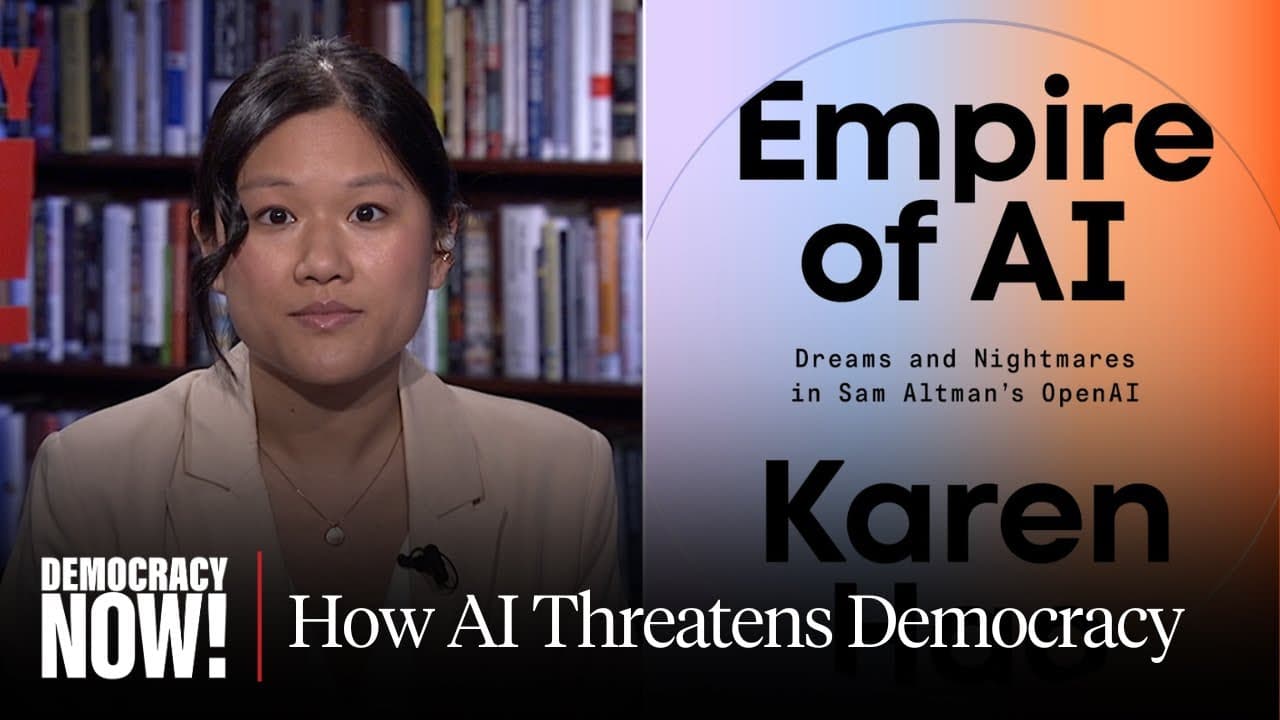
"Empire of AI": Karen Hao on How AI Is Threatening Democracy & Creating a New Colonial World
TL;DR
AI development is likened to modern colonialism, impacting resources and democracy.
Transcript
Read and summarize the transcript of this video on Glasp Reader (beta).
Key Insights
- Karen Hao's book, 'Empire of AI,' critiques AI development as a modern form of colonialism, exploiting global resources and labor.
- AI models require vast amounts of data and computing power, leading to significant environmental impacts, including high energy and water consumption.
- The expansion of AI infrastructure is often in water-scarce regions, exacerbating local resource shortages and environmental stress.
- Silicon Valley's AI companies are increasingly partnering with defense sectors to recoup development costs, raising ethical concerns.
- Data annotation firms in the Global South, like those in Kenya, are exploited for cheap labor to clean data for AI models.
- OpenAI's development strategy reflects a 'scale at all costs' approach, heavily reliant on capital and resulting in significant social and environmental costs.
- Sam Altman, CEO of OpenAI, has positioned the company as a leader in AI by securing massive investments and pursuing aggressive growth strategies.
- Legislative moves in the U.S. aim to prevent state-level regulation of AI, potentially entrenching the power of tech giants and limiting accountability.
Install to Summarize YouTube Videos and Get Transcripts
Explore YouTube Video Summarizer or Get YouTube Transcript Extractor
Questions & Answers
Q: What is the central theme of Karen Hao's book 'Empire of AI'?
Karen Hao's book 'Empire of AI' explores the idea that the development of AI mirrors colonial practices, where powerful tech companies exploit global resources and labor. The book critiques how AI's growth is driven by a 'scale at all costs' mentality, leading to significant environmental and social challenges.
Q: How does AI development impact environmental resources?
AI development requires vast computing power and data, leading to high energy and water consumption. This often results in environmental degradation, as data centers are placed in water-scarce regions and rely on fossil fuels. The industry's growth exacerbates resource scarcity and contributes to climate change.
Q: What role do data annotation firms play in AI development?
Data annotation firms, often located in the Global South, are crucial for preparing data for AI models. They employ low-wage workers to clean and categorize data, a process necessary for training AI systems. This labor is often exploitative, with workers facing poor conditions and low pay.
Q: Why are AI companies partnering with the defense sector?
AI companies partner with the defense sector to secure funding and recoup the high costs of developing AI technologies. The defense industry offers substantial financial resources, making it an attractive partner for tech companies seeking to monetize their innovations and sustain growth.
Q: How has OpenAI's development strategy affected its growth?
OpenAI's development strategy focuses on scaling AI technologies rapidly, requiring significant investment and resources. This approach has positioned OpenAI as a leader in the AI industry but also raises concerns about the ethical and environmental impacts of such aggressive expansion.
Q: What are the implications of preventing state-level AI regulation in the U.S.?
Preventing state-level AI regulation could entrench the power of tech giants, allowing them to operate with less accountability. This legislative move could limit oversight and exacerbate the social and environmental impacts of AI, as companies may prioritize profit over public interest.
Q: How does the book 'Empire of AI' relate to colonialism?
The book 'Empire of AI' draws parallels between AI development and colonialism by highlighting how tech companies exploit global resources and labor. It critiques the industry's impact on vulnerable regions, where environmental degradation and economic disparities mirror historical colonial practices.
Q: What challenges do communities face due to AI data centers?
Communities near AI data centers often face resource shortages, particularly water scarcity, as these centers consume vast amounts of freshwater. This exacerbates existing environmental and social challenges, leading to conflicts over resource allocation and highlighting the need for sustainable development practices.
Summary & Key Takeaways
-
Karen Hao's book 'Empire of AI' explores the parallels between AI development and colonial practices, highlighting the exploitation of global resources and labor. The book critiques the environmental and social impacts of AI, particularly focusing on OpenAI's role in this trajectory.
-
AI development requires significant energy and water resources, often sourced from vulnerable regions. This has led to environmental degradation and resource scarcity, raising ethical concerns about the industry's sustainability and impact on local communities.
-
The AI industry's reliance on cheap labor in the Global South for data annotation highlights economic disparities and exploitation. Workers face poor conditions and low pay, while the industry's rapid growth continues to prioritize profit over social responsibility.
Read in Other Languages (beta)
Share This Summary 📚
Summarize YouTube Videos and Get Video Transcripts with 1-Click
Try YouTube Summary with ChatGPT & Claude or YouTube Transcript Generator
Explore More Summaries from Democracy Now! 📚





Summarize YouTube Videos and Get Video Transcripts with 1-Click
Try YouTube Summary with ChatGPT & Claude or YouTube Transcript Generator