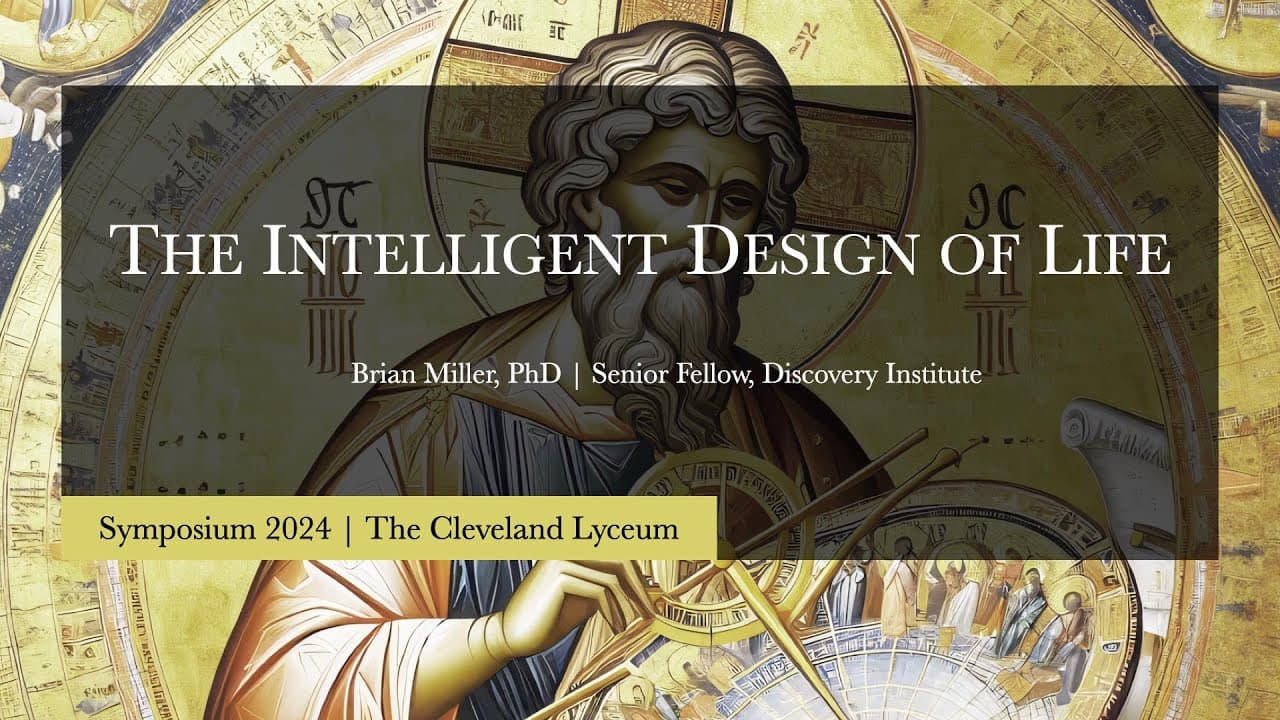
The Intelligent Design of Life
TL;DR
Dr. Brian Miller argues for intelligent design over Darwinian evolution.
Transcript
Read and summarize the transcript of this video on Glasp Reader (beta).
Key Insights
- Dr. Brian Miller critiques Darwinian evolution, emphasizing that the similarities in species are better explained by a common designer rather than random mutations.
- He argues that the fossil record, particularly the Cambrian explosion, contradicts the gradual transformations proposed by Darwinian evolution.
- Miller highlights that mutations leading to significant changes are typically harmful, challenging the notion that random mutations drive large-scale evolutionary changes.
- The time required for evolutionary changes, such as a land animal evolving into a whale, is mathematically insufficient according to Miller.
- He suggests that life exhibits top-down engineering principles, reflecting intelligent design rather than random, undirected processes.
- Miller points out that biological systems often display optimal design, contrary to claims of poor design by some evolutionary biologists.
- He argues that the origin of life presents indisputable evidence for design, as current scientific understanding deems it impossible through natural processes alone.
- Miller criticizes the reliance on natural selection as a fictitious explanation for the appearance of design without acknowledging a designer.
Install to Summarize YouTube Videos and Get Transcripts
Explore YouTube Video Summarizer or Get YouTube Transcript Extractor
Questions & Answers
Q: Why does Dr. Brian Miller believe the fossil record contradicts Darwinian evolution?
Dr. Brian Miller argues that the fossil record, particularly the Cambrian explosion, shows the sudden appearance of diverse life forms rather than gradual transformations. This sudden emergence challenges the Darwinian model of slow, incremental changes over time, suggesting instead that life forms appeared fully formed, supporting the idea of intelligent design.
Q: What is Dr. Miller's stance on mutations and their role in evolution?
Dr. Miller contends that mutations leading to significant changes are typically harmful, undermining the idea that random mutations drive large-scale evolutionary changes. He argues that beneficial mutations are often minor and degrade information, making it implausible for such mutations to accumulate into the complex structures observed in life today.
Q: How does Dr. Miller address the issue of time scales in evolutionary theory?
Dr. Miller argues that the time scales proposed for evolutionary changes, such as a land animal evolving into a whale, are mathematically insufficient. He claims that the time required for accumulating the necessary mutations far exceeds the available time frame, making such transformations implausible without invoking intelligent design.
Q: What engineering principles does Dr. Miller find in biological systems?
Dr. Miller identifies top-down engineering principles in biological systems, suggesting that life is designed with purpose. He points out that biological systems exhibit optimal design, with components perfectly engineered to function together, reflecting intelligent design rather than random, undirected processes. This challenges the notion of life as a product of evolution.
Q: How does Dr. Miller refute claims of poor design in biology?
Dr. Miller refutes claims of poor design by demonstrating that many systems previously thought to be inefficient or flawed are actually optimally designed. He provides examples, such as the human eye and ankle-foot complex, where deeper understanding reveals advanced engineering principles, suggesting intelligent design rather than evolutionary mishaps.
Q: What evidence does Dr. Miller present for the design in the origin of life?
Dr. Miller argues that the origin of life presents indisputable evidence for design, as current scientific understanding deems it impossible for life to emerge through natural processes alone. He highlights the complexity and interdependence of cellular systems, which require advanced engineering principles, suggesting that life was intelligently designed from the outset.
Q: How does Dr. Miller critique the role of natural selection in evolution?
Dr. Miller critiques the role of natural selection by arguing that it is often used as a fictitious explanation for the appearance of design without acknowledging a designer. He suggests that natural selection is invoked as a secular demigod to justify evolutionary changes, despite lacking evidence for its ability to drive large-scale transformations.
Q: What historical context does Dr. Miller provide for the evolution debate?
Dr. Miller traces the evolution debate back to ancient Greece, highlighting how materialistic and atomistic views influenced Darwin's assumptions. He critiques Darwin's portrayal as an objective seeker of truth, suggesting that his materialistic worldview shaped his interpretation of biological data, leading to the modern evolutionary narrative that lacks sufficient evidence for large-scale changes.
Summary & Key Takeaways
-
Dr. Brian Miller presents a case for intelligent design, critiquing Darwinian evolution by highlighting inconsistencies in the fossil record and the nature of mutations. He argues that many biological systems reflect optimal design, contrary to evolutionary claims of poor design. Miller emphasizes that the origin of life displays evidence of design, challenging naturalistic explanations.
-
Miller discusses the historical context of the evolution debate, tracing ideas back to ancient Greece. He highlights Darwin's materialistic assumptions and critiques the modern evolutionary narrative as lacking evidence for large-scale changes. According to Miller, the time scales and genetic mutations required for such changes are mathematically implausible.
-
The presentation explores how engineering principles apply to biological systems, suggesting intelligent design. Miller argues that life exhibits top-down design, with systems engineered to work optimally. He challenges the assumption that life should appear poorly designed, citing examples where further understanding reveals optimal functionality.
Read in Other Languages (beta)
Share This Summary 📚
Summarize YouTube Videos and Get Video Transcripts with 1-Click
Try YouTube Summary with ChatGPT & Claude or YouTube Transcript Generator
Explore More Summaries from Discovery Science 📚



Summarize YouTube Videos and Get Video Transcripts with 1-Click
Try YouTube Summary with ChatGPT & Claude or YouTube Transcript Generator