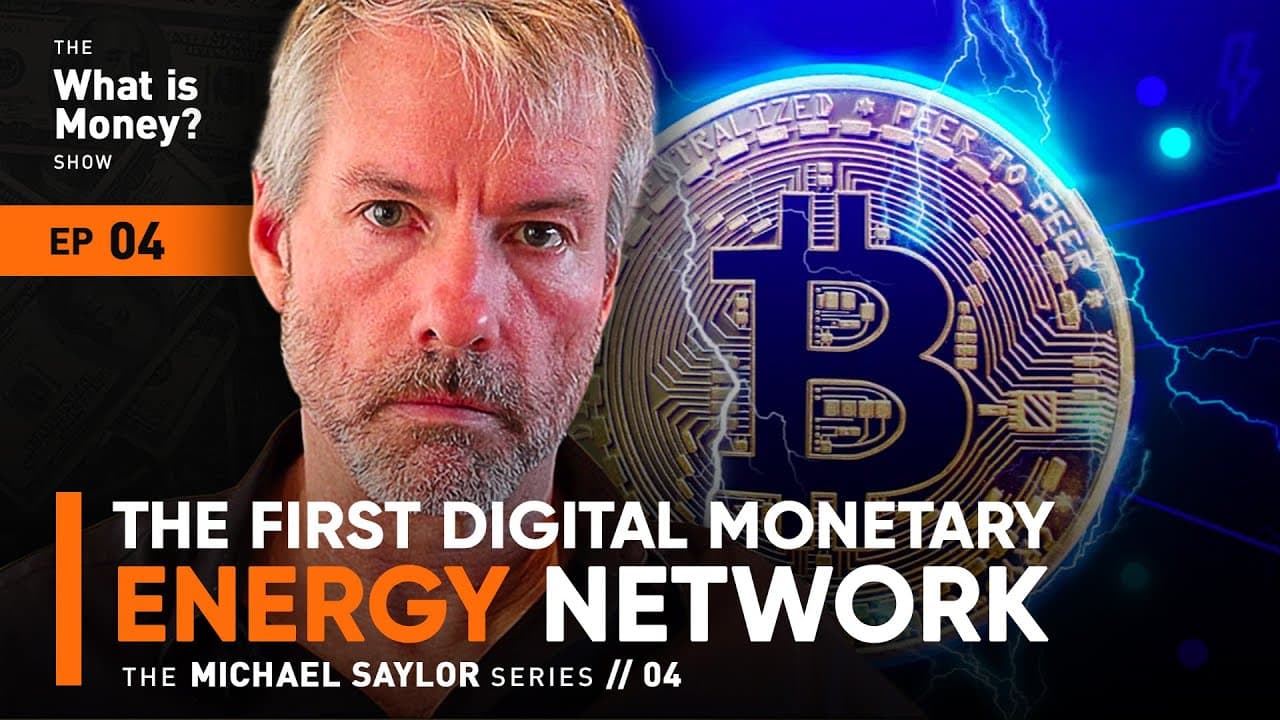
Bitcoin: The First Digital Monetary Energy Network | The Saylor Series | Episode 4 (WiM004)
TL;DR
Bitcoin is the first true digital monetary network, revolutionizing energy and value transfer.
Transcript
Read and summarize the transcript of this video on Glasp Reader (beta).
Key Insights
- Bitcoin is described as the first digital monetary energy network, offering a revolutionary way to channel and store energy across time and space.
- Money is considered the highest form of energy that humans can channel, with Bitcoin representing a new era of digital energy.
- The inefficiencies of traditional energy networks, such as power grids and gold, highlight Bitcoin's advantages in durability and cost-effectiveness.
- Gold has historically been the king of commodities but suffers from significant energy loss over time due to mining, counterparty risk, and centralization.
- Bitcoin is 1000 times faster and 50,000 times cheaper to transfer than gold, making it a superior medium for value transfer.
- Bitcoin's network is likened to a superconducting energy network, minimizing friction and maximizing efficiency.
- Bitcoin's algorithmic structure resists commodification, unlike traditional commodities, which are prone to overproduction and margin compression.
- Transaction fees in the Bitcoin network are essential, providing the necessary friction to maintain network security and incentivize miners.
Install to Summarize YouTube Videos and Get Transcripts
Explore YouTube Video Summarizer or Get YouTube Transcript Extractor
Questions & Answers
Q: What makes Bitcoin the first true digital monetary network?
Bitcoin is the first true digital monetary network because it offers a decentralized, trust-minimized system for storing and transferring value. It eliminates counterparty risk and has a fixed supply, making it fundamentally different from previous digital money attempts. Its efficiency in channeling energy across time and space sets it apart from traditional systems like gold and fiat currency.
Q: How does Bitcoin compare to gold as a store of value?
Bitcoin surpasses gold as a store of value due to its superior efficiency, speed, and cost-effectiveness. While gold suffers from significant energy loss over time due to mining, counterparty risk, and centralization, Bitcoin offers a lossless system with a fixed supply. It is 1000 times faster and 50,000 times cheaper to transfer than gold, making it a more reliable and secure medium for value transfer.
Q: What role do transaction fees play in the Bitcoin network?
Transaction fees in the Bitcoin network are essential for maintaining network security and incentivizing miners. They provide the necessary friction to ensure the network's stability and functionality. Unlike traditional systems where fees are often non-consensual and inefficient, Bitcoin's transaction fees are competitive and consensual, supporting the network's long-term sustainability.
Q: Why is Bitcoin considered a superconducting energy network?
Bitcoin is considered a superconducting energy network because it minimizes friction and maximizes efficiency in transferring value. It achieves this by eliminating unexpected inflation and counterparty risk, providing a lossless channel for monetary energy. This efficiency allows Bitcoin to channel energy across time and space more effectively than any previous system, revolutionizing global finance.
Q: How does Bitcoin resist commodification?
Bitcoin resists commodification through its algorithmic structure, which adjusts the supply flow every four years, effectively pushing back against the downward pressure on production costs. This mechanism ensures that Bitcoin's value is not subject to the same overproduction and margin compression that affects traditional commodities, making it a more stable and reliable store of value.
Q: What are the inefficiencies of traditional energy networks compared to Bitcoin?
Traditional energy networks, such as power grids and gold, suffer from inefficiencies like significant energy loss, counterparty risk, and high costs. Power grids have limitations in energy storage and transmission distance, while gold faces challenges in transportation and storage. Bitcoin, on the other hand, offers a more efficient system with lower costs and greater security, transforming how energy is channeled and stored.
Q: What is the significance of Bitcoin's fixed supply?
Bitcoin's fixed supply is significant because it eliminates the risk of unexpected inflation, providing a predictable and stable store of value. This fixed supply, capped at 21 million coins, ensures scarcity and drives demand, making Bitcoin a reliable medium for long-term value preservation. It contrasts with fiat currencies and traditional commodities, which are prone to inflation and supply manipulation.
Q: How does Bitcoin's network security compare to traditional systems?
Bitcoin's network security is superior to traditional systems due to its decentralized structure and consensus mechanism. It operates on a proof-of-work protocol, where miners compete to validate transactions and secure the network. This system minimizes the risk of fraud and manipulation, providing a more secure environment for value transfer compared to centralized systems that are vulnerable to attacks and corruption.
Summary & Key Takeaways
-
Bitcoin is described as the first digital monetary energy network, transforming how energy is channeled and stored. It offers unparalleled efficiency and resilience, surpassing traditional systems like gold and fiat currency.
-
The episode explores the inefficiencies of traditional energy networks, emphasizing Bitcoin's advantages in speed, cost-effectiveness, and security. It highlights how Bitcoin resists commodification, unlike other commodities prone to overproduction.
-
Bitcoin's transaction fees are essential for network security, providing the necessary friction to incentivize miners. The episode underscores Bitcoin's potential to revolutionize global finance by offering a lossless monetary system over time.
Read in Other Languages (beta)
Share This Summary 📚
Summarize YouTube Videos and Get Video Transcripts with 1-Click
Try YouTube Summary with ChatGPT & Claude or YouTube Transcript Generator
Explore More Summaries from Robert Breedlove 📚






Summarize YouTube Videos and Get Video Transcripts with 1-Click
Try YouTube Summary with ChatGPT & Claude or YouTube Transcript Generator