Taiwan election angers China: BBC News Review
TL;DR
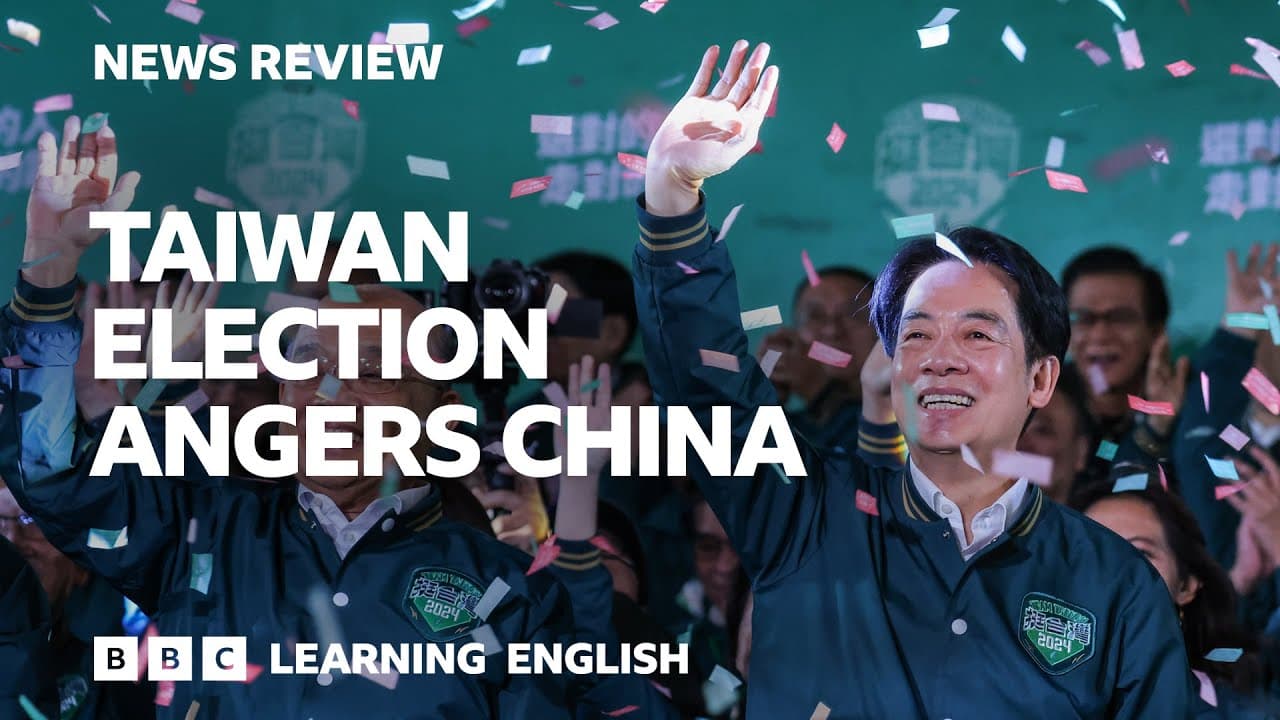
Taiwan's election angers China, maintaining the political status quo.
Transcript
Taiwan elects new president, angering Beijing. This is News Review from BBC Learning English, where we help you understand news headlines in English. I'm Beth. And I'm Georgie. Make sure you watch to the end to learn the vocabulary you need to talk about this story. And don't forget to subscribe to our channel to learn more English from the headlin... Read More
Key Insights
- Taiwan has elected William Lai as president, keeping the Democratic Progressive Party in power for a third consecutive term, signaling continuity in its political landscape.
- The new president, William Lai, seeks to maintain Taiwan's independence, a stance that has provoked a strong reaction from Beijing.
- China desires a peaceful reunification with Taiwan but has not dismissed the possibility of using force, highlighting regional tensions.
- The phrase 'status quo' refers to maintaining the current state of affairs, as Taiwan re-elects the same party, indicating no major political shifts.
- Beijing is described as 'fuming' over the election results, using the term metaphorically to express extreme anger or frustration.
- The United States has expressed 'rock solid' support for Taiwan, indicating unwavering commitment and strong diplomatic ties.
- The term 'rock solid' metaphorically describes something very strong or unlikely to change, such as the US's support for Taiwan.
- The content emphasizes the importance of understanding key English vocabulary to discuss international political events effectively.
Install to Summarize YouTube Videos and Get Transcripts
Explore YouTube Video Summarizer or Get YouTube Transcript Extractor
Questions & Answers
Q: What is the significance of William Lai's election as Taiwan's president?
William Lai's election as Taiwan's president signifies the continuation of the Democratic Progressive Party's governance for a third term. His stance on maintaining Taiwan's independence has angered China, which desires peaceful reunification, thus maintaining regional tensions. The election results indicate the Taiwanese people's preference for the current political direction.
Q: How does China view the recent election in Taiwan?
China views the recent election in Taiwan with anger and frustration, as indicated by the term 'fuming' used in the content. Beijing's desire for peaceful reunification contrasts sharply with Taiwan's re-election of a pro-independence leader, William Lai, which complicates China's diplomatic and strategic objectives in the region.
Q: What does the term 'status quo' mean in the context of the Taiwan election?
In the context of the Taiwan election, 'status quo' refers to the continuation of the existing political state, with the Democratic Progressive Party remaining in power. This term highlights that despite the election of a new president, the political landscape remains unchanged, reflecting the electorate's preference for stability and continuity.
Q: What is the metaphorical meaning of 'fumes' in the context of the election?
Metaphorically, 'fumes' in the context of the election describes China's extreme anger or frustration over Taiwan's political decision. Instead of referring to literal smoke, it conveys the intensity of Beijing's displeasure with the election outcome, which opposes China's reunification goals with Taiwan.
Q: How does the United States' stance on Taiwan reflect in the content?
The United States' stance on Taiwan is described as 'rock solid,' indicating unwavering support and strong diplomatic ties. This metaphorical expression underscores the US's commitment to Taiwan amidst regional tensions and reflects its strategic interest in maintaining stability and supporting Taiwan's political autonomy.
Q: What does 'rock solid' imply about US-Taiwan relations?
'Rock solid' implies that US-Taiwan relations are very strong and unlikely to change. This expression suggests a firm commitment from the US to support Taiwan, reinforcing diplomatic and strategic ties in the face of external pressures from China and maintaining regional stability.
Q: Why is understanding the vocabulary used in the news important?
Understanding the vocabulary used in the news is crucial for effectively discussing and interpreting international political events. Terms like 'status quo,' 'fumes,' and 'rock solid' carry nuanced meanings that convey the complexities of diplomatic relations and political stances, enhancing comprehension and communication skills.
Q: What role does the BBC Learning English play in the context of this content?
BBC Learning English plays an educational role by helping viewers understand news headlines and key vocabulary related to international events. Through explanations and examples, it aims to improve English language proficiency, enabling learners to engage with global news stories and discussions more effectively.
Summary & Key Takeaways
-
Taiwan has re-elected the Democratic Progressive Party with William Lai as president, maintaining the political status quo and angering China, which seeks reunification.
-
The election results have led to Beijing's 'fuming' reaction, highlighting the strained relations between China and Taiwan over issues of sovereignty and independence.
-
The United States has reiterated its 'rock solid' support for Taiwan, emphasizing strong diplomatic relations and commitment amidst regional tensions.
Read in Other Languages (beta)
Share This Summary 📚
Summarize YouTube Videos and Get Video Transcripts with 1-Click
Try YouTube Summary with ChatGPT & Claude or YouTube Transcript Generator
Explore More Summaries from BBC Learning English 📚

Summarize YouTube Videos and Get Video Transcripts with 1-Click
Try YouTube Summary with ChatGPT & Claude or YouTube Transcript Generator